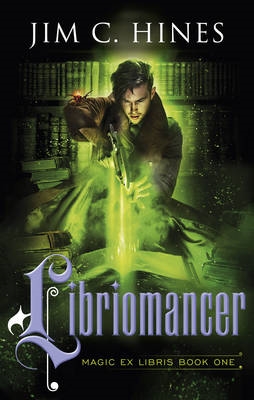
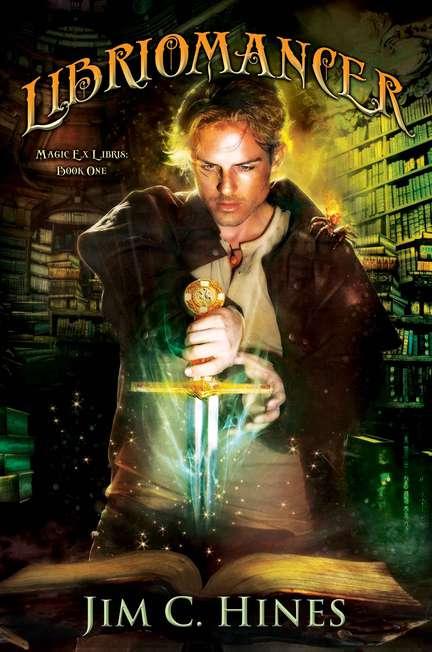
Libriomancer by Jim C Hines
Book One of the Magic ex Libris series
Published by Del Rey UK, March 2014. US edition August 2012.
ISBN: 978 0 091953 454
328 pages
Review by Rob Bedford, Mark Chitty, Nila White and Mark Yon.*
*In an unusual occurrence, the staff at SFFWorld found themselves having read or all reading the same book. So, in a slightly different way for us, we agreed to review the book in a discussion format. Here’s what was said.
————————————
To start with, from the book blurb: ‘Isaac Vainio is a Libriomancer, a member of the secret society founded five centuries ago by Johannes Gutenberg. He is gifted with the ability to magically reach into books and draw forth objects.
But when Gutenberg vanishes without a trace, Isaac finds himself pitted against everything from vampires to a sinister, nameless foe who is bent on revealing magic to the world at large… and at any cost.’
MarkY: I must admit that, for me, reading that brief summary on the back made me think it was going to be some sort of Harry Dresden/Harry Potter facsimile. So I was initially expecting to be rather disappointed! But I’m very pleased to be proved wrong. What was everyone else’s first impressions?
Nila W: I had never read anything by Jim C. Hines before this, so I really didn’t have too many expectations. I picked out the book to read simply because I like what Mr. Hines has to say on his blog (he often rants against racism and sexism in genre fiction). So, I guess, if anything, I was expecting a book that equally represented humanity. While I think Libriomancer does attempt to do that, as well as turn some tropes on their head while making fun of them, there were a few things that bugged.
MarkC: Much like Nila, I hadn’t read anything by Jim C Hines prior to this, and while I’d heard of him, I’d never really looked into his novels. As for first impressions, well, let’s say that based on the blurb I had mixed feelings. I think it was that one word: vampires. It was RobB that convinced me when, on twitter, he said how much he loved it. So, I gave it a go and was very pleasantly surprised – the whole idea of pulling items out of books just struck a chord with me, and his prose made it exceptionally easy to get lost in the story.
Rob B: This is also the first novel from Hines I’ve read, though I do have a few of his others somewhere on the slopes of Mount Toberead. I was sucked into the story very quickly and became a true page turner.
Mark Y: I think I’m right in saying that three of us really liked it. One of us was less happy?
Nila W: I guess I’m the odd (wo)man out. It’s not that I didn’t like it. It was fun, the story made sense, and it would be pretty darn cool to be able to reach into a book and pick out certain elements, but as with any book, a reader brings certain expectations that an author has no control over. By the time I got to the end, it was ‘meh’, not for me.
Mark Y: Fair enough. I guess that puts the pressure on the rest of us, then: what did we like?
MarkC: I very much enjoyed Libriomancer. As I said, I wasn’t overly pleased with the mention of vampires in the blurb, mainly because they just don’t float my boat, but the first chapter changed my mind about that, poking fun and establishing the style that Hines took and ran with. Pulling items out of a book has to be one of those daydreams every reader has, and I just felt it worked. The more we found out about libriomancy the more questions were raised, and though not all answers were forthcoming it really did feel unique and interesting. And, of course, Hines managed to weave these together into a decent and coherent story that was not short on action.
MarkY: There’s a nice sense of humour that runs through the book. It’s not always easy to do, but I think Jim manages it well here. Libriomancer is a book written with a knowing nod and a wink to all those bibliophiles who understand the magic of a good book and a library to house them. There’s lots of little touches that you may recognise from elsewhere – Stephen King’s small-town America, vampires and werewolves, ancient spirits and secret societies that Dan Brown would be proud of. It’s the way that all this is combined that makes the plot entertaining, though.
When you’ve got vampires collectively named as ‘Sanguinarius Meyerii’ after a certain writer of sparkly vampires, and a main character whose surname is ‘Vainio’, you just know the writer’s playing with the genre. Whilst the Dresden/Potter similarities are there, this is a lot more fun.
Nila W: Mr. Hines has a clean and clear writing style that makes it easy to just drop into the book’s world. I also really enjoyed the premise, the idea of pulling objects out of a book has a certain appeal for those of us who read a lot.
Rob B: On reflection, I saw Libromancer as sort of the fantasy counterpart to John Scalzi’s Redshirts, but ultimately a bit more successful. Hines managed to hit the right fan buttons with the story and shout-outs without seeming as if he was pandering to the reader. There was also a more clear and linear story here in Libromancer and a great seed for potential stories.
Mark Y: For me most of all it was the clear love of books throughout that won me over. Libriomancer is a book that makes you want to pick up other books, or it did me, anyway. Anybody else feel the same way?
Nila W: Hmmm, not really. It seemed more of an action-adventure story for me, rather than a homage to all the books he mentioned. Though I was impressed at how well all the story elements tied together with book history.
MarkC: To be honest, it made me feel like I haven’t read enough books. Hines clearly loves books, and he mentions so many throughout the novel that I kept on thinking that my reading history is woefully inadequate to get all the in-jokes. But it did make me want to expand my reading.
Rob B: Like Jo Walton’s Among Others, Libromancer made me want to read more, especially the books Jim mentioned in the story and more of Jim’s books. In short, I found it to be a great advertisement for the joy of reading the fantastic.
Mark Y: I recognised most of the books Jim mentioned, which was an aspect I liked. My copy also had a book list at the back, which was useful.
MarkC: My copy too, and because of the holes in my reading it was nice to have that bibliography included, though I’m sure I missed a fair few references.
Mark Y: I also liked Jim’s cute animal in the tale – Smudge, the self-combusting spider.
MarkC: I hate spiders, they creep me the hell out! Saying that, I did like Smudge and the way Hines weaved him into the story so he was more than just a token sidekick.
Rob B: Smudge, I think, features in Jim’s Jig the Goblin novels (again, more books I’d like to read!)
Mark Y: Having said that, it’s not perfect. Nila, you were less happy with it. Care to say why?
Nila W: I’m always happy to say why I did or did not like something. I didn’t like that he went with a sexy nymph as the love interest. It was just so obvious and every time she came onto the page it was, like, please, don’t mention her sexiness again. Oops, he did. I know Mr. Hines is trying to up-end stereotypes and make genre-fiction readers take a hard look at those stereotypes, but I am not the kind of genre-fan that needs that lesson taught to. I’d rather just see a “normal” woman (like Isaac is more or less a normal guy), play a cool character in a fantasy novel (just like Isaac gets to do some cool magic). No matter how much I might admire Mr. Hines for trying to put a spotlight on the genre’s failings, I believe he fails by allowing that light to dip into Lena’s cleavage.
MarkC: I agree to an extent here. Seeing Lena as a sexy wood nymph did make me groan out load. I mean, did she really have to be? I do have to say that I didn’t find it to be as off-putting as I first thought, and I know that there were many aspects of her character that were integral to the novel but, like Nila says, the stereotype is there.
Rob B: This part didn’t bother me too much, but I feel it was emphasized a little too much.
Mark Y: That’s a fair point, Nila. Not sure I’d agree with you though that Isaac’s a ‘normal’ guy, even without the bibliomancy. There are aspects of him that are stereotypical, let’s say. Being a book-reader is not typical (though I do understand that many of the book’s readers might be!).
And you’ve raised a good point too: is this a book that male readers could identify with and female readers dislike for the same reason/s?
MarkC: I think it could be, though perhaps not in every case. Personally I found that what Jim Hines has done here is create a novel that is a homage to bibliophiles, and while his characters can be stereotypical at times, there is more to them than that. But it is a valid point, though I wouldn’t hesitate recommending Libriomancer to male and female readers alike.
Nila W: I also thought the villain using a self-published work to take over the world was a bit of a dig. I happen to like a lot of self-published writers and their books.
Mark Y: Yeah, I got that one, although I understood it to be a fair plot point, in that if the book was widely distributed, that would have defeated its purpose, wouldn’t it?
MarkC: I feel the same – it was a self-published novel for a reason, and I believe that Hines says the novel in question was not badly written and that the action scenes were done well. I don’t think it is a complete dig at the whole self-publishing industry, though I wouldn’t say it was entirely faultless either.
Nila W: The last thing that left a sour note was that in his book, magic equalled religion. And I really do not need to see the fact of how strongly religion plays a role in our lives reflected in the books I read for pleasure. I want to escape my present-day reality, thank you very much.
MarkC: I didn’t get that feeling myself, Nila. Magic was certainly strictly controlled with apparent endless procedures to follow, but I wouldn’t go as far to compare it to religion. I found myself thinking of Charles Stross’ Laundry novels in this respect – the boring and controlled way that everything must be done, a form for every occasion, as it were. And the hierarchy involved seemed to be there to restrict expansion of knowledge, with Gutenberg taking prime position in this respect.
Speaking of which, and it’s hard not to venture into spoiler territory here, but Gutenberg came across as someone who could wave his hands and sort it all out. If it were SF I’d go as far as saying it was very deus ex machina.
Mark Y: For me, there were a few echoes of Jim Butcher’s Dresden Files books in terms of style and characterisation. I know that there were similar comments made about the character of Harry Dresden in the same way that you have, Nila. Anybody else get a Dresden-esque vibe??
Nila W: Haven’t read Dresden, so no idea on that one.
MarkC: It was definitely there, and I think it’s hard not to compare the two main characters of Isaac and Harry. Isaac’s choice of a long overcoat really shouted it for me, as did his wise-cracking, and I even got the feeling that Hines referenced a Dresden book at some point, though that could be just me. And with having read all the Dresden Files in a three month period last year it fresh in my mind, so comparisons on my part were going to happen!
Mark Y: Yes, I’d forgotten the long overcoat! Did make me think I could do with one myself to carry books in….
Rob B: I can see the parallels to Harry and The Dresden Files, the same level of snark and structure of the character in Isaac. That said, I do think Isaac is more than enough of his own character.
MarkC: One of the things I wanted to mention about Libriomancer was the magic system itself. I’m not the biggest Urban Fantasy reader, I’m much more into SF, so I perhaps look at these things slightly differently to other readers. I found the system to be interesting, but ultimately lacking in any sort of clear rules, if you would. There seemed to be so much going on with so many different types of magic and magical beings that I struggled to see any coherent foundation to it all. And the ending just threw a spanner in the works as far as how I’d figured it all out!
Mark Y: Rob: you’re in the fortunate position of having read the book a while ago, back in September 2012. (Review here.) Has your opinion changed in the time since you read it?
Rob B: It has aged well with me and I may be glossing over some of the slightly negative aspects with the overall enjoyment I received from the novel.
Mark Y: Nila, am I right in thinking you’ve read it a while ago, too?
Nila W: I finished it late Jan 2013. So, a bit more than a year ago. I haven’t given the book much thought since then, so, no, my opinion hasn’t changed. Nor has my opinion of Mr. Hines changed. I admire him for the things he says on his blog and I think he’s a great writer.
Mark Y: It is the first of a series. Though we’re writing this at the time Book One appears in the UK it first appeared in the US in 2012. Any news on the rest of the series from the States?
Nila W: To be honest, I decided not to continue with the series. It just wasn’t for me, but I think the second one was as well received as the first.
Mark Y: And I suppose, finally, the $64 million question is: would we want to read the next one?
Nila W: Not for me.

MarkC: For me, the sequel, Codex Born, is a must-read once it comes out over here in the UK – I’m rather interested to see where Hines takes the story from here.
Rob B: Absolutely.
MarkY: There’s the first chapter of Codex Born in the back of the UK copy, which has me much intrigued. Werewolves and e-books: like MarkC and RobB, I’m interested to see where this series goes.
SFFWorld, March 2014