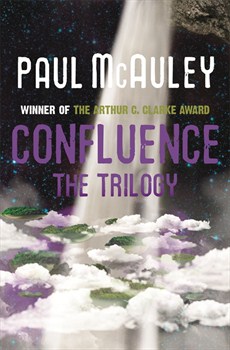
 Published by Gollancz, in a revised form as part of Confluence, February 2014
Originally published as a separate novel in 1997.
275 pages (Confluence The Trilogy is 944 pages.)
ISBN: 978 0 575 11939 0
Review by Mark Yon
Boy, did I get this one wrong. You see, I’ve passed this one by, more than once, and I only have myself to blame.
With a series title, Confluence, as well as the title of this first book, Child of the River, it just did not make me think that it was SF. Even when I took a cursory glance at the plot synopsis, it made me think that it was more about gods, prophecies and some sort of mystic pantheon rather than SF. And to me, Paul, winner of the Arthur C Clarke Award, is ‘an SF writer’, and often towards the hard end of the spectrum. Anyone who has read his Quiet War series – that’s what I think of when I think of Paul’s writing. Not a book seemingly about a river.
Like I said, I was wrong. This is clearly one where my own preconceptions steered me wrong: I did the thing I know I shouldn’t do. The title made me assume things I shouldn’t. Now having read it, I must admit that there is a superficial similarity to what I expected, but Child of the River is much, much more than what I thought it was going to be.
Child of the River tells the tale of Yamamanama, a young boy originally floating down the Great River with his dead mother. His origin is a mystery, but he is taken in and brought up by the Aedile of Aeolis, a local clerk. A mysterious stranger and an attempted kidnapping show Yama that he may be important, for reasons that he does not know. He decides that he needs to find out more of his background and uncover the answers to his mysterious past.
Part of this discovery involves Yama experiencing more of the world that he lives in. Much of the book is about this journey. Confluence, with its complex melange of cultures, races and backgrounds, is wonderfully detailed. It rather reminded me of Silverberg’s Lord Valentine’s Castle. With much of its history so long ago much has been forgotten, rather like in Silverberg’s Majipoor novels. There’s even a touch of Chad Oliver, widely regarded as one of the key writers of anthropological SF in the 1950’s, in its depiction of alien races and their cultures.
As Child of the River progresses we discover that whilst its inhabitants live a life that seems rather medieval-Fantasy-like, there is a secret world, an ancient history of technology and artificiality that keeps things going on this artificial world. Here we are witnessing the decline of a civilisation, rather like Asimov’s Galactic Foundation or Peter Hamilton’s Void series (the Edeard sections), where a more primitive society exists than we expect in a science-fictional future. The backstory becomes more science-fictional as we continue to read. Long ago, The Preservers shaped over one hundred different bloodlines before ‘withdrawing their blessing’ in the Age of Insurrection, where these bloodlines overpowered the avataristic machines and issued in a new era of technological decline, in a way reminiscent of Dune’s Butlerian Jehad.
The world has the remnants of ancient technology in antique artefacts and often excavated in the necropolis where, on this world, the dead outnumber the living. The Preservers have now been deified as a religion, with people like Yama’s boyhood friend Ananda being trained in theology from early childhood.
Not all of the ancient artefacts are friendly. Some are revered without knowing why, which made me rather think of AE van Vogt’s Empire of the Atom, where nuclear power and its workers had been elevated to a religion, and even Arthur C Clarke’s The City and the Stars (one of my favourite novels) which combines a lengthy ancient history with a decaying present-day technology, albeit in our future.
I’m sure that all of these hints of pasts and futures are deliberate on the part of Paul. Child of the River is a book that intentionally works on so many levels. At its simplest, it is a rite of passage novel, as we discover Yama’s rather mysterious past and potential future. His journeys around the world, along the river and through the vast necropolis to the city of Ys downstream are both a physical travelogue and a social development. The rivers itself runs through everything, as a visible metaphor for life. In a rather Dickensian twist, Yama discovers secrets as he attempts to uncover the origins of his mysterious background. Yama discovers that he can control some of these old relics, a most unusual talent. This is because he is the only genetic link between the planet’s present population and the ancient Builders, the ones who created all that they see for the Preservers. This makes him a valuable asset that others would love to obtain, although exactly why is still not clear at the end of the novel, although it is clear that his destiny has a number of possibilities.
The ending leads to revelations and further mysteries, with a rather precipitous cliff-hanger ending. Luckily, the second book, Ancients of Days, is on the next page of this omnibus edition.
In short, Child of the River is a brilliantly revelatory book that, like me, you may have missed before. It’s world-building is terrific and its plot reveals more as you read to keep the reader engaged. It is most definitely worthy of your attention: I’m kicking myself for not getting to it sooner, but am so pleased that Gollancz have published it in a hefty new omnibus edition*: I can’t wait to read the next book in the trilogy…
Recommended.
Mark Yon, February 2014.
*Note: Paul’s comments on rewriting the Trilogy are HERE.