 For those who were not around at the time, it is perhaps difficult for modern film buffs to realise how unappreciated some of the genre films now seen as classics were.
I saw Blade Runner with only two of us in the cinema (I hated it, but it is now one of my favourite films of all time). Labyrinth played to empty cinemas when I worked at one. Dune (the 1980’s version) too. When I worked at a cinema The Terminator was shown on the smallest cinema screen available at the time because few people were interested.
This was also the case with Alien in 1979. It came out with little flourish here in the UK.
And as for merchandise? There was very little. I did buy a Nostromo cap and took the stitched badge off the cap to wear on an Italian army jacket I was fond of wearing, but that was about it. (Wonder whatever happened to it?)
There was the odd Star Trek thing, some Star Wars stuff (the movie had only come out in the UK the year before, December 1977 in London, (1978 for the rest of us!) but nothing like today.
My reason for mentioning all this is that if I remember right the success of Alien caught everyone by surprise. Although my cinema was pretty empty when I saw it, it did OK. It was the arrival of VHS in the early 1980’s where the film’s popularity seemed to grow.
It is also odd in these hyper-publicity days that Alien was a film that you went to see knowing next-to-nothing about – how things have changed! I remember legendary film reviewer Barry Norman (The UK’s equivalent of Roger Ebert at the time) reviewing it and showing a clip, although the cinema was pretty empty when I saw it.
It seems difficult to describe now how little the film Alien was unnoticed on its release in 1979. There was a brief trailer at the cinema, and very little fanfare. In the UK reviews were few at the time and there was nowhere to read them unless it was in the newspapers. trade magazines or television. My first view was of it on the cover of Starlog, (June 1979, issue 23 if you want to check!)
I do remember it being briefly mentioned on TV here in the UK by the inestimable film reviewer Barry Norman. There was a brief review on Radio 4 too, if I remember right. But that was about it.
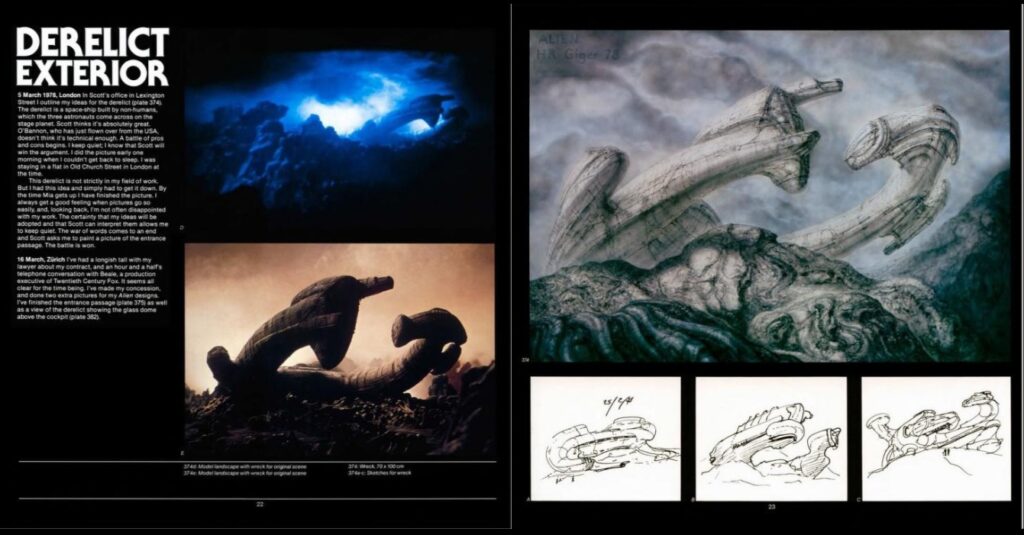
This meant that the now familiar (perhaps over-familiar?) scenes of the Alien’s arrival, the cat Jones, the final scenes between Ripley and the alien on his space shuttle, the fossilised alien and its organic- looking spaceship were all unknown. There was little material to promote the film.
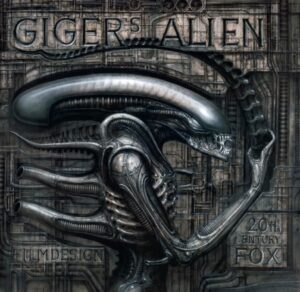
Anyway, this was one of the few books I remember from the Alien franchise. At the time it was a large coffee table-type of book. Being a young lad of limited means – I had a paper-round! – I saw US advertisements for this in magazines such as Starlog, and wanted – lusted – after it, with its glossy pages and odd but detailed art.
Alas, I was never able to buy it, even when Titan Books published a trade paperback version in 1989 – until now! Titan Books have rereleased this book – for the first time, I believe, in hardback – in the UK. (The US did have a hardback back in 1979, but I never saw it.)
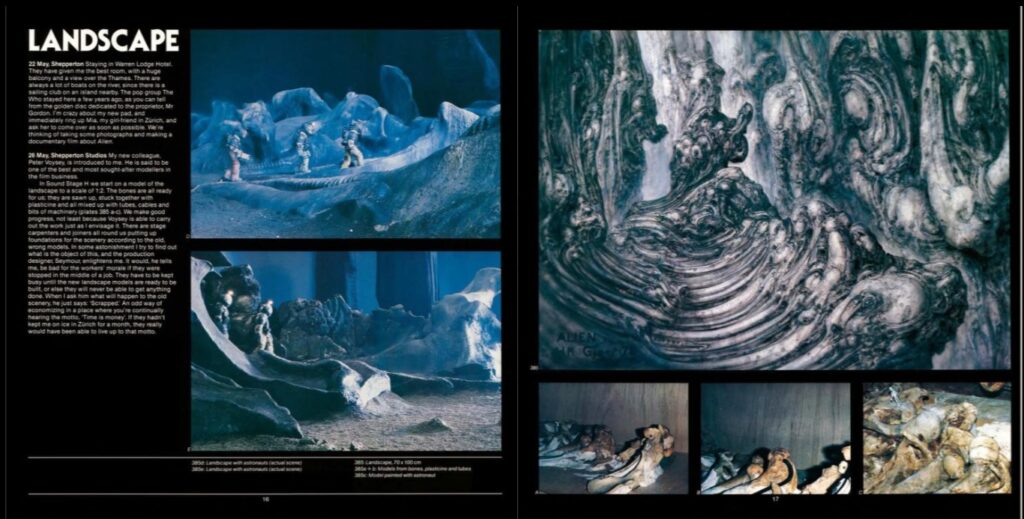
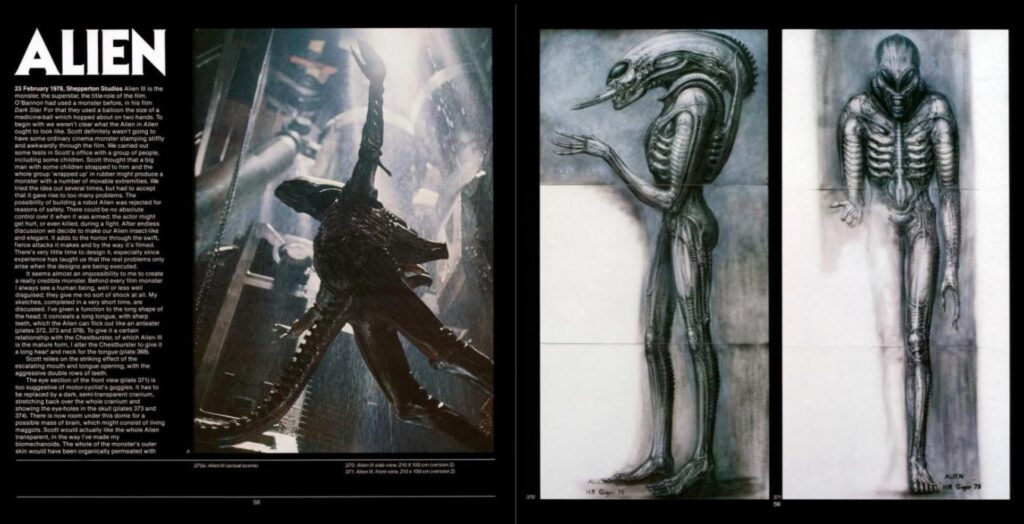
It is slim (only 80 pages), but it is mighty – the size of a vinyl record sleeve, it allows the reader to see some of the art in detail: and the fact that modern printing techniques (and remastered images from the Giger Museum Archives) means that the detail on these images in the new book is pretty good. Not to mention creepily and oddly erotic.
The Foreword by Timothy Leary – yes, THAT Timothy Leary, of LSD infamy! – is as high-flying as you might expect, full of references to other visionaries such as” William Blake. Hieronymus Bosch, Ernst Fuchs, Salvador Dali and Pythagoras, Houdini, and Aleister Crowley”, not to mention “the great medieval sorceress Barbarella.”
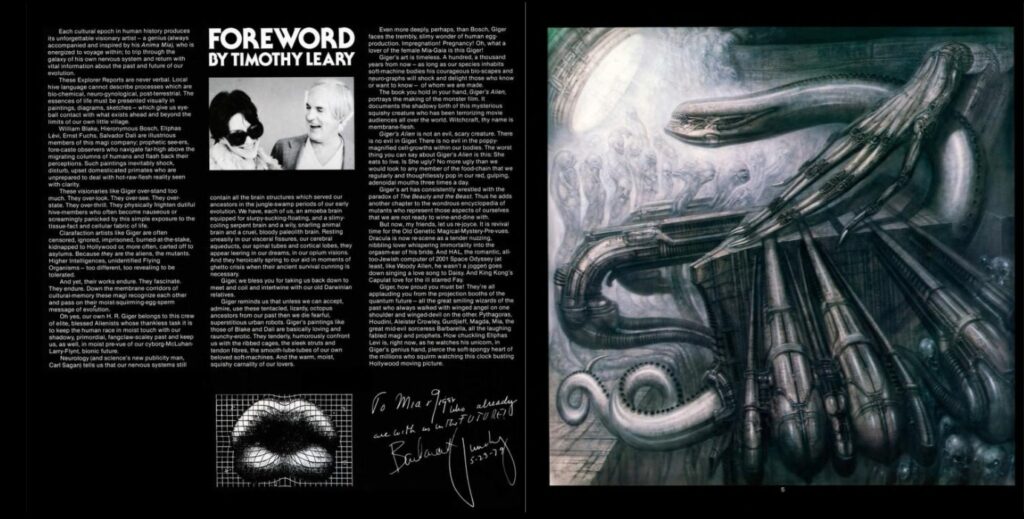
From the perspective of nearly 50 years on, I was surprised to find that the book also shows how much these kind of books have changed. Publicity photos and pictures from film sets were rarer in those days, taking more than a press of a button to get the image required. As a result, actual images were sparser in such books.
This sort of works here though, in that “less is more” approach. Nowadays you would get a book hundreds of pages long with interviews with cast, director and artist and the art almost taking second-place to the production of the film. Here the art is primary.
As well as the rather remarkable imagery, what is also of interest here is the excerpts from Giger’s diary from the time. From these, Giger seems like an interesting character-clearly obsessed and driven by his art to an extraordinary level in order to produce the images that represents his vision.
With that in mind, the diary comments are refreshingly – and brutally – honest, and do not always show Giger in a good light. Giger himself admits to this in his Introduction, written in 1979, where he describes himself as” often disappointed, unfused, impatient and petty.” and goes on to apologise: “I am well aware that I also often offended and annoyed my colleagues when I offered harsh criticism and insisted on my design.”
There are parts of this book that show that the film Alien was a little thing and certainly not with the mega-backing these movies would have today. For example, its limited budget meant that Giger was asked to pay for the cost of transporting his art for his home in Switzerland to the UK by 20ᵗʰ Century Fox, which he comments on in the diary.
After producing the initial sketches, he was effectively laid off, only to be brought back on board at the Studios as the sets were being built – something which in the end must have cost the film studio time and money.
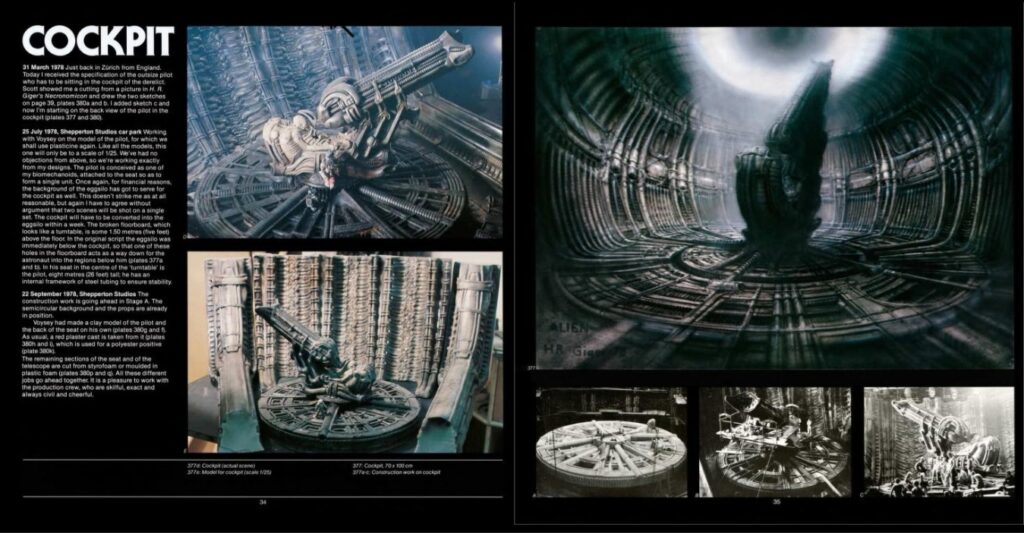
Reading them I was reminded of the intense pressure put upon the creatives in bringing a film to life. Such comments do show some of the challenges faced by Giger in bringing his work to life in the film, perhaps more so than the sort of more-sanitised version you would get in most accounts today.
Such sacrIfices to time and money mean that often a final version of a film is not what the film initially started out to be, and so it is here. There are also images and art from, for example, the cocoon section of the film (added later in the extended cut of the film) which would have been of interest to fans in 1979. (James Cameron also used this idea in Aliens (1986) as well, of course.)
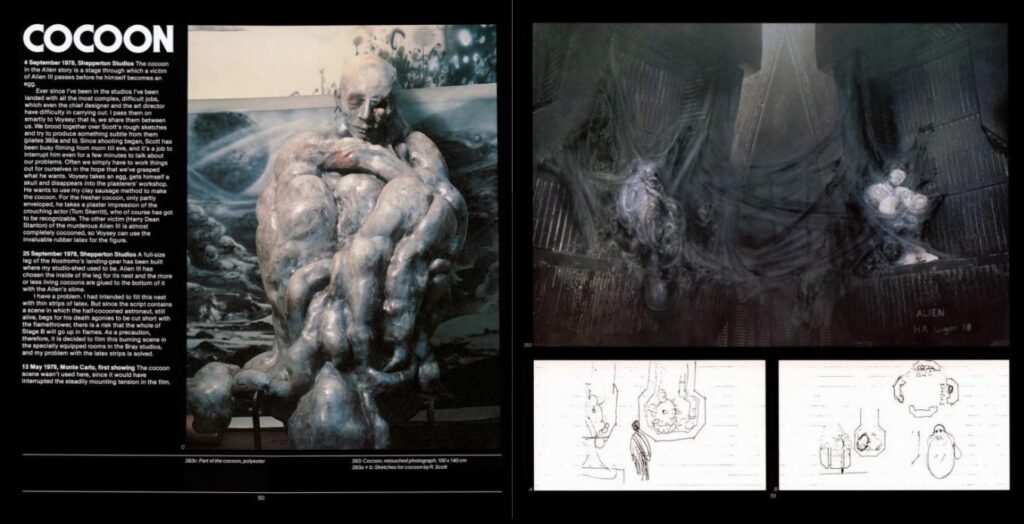
Whether this is a reminder of the impact the first Alien movie had upon an unsuspecting audience in 1979, or your first encounter with the art that inspired the film, Giger’s Alien is a remarkable document of its time. It looks incredible, and gives you information about the art and film process that you may not have known before that is worth a read, but perhaps not the sort of book to leave on your coffee-table for Granny to see!
© 2026 Mark Yon
Hardback | Titan Books
GIGER’S ALIEN by H R Giger
September 2026 | 80 pages
Original version: November 1979
ISBN: 978 1835 416 570