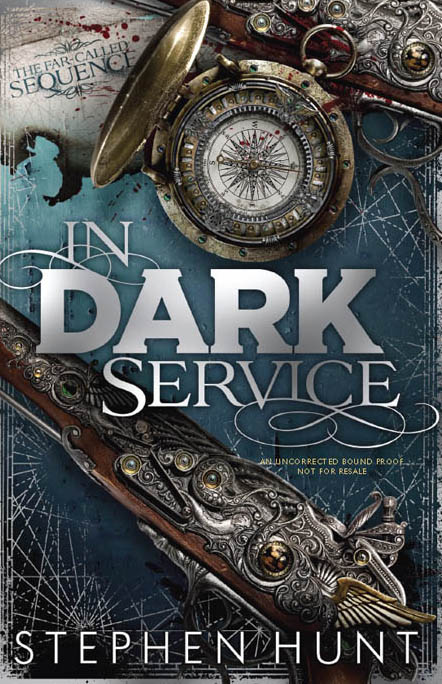
 In Dark Service by Stephen Hunt
Far Called Trilogy, Book 1
Published by Gollancz, May 2014. Review copy received.
564 pages
ISBN: 978-0575092075
Review by Mark Yon.
So: what to make of this large tome of science-fictional romp? Stephen shows both his love of the genre and that he can write a page-turner, albeit with some stutters along the way.
In Dark Service is a tale that happily mixes up historical precedence with science-fictional steampunk technology, throws in a dash of sword and sorcery Fantasy and then finishes with a flourish and a nod to the pulp fiction of Flash Gordon and the Golden Age.
It is good to read of a world that is a bit more than the usual setting, and I liked the point that one of the key features of this novel is the planet itself. The sheer size of Pellas reminded me of Dune’s Arrakis or even Jack Vance’s Big Planet in its scale. By building a world too big to traverse in your lifetime, this also creates an enormous blank canvas upon which the cast (and the writer) can play. As in the best planetary romances, Pellas is filled with different places and settings, groups and societies, all a little beyond the usual. There’s glimpses of an intriguing backstory too that suggests that Pellas has a long history. I am hoping that much of this will develop further as the tale expands.
However, being the first part of a trilogy, it does take its time setting up in this one. In the beginning, all is rather Gone with the Wind as we are introduced to the two key families in this generational tale. The Carnehans – Father (both actual and religious) Jacob Carnehan, wayward librarian son, Carter, and wife Mary introduce us to the bucolic lifestyle of Northhaven in the Kingdom of Weyland. There too are the second of our main families, the rich land-owning family of Benner Landor, his (also wayward) son, Duncan, daughter Willow and Duncan’s beau, Adella Cheyenne.
So far, so idyllistic. It doesn’t take long though before this is upturned by the arrival of Vanadian sky-pirates, who attack the village and capture many of them for slaves.
Jacob, with the finances of Benner and the help of local constable Wiggins set off in pursuit, determined to recapture the hostages. Alien gask Khow, whose son Kerge has also been captured, also goes along having an ability to somehow track his son.
However, the world of Pellas is so vast that they lose pace and the slaves end up thousands of miles away working as slaves for the Vanadians, eking a barely subsistence lifestyle as slave miners and under constant threat of death mining valuable minerals from stratovolcanic ejecta. Here the Princess Helrena and her young daughter Cassandra rule a strict slave society which the villagers find difficult to adjust to.
Much of this plot so far takes up the first two-thirds of the book. After quite a brisk start, it must be said that the middle part of the book suffers a little as we find our heroes try to travel/escape. Repetitive misery does little to project the tale forward, though we do get glimpses of a wider, more technological world – strange menhirs, Vandis, the capital city of the Vandians and their Empire.
By contrast to the idyllic Southern gentility of Northhaven, the Empire of the Vanadians seems to be based on a rather Romanesque emperor model. We discover that the sky-pirates are part of a complex and harsh society, where people’s positions of power are always under threat, rather like the Roman political system. The captive slaves are the bottom of this social structure, used to mine stratovolcanic ejecta in order to obtain rare elements otherwise unobtainable (I am resisting the urge to type ‘unobtainium’ here, though the idea’s tempting.) It is the trade in such minerals that keep the forever-quarrelling political factions of the Vandians cooperating with each other, albeit reluctantly.
Nevertheless, when things finally kick off properly, the ending is a rip-roaring blast and soon picks up the momentum that was threatened to be lost in the middle.
In Dark Places is an enjoyable book that should be applauded for its attempt to mix genres up a little into something a little different, even if, in places, the actual execution can be variable. Some readers may find its execution rather frustrating in that for every point of brilliance there is a counterbalancing clunk (see the ‘that’s what we call… a tank’ speech).
There were aspects of the novel that were a little less convincing, once I thought more about it. I felt that a world this size that has few resources to speak of, having had all its resources extracted from the rocks felt rather implausible, to my mind. Similarly, for a society that has rockets and can use antigravity, there must be easier or more efficient ways to extract resources than the methods shown here – off planet, if not on.
Some of the other events that occur also show missteps in places, all of which threatened to draw the reader out of the narrative. Of the most important, the characterisation was most variable. Some of the characterisation is rather clichéd and basic, if not bordering on the sketchy. Some of their actions are also ineffectual, if not just plain dumb. For example, I was not convinced that two of our characters would spend their time brawling with each other, even whilst under alien restraint, although movies like Flash Gordon (1980) may prove me wrong. Alternatively the character of hobo-esque Sariel is an intriguing one, and one I’d like to read more about.
There’s also the issue of the nature of coincidence, which can happen often – rather too often – for some reader’s liking. On such a large and complex world the chances of some of the events happening are mind-boggling statistically, although I’m sure the mathematically-minded Gask would appreciate it.
Nevertheless, on balance, the energy and scale of the work outweighed the dingbats. There’s a lot here to like. Despite my reservations, I enjoyed it on the whole as a rather pleasing homage to 1930’s pulp-fiction. It’s not perfect, but there’s enough here to like to continue with the series.
Mark Yon, May 2014.