 I consider myself lucky to have been reading science fiction for a long while (And since you didn’t ask, it’s over 50 years!) One of the things that keeps me reading is that I appreciate how much the genre has changed. Like many of my age, my first introduction to science fiction novels was through the work of the so-called ‘Big Three’ – that’s Asimov, Clarke & Heinlein. This was usually because they were the three most accessible authors to me in my small town in Northern England – they were what I could get my hands on, usually through the local library or second-hand copies at the local market.
However, time goes on and tastes change – what was popular 50 years ago, or even 15 years ago, is much less so now. Science fiction literature, despite often being claimed that it is ‘about the future’, is actually more about the times they were written, or indeed the readership at the time. In the 1930’s they were mainly adventure stories for boys, although admittedly things a bit weirder than your average western or pirate story. In the 1950’s, as we entered the Space Age, they were about Man’s (and yes, Man’s – it was still mainly a male readership) conquest of the solar system and the colonisation of places a bit nearer home – usually adventure stories set on Venus, Mars, and so on, with the odd galactic travel to vary things a little. These often showed how good humans were and how much potential they had when they travelled beyond our planet, as we undoubtedly would.
Of course, I am glad that things have moved on these days – I’m pleased to type that the science fiction of 2026 is more literate, more complex and more varied than ever before. More diverse characters, more complex characters, and a more diverse range of authors and cultures. It’s partly what’s kept me reading for all of this time.
The result of this is that much of the genre’s past history has been left in the cosmic dust – perhaps more now than ever before today, when a book more than 5 years old is seen as ‘old’. The books in print available from the ‘Big Three’ appear to be less than a dozen in print, although admittedly more are available for devices such as the Kindle.
And let’s admit it, a lot of those stories have their place in time and perhaps deserve to remain there, although personally I still love reading stories published before I was born, mainly for their leanness of prose (paying by the word, as writers mainly were in the old days, tends to limit verbiage!), sheer energy and enthusiasm.
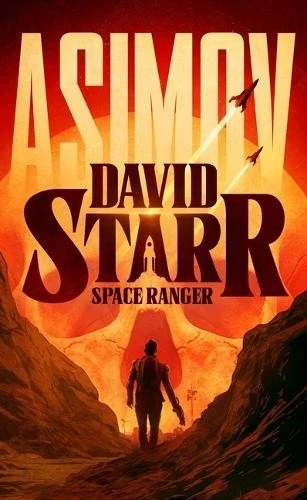
Which brings me to this book, a republication of a book first published in 1952, the point where many people looked forward to the colonisation of places beyond our Earth. The magazines were filled with such stories at that time.
Now published by Blackstone, after being out of print since the late 1990’s (which was a Book Club omnibus), I was interested to see how much the stories have held up.
From the publisher: David Starr, Space Ranger is the first book in the Lucky Starr series written by the legendary Isaac Asimov, author of I, Robot, Foundation, and the Galactic Empire series.
David reached for the sick man, lifting him as though he were a rag doll. Artificial respiration was useless. The Space Ranger had no illusion as to the possibility of recovery. He knew the symptoms–there had been many such cases lately–the sudden flushing, the loss of voice and breath, the hopeless minute’s fight for life, and then, the end.
He turned to the trembling restaurant manager and identified himself. “My name is David Starr. I am a member of the Council of Science. What was the dead man eating before he collapsed?”
“Stewed marplums,” the manager replied, wringing his hands in anguish. “Nothing like this has ever happened here before …”
“Just the same you had better eliminate marplums from the menu,” David said.
Extraterrestrial delicacies had laid claim to yet another victim!
The story is pretty straightforward. It is a throwback to the pulps – again, deliberately, filled with ‘derring-do’, Asimov himself once said about the series. I understand that ‘Space Ranger’ was meant to be the first in a series – there are six! – that were to coincide with a television series, which never happened.
Asimov himself seemed a little embarrassed by them – they were first published under the pseudonym of ‘Paul French’, perhaps so as not to be confused with the more usual fiction of Mr Asimov. They are very much minor works, which is interesting to see them republished, whilst much of Asimov’s ‘grown-up’ work is not.
The David “Lucky” Starr series were deliberately written for younger readers, without too much detail, depth and complexity. In other words, they were straightforward Sf adventure tales, like the pulp stories of the 1940’s, or perhaps like Heinlein’s juveniles and his Tom Corbett/Destination Moon scripts – Heinlein’s juvenile novel Space Cadet was published in 1948, and Destination Moon was released in 1950.
I can see that these may have been an attempt to cash in on the rising popularity of space stories at this time – see also Tom Corbett and Captain Future, for example – and the attraction of an Asimov television series quite tempting, even when it wasn’t made. This origin story of how David Starr became a Space Ranger clearly has elements in common with other popular series of the time as well, such as Jack Williamson’s Legion of Space series and the space opera of E E ‘Doc’ Smith’s Lensmen series. There are plot coincidences, but none more so than say Flash Gordon, Buck Rogers or Tom Corbett. The idea of telepathic communication, as shown by mysterious aliens, is straight out of the ideas around ESP and the like in the 1950’s. This also dates the novel a little more for me.
It would be easy to criticise David Starr for those reasons, but at the same time there’s a lot that is rather refreshing. There is an outlook that although the place is dangerous, there is hope and optimism for the future, which is very 1950’s:
“You have a questioning mind that seeks to understand what it dimly senses, without possessing the truer, deeper senses that alone can reveal reality to you. In your futile seeking after the shadows that encompass you, you drive through space to the outermost limits of the Galaxy. It is as I have said; — has named you well. You are a race of Space Rangers indeed.”
To go with this retro feel, the Mars that David Starr is upon is ‘old-style Mars’, with its dangerous deserts and desolate sandy landscapes. Most of all, the story has a beguiling enthusiasm and energy that is less cynical and more romantic (in its widest sense) that contemporary stories often lack. Less surprisingly, the science has also dated – Asimov himself pointed this out in an introduction he wrote to the book in 1970/71.
George RR Martin said it like this in his deliberately retro anthology Old Mars in 2012:
“Yes, the Mars of Percival Lowell and Norman Bean and Leigh Brackett and C. L. Moore and Ray Bradbury does not exist, but why should that mean we cannot write about it? Science fiction is and always has been part of a great romantic tradition in literature, and romance has never been about realism”.
I did find it interesting that David Starr may have inspired later writers – do the sandy deserts of Mars suggest Tatooine or Arrakis, for example? The killer dust storms of the planet Asimov depicted here did make me think a little of Frank Herbert’s Dune, whilst the sand car races across the desert and David Starr’s ‘force-blade’ weapon rather sound like things George Lucas may have liked:
“Outwardly, it was merely a short shaft of stainless steel that was a little thicker than the shaft of a knife but which could still be held nicely in the palm. Within it was a tiny motor that could generate an invisible nine-inch-long, razor-thin force-field that could cut through anything composed of ordinary matter. Armor was of no use against it, and since it could slice through bone as easily as through flesh, its stab was almost invariably fatal.”
Can you still tell that Space Ranger is an Asimov story? No, not really, but of course this may be deliberate, and why the book was initially published under a pseudonym.
The only things that suggested that it was Asimov to me was the author’s occasional lapse into explaining science – Asimov by this point was beginning to write non-fiction as well as fiction, and I feel that that has resulted in a lot of ‘telling’ coming through in places.
Secondly, the mystery element of the story – who or what is poisoning Martian foodstuffs for ill gain – feels like typical Asimov, and something akin to his later work The Caves of Steel (1953) or his Tales of the Black Widowers mysteries, perhaps.
The bottom line is whether these would be read by younger readers of today, those starting out reading SF? Well, there’s no ‘bad language’, nothing there to offend young readers as far as I could tell, although there are people murdered and killed, which create a darker plot element that may be an issue.
The dialogue definitely feels like it is from the 1950’s, with its fair share of made-up names and mild expletives – ”Great Galaxy!” and “By Jupiter!” being just two of them that might be derisory today.
There is also the issue that girls are not in the plot, as was often the case in the stories of the 1950’s (Heinlein’s writing was a notable exception), and I guess that that may alienate some of the readers.
But generally, and despite all of this, David Starr was a short, quick read – easy to understand and follow, where the good guys hold up morals and ethics such as honesty, decency, loyalty and friendship, and the bad guys are clearly not good and get everything they deserve by the end of the novel – and as such it was an enjoyable read, a throwback to the old-fashioned pulp of old and reminded me of the books I read when I started. If you can live with the limitations of the plot and the unpretentious characters, it is a great fun read, although must not be thought of as Asimov’s best.
© 2026 Mark Yon
Hardback | Blackstone Publishing
DAVID STARR, SPACE RANGER by Isaac Asimov
(Originally published 1952 under the pseudonym ‘Paul French’)
May 2026 | 208 pages
ISBN: 979 8228 585 904