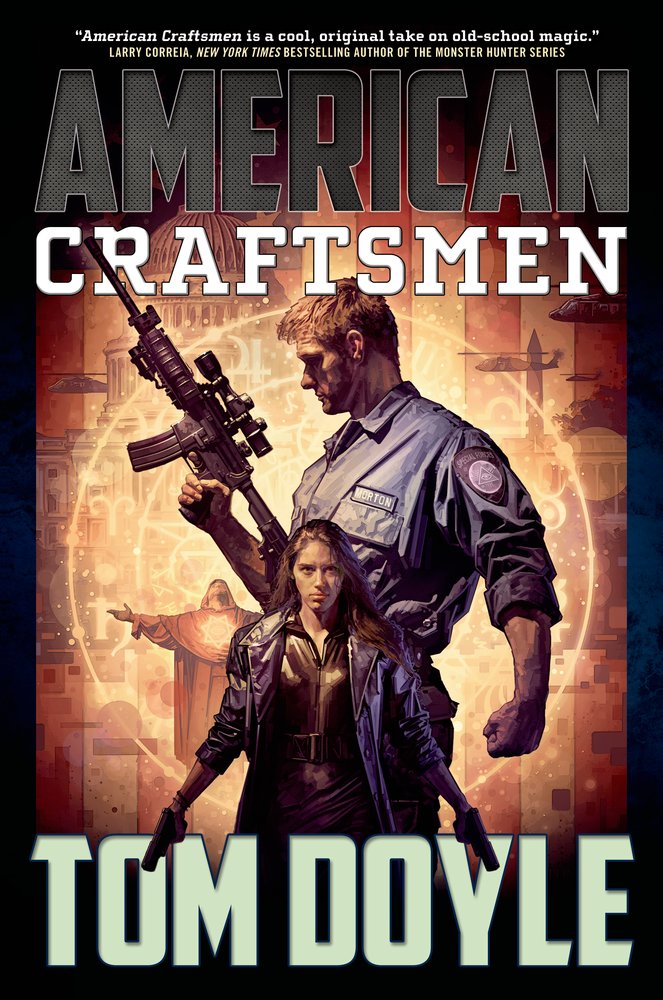
 We have talked to Tom Doyle, author of American Craftsmen.
Can you tell us a bit about American Craftsmen and what we can expect?
American Craftsmen is a modern-day fantasy of military intrigue. The craftsmen of the title are magician soldiers and psychic spies descended from some of the founding families of the country. Two craft soldiers from rival families, Dale Morton and Michael Endicott, and a friend from a mundane background, Scherie Rezvani, fight against a treasonous cabal in the Pentagon’s highest covert ranks. The backstory assumes that Poe and Hawthorne were writing thinly veiled nonfiction.
Can you give us some insight into your main characters?
Captain Dale Morton, my main protagonist, is a modern descendant of Thomas Morton, who was a pagan amidst the Puritans of colonial Massachusetts. Dale is a battle-tested veteran who feels the cumulative stress of years of occult service. At the opening of the book, his mission goes horribly wrong, and he spends the rest of the story trying to track down those responsible. I enjoyed exploring the points of emotional fragility for this powerful person and in finding ways to keep his cynical humor intact in adversity.
Major Michael Endicott is a descendant of a Puritan family that’s been feuding with the Mortons for hundreds of years. Initially, Endicott is extremely suspicious of the Morton family in general and Dale in particular. But as he discovers more about what has happened to Dale and others, he has to make difficult choices about family and duty. In my earliest draft, Endicott started out as almost totally unsympathetic, which didn’t work. So he evolved into a quite different character: a person trying to maintain his integrity even as his trials and tribulations seem to mock him.
Scherie Rezvani is a second-generation Persian-American. She a science fiction and fantasy fan with an interest in learning military skills. For reasons she’s not fully conscious of, she’s drawn into the occult world of the craftspeople, though it’s doubtful that she can survive there for long.
How did you get the idea for the story?
Strangely, one of my initial inspirations was L. Frank Baum. When he began telling children’s stories, he had the idea of discarding the existing European folktales and building a fantasy that was modern and distinctly American. That’s how we got The Wizard of Oz.
I wasn’t going to write a children’s story, but the idea of confining myself to a U.S. mythos for an adult fantasy was very appealing. At first, my book was going to cover a whole secret world of American magic. But the reader of my earliest draft section, author Stephanie Dray, saw the military intrigue element and said, “This is great. Do this.” I really owe her a lot for getting me to focus on that plotline.
What goals might you have set for yourself when writing American Craftsmen and how do you feel about the end result?
My goal was to create a modern-day fantasy that used a mythos derived from classic American stories. I’m pleased with the result, but having built the foundations of my world, I would like to expand the perspective, both internationally and domestically, in my second book, The Left-Hand Way.
Can you tell us a bit about the road to publishing American Craftsmen?
Getting this novel published had been the most difficult thing I’ve ever attempted with success. American Craftsmen is the second of three very different manuscripts that I’ve written. When I finished it back in 2009, my agent at the time declined it, so I started writing another novel while I looked for another agent. I signed with my current agent, Robert Thixton at Pinder Lane, in 2011. When Claire Eddy at Tor expressed some interest in American Craftsmen in 2012, I told my agent to highlight for her that, though the novel was a self-contained story, it had an epilogue that would work as a sling-shot into a second book. Claire came back with the question, “Why not three books instead?”
What is the hardest thing about writing?
For me, it’s avoiding distractions, and by distractions I mean all the other things in life that I should be doing, but which I need to give less time and priority to if I’m going to get enough writing accomplished.
For your own reading, do you prefer ebooks or traditional paper/hard back books?
I prefer traditional books, as my eyes appreciate the break from a screen, even of the electronic paper sort. But ebooks are very useful, especially to meet a research deadline.
What kind of books do you read, any favourite authors?
I read and listen to audio versions of books from many fiction genres and nonfiction subjects. For the American Craftsmen series, I’ve been reading or rereading a lot of the early American canon along with military and espionage stories. But following what I think was Ursula K. Le Guin’s advice for speculative fiction writers–if you want to write it, read it–I read lots of science fiction and fantasy, and I try to stay on top of the best works in the field. Two of my favorite genre authors are China Miéville and Jacqueline Carey.
What do you do when you’re not writing, any hobbies?
I hold a weekly rock band jam at my house. I play a number of instruments badly, but since the jam is at my place, they can’t kick me out. I enjoy running; I get a lot of book listening in while I run.
What’s next, what are you working on now?
American Craftsmen is the first book in a three-book series. I’ve recently turned in book two, The Left-Hand Way, and I’m hard at work on book three, The Master Craftsmen. But I also have two other novels that I think would be great as stand-alones or first books in different series. One is the continuation of my award winning story, “The Wizard of Macatawa,” a fantasy about L. Frank Baum in 1899 and a kid growing up on Lake Michigan in the late ‘70s. The other is the continuation of my twisted space opera, “Crossing Borders.” I hope they’ll see the light of day at some point. If you’re interested in a preview of what those novels would be like, the short story precursors are available in my collection, The Wizard of Macatawa and Other Stories, or you could listen to the audio versions at www.tomdoylewriter.com.
Thanks for inviting me here!