Who is E.L. Tettensor?
Ex-musician, aid worker, Flames fan, INTJ, writer of fictions. Formidable at Hearts, rubbish at Settlers of Catan. Seriously considering taking up Whist. I suffer from a coat fetish and an unreasonable affection for Mott’s Clamato juice.
Those are the essentials, I think.
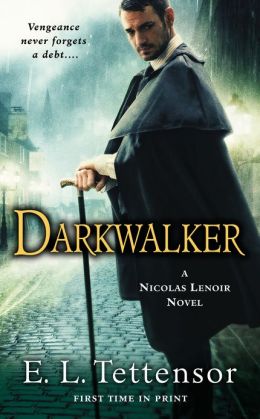 Who is Nicolas Lenoir?
A harder question. There’s who he is, and who he used to be, and that’s two very different people. The Lenoir series is as much about the character as the mysteries, and it’s really the chronicles of a broken man’s quest to glue himself back together, piece by agonising piece.
Lenoir grew up in a time of revolution, when everything seemed possible. Unfortunately, he also lived through what comes after revolution, a reality that failed spectacularly to live up to its promise. It left him jaded, cynical, and eventually corrupt. When we meet him in Darkwalker, he’s a man going through the motions. By the time of Master of Plagues, he’s regained something of his inner fire, but he’s still got a long way to go.
I’ve seen Nicolas Lenoir & the books compared to Sherlock Holmes. How do you suspect these two characters would size-up each other?
I doubt they’d get along. There just isn’t enough room in Kennian and London put together for both of those egos. But there would be grudging respect, I think. Lenoir lacks Sherlock’s almost supernatural eye for detail, but he could give Sherlock a run for his money in the logic department. And neither man is what you’d call sentimental. In fact, Lenoir might outdo Holmes when it comes to emotional detachment. Calling him a loner is like calling water wet. They also share a certain zealotry when it comes to The Case – Sherlock because he loves the puzzle, Lenoir because it’s all he has in life. They’d probably have a tetchy but fascinating chat over wine – right up to the part where Lenoir mentioned the Darkwalker, at which point Holmes would snort contemptuously, don his deerstalker, and quit the pub.
 If readers are jumping into The Master of Plagues as their first experience with Nicholas Lenoir, what do they need to know?
The nice thing about Master of Plagues is that you don’t need to have read Darkwalker to enjoy it. There are a few references to past events, but they don’t have a major impact on the story.
The main thing you need to know going in is that this isn’t a high-magic world. The supernatural is there – the books vary in terms of how much – but it’s subtle and creepy, rather than spectacular and in your face. It’s a dark world; I picture it in ash and charcoal, with shining wet cobblestones and steam rising from the sewers. These books are all about atmosphere.
What was the most challenging aspect of writing book 2 in a series?
Meeting the expectations you’ve set in Book 1 is a challenge. I don’t just mean in terms of quality (although obviously you want each book to be at least as good as the last), but also in terms of tone. Book 1 primes readers to expect a certain type of story, with a certain cast of characters, and as I’m learning, some readers will be quite prescriptive about what they want to see in a sequel. You can’t let yourself be guided by that, of course, but you do need to be aware of the expectations you’ve created with Book 1 and how those will be addressed in Book 2 – or not.
How do you keep track of events and characters over the course of the series at this point, 2 books into the Nicolas Lenoir series? I’ve seen/heard some authors keep notes or even create wikis for their personal use for storing tracking information.
Continuity is definitely an issue. I find it less challenging with events and characters than I do with setting. The City of Kennian is practically a character in its own right. It gets a lot of page time – street names, neighbourhoods, social dynamics, etc. – and you need to keep track of all of that for consistency. To do that, I actually took the “style sheet” prepared by the copyeditor of Darkwalker as a basis. It’s a reference document that shows not only your style elements (UK vs. US spelling, say) but also keeps track of characters and places that you’ve mentioned, and what page they first occur on. It’s really handy, and I used it to build a sort of mini-encyclopaedia of Lenoir. So far, it’s worked really well.
With your books set in a place that resonates with Victorian London, what kind of research did you do to keep the setting and characters authentic to the era/location evoked?
Actually, the analogue is probably more Regency London than Victorian, closer to the opening of the 19th century than its close. So, for example, you see Lenoir armed with a flintlock on the cover of Master of Plagues, as opposed to a revolver or something more modern.
In terms of research, I have to admit, not much. Between literature and films, I’ve spent a lot of time in 19th century London, as I think many of us have. I did find myself researching details – about the shipping industry, for example, or the architecture of the slums, or the sound a flintlock makes when it fires – but in general I felt that I had enough scaffolding to build on without digging too deeply into history.
Your agent/agency, JABberwocky is one of the premier writer’s agencies/agents specializing in genre. Can you tell readers a bit about the process from your initial contact with them until becoming a client?
Every writer’s journey is unique, but I think mine is downright weird. I got my start writing humour, and my first pro gig was a humorous short story in Realms of the Dragons II, in the Forgotten Realms. I’d never read Forgotten Realms or played D&D, but I’d read some DragonLance back in the day and reckoned that could be a good way to break in. Which it was: shortly after RotDII, I was offered a Ravenloft novel. I promptly reached out to Steve Mancino, then of JABberwocky, with a contract in hand. After Steve left, Joshua had a look at the work I’d done for the Ravenloft novel – which was never finished, because Wizards of the Coast cancelled the line about five seconds after re-launching it – and agreed to take me on. I now have the world’s greatest book coach. The tough love kind, but it works.
Many writers try to capture exotic, fantastical locales, or locations that aren’t familiar to readers in the wider world. Living in Burundi, one might say you live in an unfamiliar locale to many readers (yet quite familiar to you, I would suppose). Would you guess that writing about more familiar locales would pose the same challenge to you as, say, a Londonite writing about African locales?
I’m fortunate in that I’ve had an opportunity to travel pretty extensively, and also to live in different parts of the world. I’ve lived on the west coast of North America and the east, in big cities and small. I’ve lived in Europe. I’ve lived in Africa. And if I haven’t lived there, chances are I’ve spent time there, or somewhere nearby. So that gives me a lot of fodder for writing. I’m as comfortable in Paris and New York as I am in Istanbul or Islamabad or Bujumbura. For a book like Master of Plagues, I’m able to weave together experiences from all over – Africa, Europe, the Middle East – and hopefully make it really authentic.
It is an open secret that you write under the name “Erin Lindsey,” why the two names?
Well, it was never meant to be a secret. It’s just that I was launching two very different debuts at roughly the same time, so it made sense to have two different brands, since we didn’t really know what the future held for either series. Also, we didn’t necessarily anticipate a lot of crossover between the two series – they are just so different – and we didn’t want to confuse readers of one or the other, partly related to what I mentioned earlier about expectations.
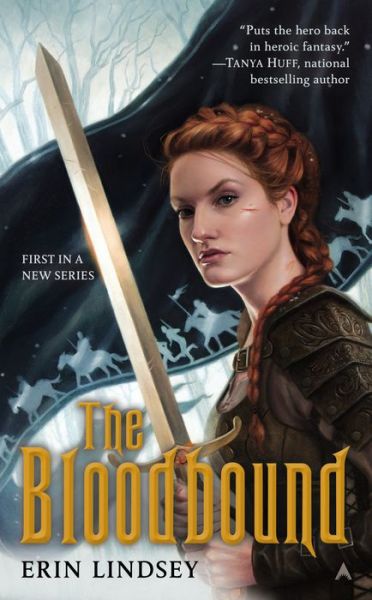 How is it balancing your Erin Lindsey writing from your E.L. Tettensor writing?
It would be easier if I didn’t also have a full-time job and live in a very challenging place. That’s a lot to juggle, and I must admit, 2014 was a tough year for me. When your deadlines are so close together, you have to be able to switch gears really quickly, which is tricky when you’re switching gears between a dark, brooding mystery and a high-flying fantasy romance. Ultimately, though, I think both series are better for it, because I get to flex a lot of different muscles and keep them in shape. That comes in handy when you need to, say, drop a really dark, creepy scene into The Bloodforged.
Master of Plagues will be published by the time this interview is posted. What is next, more Nicolas or more books from Erin Lindsey?
Immediately on deck is The Bloodforged, Book 2 of the Bloodbound series, which hits shelves September 23rd. That will be followed by The Bloodsworn, and after that – who knows?