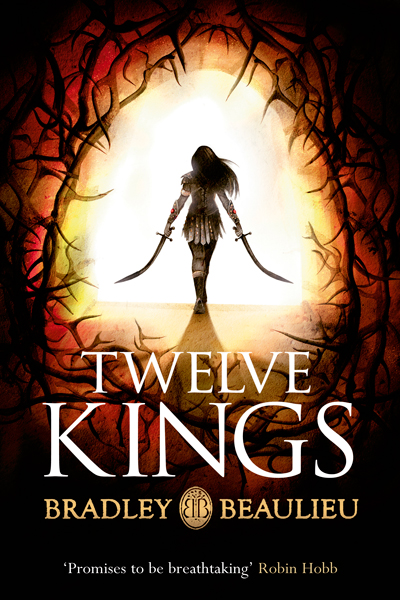
 Twelve Kings (aka Twelve Kings in Sharakhai in the US) is not Bradley’s debut novel, though it is the first major release here in the UK. US readers may recognise Bradley’s name from his Lays of Anuskaya series, beginning with The Winds of Khalakovo. He has also been a Gemmell Award shortlist nominee and an L. Ron Hubbard Writers of the Future Award winner.
This is a book that should fit right into the next set of nominations for the Gemmells.
Epic in tone and scale, we begin the novel mainly from the perspective of Cedamihn Ahyanesh’ala (Çeda, pronounced Chayda).We see her life as a young gladiatrix and street tough, both in the arena as ‘The White Wolf’, never defeated, but also the life she leads outside the arena, as a runner for the local gangleader. Through backstory we discover Çeda’s relationship with her life-long friend Emre and how her mother Ahya was killed when Çeda was young. Blaming the ruling group for her mother’s death and promising revenge on the twelve kings of the city of Sharakhai, Çeda has been left to be brought up under the care of apothecary Dardzada.
This somewhat hectic double lifestyle changes when Emre, delivering a secret package for the local gang leader, is attacked and has to be rescued by Çeda. The rescue is made much more difficult because it happens on the night of Beht Zha’ir. This is when Mesut, the Jackal King, takes the carnivorous asirim from the blooming fields outside the city to collect a blood tithe, arranged by the Twelve Kings, through the streets and houses of Sharakhai. It is a time normally when the populace of Sharakhai stay indoors lest they be taken away and eaten by the asirim, but an ideal time for secret deliveries.
Çeda saves Emre but at the same time meets an asirim wearing a crown, who does not kill her but kisses her. Once Emre has been retrieved, Çeda finds that his delivery item contains’ a major secret about the twelve Kings that both horrifies her and gives her an advantage in her plans for revenge.
As the plot develops, the cast of characters expands. The arrival of Ramahd Amansir from neighbouring Qaimiri steps the plot up a gear. He defeats Çeda as a dirt dog (gladiator) and their following discussion leads Çeda to believe that she has a new ally also wanting revenge. Ramahd, and his strange sister-in-law Meryam, are determined to gain revenge on those who killed his wife and his daughter, the ones still organised by Macide, the godfather of Sharakhai’s criminal underworld.

A rebel group, The Moonless Host, are searching for the tomb of Hamzakiir, an ancient King who they hope to use to usurp the Twelve Kings. To speak with Hamzahiir, they need a breathstone, a blood magic-based jewel that allows the user to speak to the dead. Çeda and Emre find themselves involved, in different ways.
Much of the middle part of the novel is about Çeda discovering secrets about her own family and her past, and trying to find out how she can take on the Kings to depose them of their 400-year rule. It shifts from the present to the past, filling in backstory from five and eleven years previous.
The last part is an exciting, page-turning event as the various plot threads are deftly woven together. There are a number of disclosures that surprised me. Though the tale is just beginning, there is a huge reveal in the end, which will have consequences for Çeda and Sharakhai later in this epic series.
Twelve Kings is a book that rather confounds current trends. For example, it is based in a desert world, rather than a faux-Medieval Tolkienesque one. Though it has dark moments, it is not grimdark. As befitting an Epic Fantasy, it has a range of characters, but not too many, concentrating on four main perspectives. It has a range of places in its setting, but is mainly focused on the city-state of Sharakhai. It even has a quest element, something that has been absent from many a recent Fantasy novel.
So it may not be ‘trendy’. But it is engaging, absorbing, entertaining, and exciting.
Firstly, the setting is superb. Evoking images of desert landscapes and exotic cultures, Twelve Kings is definitely not a Tolkien-clone. The arid desert environment is often described in terms that we would normally use for oceans, with a terminology to match. In the city itself, the impression of size and great variety is given without resorting to detailed place descriptions that can be obtrusive to the plot. I also liked the fact that there is an entertaining mix of different tribes and cultures which gives Sharakhai a multicultural feel, reminiscent of downtown Casablanca or Marrakesh. Travelling a little further afield from the city-state of Sharakhai itself, we have desert journeys, sandships and pirate battles across the Great Shangari Desert.
Of course, a good book needs something more than just a good setting. Bradley manages to combine our previous ideas of big deserts (Dune) with something that is subtly his. There is magic in this world, which the twelve kings use to maintain their rule. Much of this is based around the arcane use of blood, which gives rise to some very Elric-style events. To add to this, strange creatures walk this desert world – poisonous rattlewing beetles, the black laughers (some sort of hyena), and, of course, the immortal asirim themselves. The asirim are wonderfully creepy, part werewolf, part vampire, long-living slaves to the blood-tithe who we discover are part of the big secret.
Most of all though, this book works on the quality and the strengths of its characters, and in particular Çeda. Through the backstory, we realise that Twelve Kings is really about the relationship between Çeda and her childhood associates. Emre is her lifelong friend, someone on whom Çeda has both relied on and saved at various times in their lives. Through the glimpses of Çeda and Emre’s earlier life we also meet Rafa, Emre’s older brother, whose unfortunate fate binds Emre and Çeda together more. Hamid is the shy one, the one who secretly fancies Çeda, whose lifestyle choices have led him to a life of crime as an adult. Tariq is the bully, the one whose dealings with the local crime gangs creates little but trouble for both Emre and Çeda.
Although the book’s focus is about Çeda and the difficulties she faces to reach her destiny, obviously her actions have consequences on all those who know her. Though I guess my loyalties should lie with Çeda, strangely, the person I feel for most in the novel is Dardzada, the apothecary who has to deal with Çeda growing up. It is not an easy task and many difficult decisions have to be made to keep Çeda’s background a secret. He does so out of love and loyalty for Çeda’s mother, Ahya, but this also leads to his estrangement from Çeda. His gruff, tough approach to living belies a caring side that is genuinely concerned for Çeda, even when she doesn’t appreciate his support. It is a situation that is handled most delicately and pleasingly well.
Generally the style of the narrative is great, with a combination of vivid imagery and just enough invented vocabulary to draw the reader in without them having to work hard for it. The double life that Çeda leads is well portrayed but is in stark contrast to that of the twelve kings.
“You are an arrow, Cedamihn. A spear pointed at the heart of Sharakhai. And we will work together to unravel what the Kings have done in the name of their gods.”
The balance between warrior and street-tough is a difficult one to judge, but Brad does it here brilliantly. Çeda is not a sanitised heroine by any means, but she wins the reader over as a passionate, fierce and loyal person who makes blunders and yet stays true to her beliefs. The core of Twelve Kings is about following her journey and watching her grow into an adult from her actions and her mistakes.
There’s a lot of thought gone into this book. One of the little additional touches I liked whilst reading was that each of the viewpoints given is signified by a different picture at the beginning of each chapter. Çeda’s symbol is the adichara flower, the lethal plant whose petals are an illegal drug. Ramahd’s is a heron-like bird, the symbol of his family. Çeda’s friend Esme has a rattlewing beetle in a scarab-style posture whilst the perspective for Ihsan, the King of Sharakhai, is shown with a bladed shield. As you might expect, Çeda’s is the one we see most, whilst the Kings only really appear at key points in the book. (I’m sure this may change further into the series.)
There are occasional parts that don’t work quite so well – an uncomfortably written sex scene, the odd clunk of exposition and dialogue. Some readers may baulk at the flitting between past and present, though what is told in the past is important and the style is rather en vogue at the moment. But really, for a book of this length and drive, the flaws are surprisingly few.
How often do you read a book not wanting it to end? Or, as you read, you feel so much in a book’s grip that you are happy, just knowing that this is good. It happens too rarely for me these days, but Twelve Kings is the first book that did this for me in a long while. Twelve Kings provides superior world-building, memorable characters and an exciting plot in a thoroughly entertaining adventure that I struggled to put down.
Putting it simply, Twelve Kings is the best new Epic Fantasy I’ve read in years.
Thoroughly recommended.
Twelve Kings (in Sharakhai) by Bradley Beaulieu
Book One of the Shattered Sands
Published by Gollancz, September 2015.
568 pages
ISBN: 978 473 20300 6
Review by Mark Yon