David B. Coe has been consistently releasing novels since his debut novel, Children of Amaraid first published in 1997. The novel (and its sequel, The Outlanders) were awarded the William L. Crawford Award for best first fantasy series. David recently reacquired the publishing rights to the books and decided to re-edit the books and re-release them in what amounts to an “Author’s Preferred Edition” or “Director’s Cut.” The first of which, the aforementioned Children of Amarid, is the subject of this review.
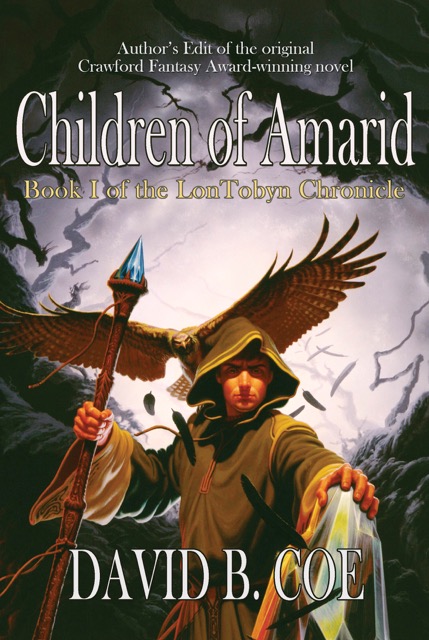
Children of Amarid follows a familiar tale to readers of fantasy – a youthful protagonist (son of a blacksmith) comes into his own as he travels his path of destiny to magical power. In this case, the protagonist is Jaryd and he is recruited into the Order of Amarid, the kindly organization of mages who protect the land of Tobyn-Ser. When the novel begins, Jaryd has been having dreams that hint at dark mages, cloaked in the disguise of the Order of Amarid wreaking havoc. When a town is destroyed by those supposed mages in an event that mirrors his dreams, Jaryd realizes his dreams are indeed prophetic. When his somewhat reclusive Uncle Baden arrives to recruit Jaryd into the Order of Amarid, Jaryd’s path of destiny truly begins.
Jaryd and Baden come to realize there is a traitor in the ranks of Amarid, twisting the noble ideals of the Order to their own selfish goals. The attack Jaryd prophesized was not the only attack, stories have been circulating that other towns have been razed, people killed victimized by rogue members of Amarid. As Jaryd becomes more entrenched in the order of mages, he comes to learn the history, how two friends – Amarid and Theron – founded the order and a falling out occurred hundreds of years in the past. It is suggested that a delegation – including Baden and the newly anointed Jaryd, his budding love interest Alana, along with the leader of the Order and a couple of other mages, make a journey to Theron’s Grove, where they hope to seek aide from the shade of the dead mage. What they learn is that history clouds the truth and that those closest may be the ones who are least trustworthy.
Coe approaches these familiar themes and character types with a nice air of freshness. Despite initially being published nearly twenty years ago, the story does not feel dated in the least. His characters are mages, some quite powerful, but they are grounded. As one of the characters remarks about another character with an historically bad reputation, (and I’m paraphrasing), he was just human. That is very much the case with Coe’s characters, they are human, extremely logical, and wonderfully believable. Their dialogue comes across rather straight-forward, humane, and very engaging. The plot of the novel is conveyed to a great extend through dialogue, which when balanced as well as Coe balances it here, manages to continue the plot’s forward momentum and provide insight into the characters themselves.
What I appreciated in this opening volume of The LonTobyn Chronicle was the level of the stakes. There was no immediate global threat, Jaryd had to deal with the fairly typical life choices an 18-year old would have to deal with (impatience with elders, romantic entaglements), and the intimate and more personal nature of the tale. While there is indeed potential for more world-shaping events to come in future volumes, Coe did a really nice job of laying the ground work for his characters and world with the level of potential consequences here in Children of Amarid.
As for the world-building, Coe adds some nice flourishes into what is initially a fairly standard medieval-level-of-technology world. As more of the world is revealed, the rival nation of Lon-Ser shows a remarkably advanced level of technology, far beyond that of Tobyn-Ser where the Mages of Amarid reside. Also, I was reminded a little bit of Elizabeth Moon’s landmark Deeds of Paksenarrion trilogy (a series I love, btw). In my overview of that series over at SF Signal, I mention how she wanted to write Paladins (the holy knights of Dungeons and Dragons) “correctly.” While I can’t say if Mr. Coe had intentions of writing Druids “correctly” when he set about writing Children of Amarid (and The LonTobyn Chronicle as a whole), the mages here feel as if they are Druids of D&D handled quite well and realistically.
As a first novel in a trilogy, Children of Amarid and does exactly what an opening novel should: introduces the characters and world, provide hints at larger things on the horizon, and leave enough that the reader wants to see what happens next. Pleasingly, Coe provides resolution to many of the plot issues introduced in the beginning, making Children of Amarid a tale that holds closure. What Children of Amarid has also done is given me another author with a deep backlist to explore.
I hadn’t read the Children of Amarid upon its initial publication, but the series in particular and author in general have long been on my radar. Coe churns out well-respected novels across a few branches of the Fantasy genres and I’ve wanted to sample his work for a while. With the prevalence of fantasy novels with a more cynical, grimdark nature on a continued rise, I found Children of Amarid almost a refreshing change of pace for its hopeful and relatively optimistic nature. That isn’t to say dark things don’t occur over the course of the novel, just that the darkness doesn’t weigh down and pervade every aspect of the novel. For a novel that is nearly 20 years old, it has aged quite well. I’m glad that Mr. Coe had the opportunity to touch up this debut novel and hope to see this book find a new readership. For me, I’m looking forward to the reissues of The Outlanders (October/September) and the final novel Eagle-Sage in December.
© 2016 Rob H. Bedford
Recommended.
Don’t forget to enter our giveaway here at SFFWorld to win a copy of Children of Amarid!
The LonTobyn Chronicle, Book 1,
Reissue June 2016 (Original publication April 1997)
Trade Paperback, 384 Pages
Review copy courtesy of the publisher Lore Seekers Press / Lets Talk! Promotions