

 Ralph Kern puts the Worlds to Writes with Peter Cawdron: THE Lonely Planet.
Thanks for joining us here at SFFWorld for the next interview on the themes, technologies and events which feature in an author’s work.
In this interview, I’m joined by Peter Cawdron, the international best-selling author of twenty science fiction novels, novellas and short stories. So far, his stories have taken us on odysseys through the plains of Africa, out to Saturn and far beyond the plane of the Galaxy.
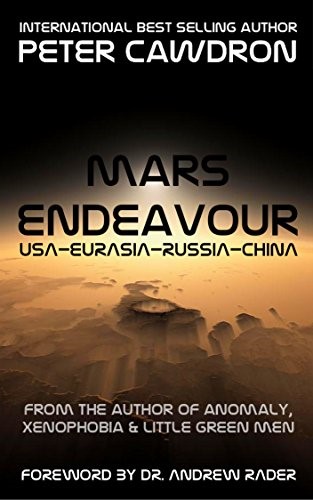
Today though, we’re going to focus on our closest neighbor where his next novel, Mars Endeavour is set.
Peter, thank you for taking the time to answer a few questions and congratulations on the release of Mars Endeavour (which just for clarity is not related to my own novel, which also happens to be called Endeavour). This book explores the challenges which the first settlers on Mars will face. Colonizing Mars may be some way in the future yet, and visiting it as a tourist destination even further, but let’s imagine you are giving a tourist pitch as to why we should visit.
So, let’s start at the beginning, Peter. To the glance, Mars is a barren desert. If I were to pick any destination to visit in the Solar System, just why would I want to go there?
You wouldn’t. If you could choose any destination in the solar system, there’s lots of other places that are far more visually spectacular, places that are potentially better science targets, like Europa around Jupiter or Enceladus around Saturn. The problem is distance.
Mars varies between roughly 40 million and 225 million miles away depending on the orbit, whereas Saturn is 750 million miles away at its closest approach, reaching up to 1.2 billion miles. It’s not just that it’s 18xs the closest approach of Mars, but that the need for fuel and the difficulty of such travel increases exponentially. Getting humans to Mars will be extremely difficult. Getting humans to any of these other tantalizing locations borders on absurd by comparison.
When it comes to travel, there’s a concept known as payload fraction. For aircraft, this is around 50%. For spacecraft, it’s well over 90%. The Saturn V that put humans on the Moon was rated at 95.7% meaning the crew and Lunar Module, etc, accounted for less than 5% of the launch mass. When you look at a space rocket sitting on the launch pad, MOST of the mass won’t leave Earth—it’s mainly fuel needed to simply escape Earth’s gravity well. To get anywhere in the solar system, we’re going to need to build and/or fuel a spacecraft in orbit, in much the same way we’ve built the International Space Station. And as you can imagine, the cost and difficulty in doing that is going to be insane.
So if we could go anywhere, we probably wouldn’t settle primarily on Mars as there’s far more interesting targets elsewhere, but Mars gives us the opportunity to build an outpost. And thanks to the abundance of perchlorates on Mars, mining rocket fuel should be possible, meaning Mars may become the stepping stone for humans to reach Europa and Enceladus.
Mars is kinda like a gas station on the way to Disneyland. Mars has lots of interesting science targets, but none quite as rich and promising as the moons of the gas giants.
 From what I can see, the planet has some pretty impressive geography, some of which would put Earth’s to shame. What are the sights which I should look out for while I’m there?
There’s some wonderful places to explore, like Olympus Mons, the largest volcano in the solar system, and Valles Marineris, the largest canyon system in the solar system, and the Hellas Basin, which is one of the largest craters in the solar system, but these might not be as grand as they seem. The problem is… Mars is small. Stand at the base of Olympus Mons and you won’t be able to see the top, because the curvature of the planet will hide it from view. The top is literally below the apparent horizon as you look up the slope. The same is true for large sections of Valles Marineris. The canyon is so wide that standing on one wall, you won’t be able to see the far wall as it will be below the horizon.
Oh, and Mars isn’t red. It’s more of a ruddy brown. The sun is much fainter that far away, and the sky will appear washed out. Some sections may reach the colors we see in scifi movies, but most won’t.
If you’re a fan of geology, though, there’s billions of years’ worth of relatively untouched vistas to explore. If you’re not, there’s rocks, rocks, and more rocks.
I hear that the Martians have really changed their culture to adapt to their new home. What things would you recommend I take part in at Endeavour?
Bunny hopping like the Apollo astronauts would be fun, as would the high jump.
The lower gravity (roughly a third of Earth’s) has some unusual side effects. Things will fall noticeably slower. Imagine taking a shower and watching individual water droplets fall. Throw a football or hit a golf ball, and you’ll probably be able to send it anywhere up to 2-3xs as far as you can on Earth. That could make football interesting.
Walking will be difficult because the gait needed will feel wrong/unnatural. Surprisingly, though, running may be easier. Lean forward at an angle that would have you face-plant on Earth, and you’ll be able to run 100M in an Olympic time.
Returning to Earth after a few years, though, will be a real drag. Even if you retain all your muscle mass (not likely), your muscles will have accustomed to functioning at 1/3 of their Earth rate. This could have severe implications for the heart muscle, so take out health insurance.
Mars is often given as a planet where life could have evolved. Do you think it is the best candidate for finding alien lifeforms? What other opportunities are there in the solar system?
Life could have evolved on Mars. As I discuss on my blog, there’s even a case for considering subsurface microbial life today, but the real targets for life beyond Earth are the moons of Saturn and Jupiter.
Titan, for example, although frozen and covered in methane, has surprised us with unexplained chemistry. There’s a shortage of hydrogen close to the surface, which is surprising and signals some exotic chemical process at work we don’t fully understand. Could it be life? We just don’t know, but it’s worth looking.
Both Titan and Europa have far more water than Earth. Although most of this is locked up in ice, there are vast subsurface oceans on Europa and Enceladus that could contain life in much the same way as Earth has life thriving around deep sea volcanic vents.
I always like one of my questions to look far into the future. We often hear the term ‘terraform’ being mentioned. For the benefit of our readers, would you be able to explain it and what challenges that might bring.
Terraforming describes the possibility of transforming planets so they become Earth-like.
I doubt we’ll ever terraform Mars. I get criticized for saying this, as, “Never say never,” but I think it’s misleading to suggest Mars could be a replacement for Earth at any point in the next 100,000 years—minimum. Mars is simply too small. It’s a physical limitation no amount of technology is likely to ever overcome.
Mars has two major problems. Physically, it is so small that it struggles to retain an atmosphere. As gases warm, they become more energetic. At any temperature even remotely approaching that on Earth, Mars will rapidly lose gases such as oxygen, nitrogen, water vapor, etc. There’s really no technological fix for this problem as it arises from the low gravity. Also, Mars lacks a decent magnetic field, which means it gets bombarded by solar radiation, which exasperates the loss of atmosphere, and will leave any inhabitants exposed to harsh cosmic rays.
For a long, long time to come, Mars is going to be akin to an Antarctic research station. There will come a day, when our descendants can partially terraform sections of Mars, perhaps in gigantic domes, but Mars will never be Earth 2—and to me that highlights the need to take care of Earth 1 and steward its resources properly. The biodiversity we have here on Earth is truly astonishing—3.8 billion years in the making. Let’s not squander that with a few centuries of pollution.
Thank you, Peter. We wish you all the best with your latest release. One final thing. I want to do a ‘pay it forwards’ where I get an interviewee to ask a question for the next article. Next up is Robert M Campbell, who wrote the fantastic Trajectory series.
Robert, what’s your favorite classic (20th century) science fiction story, and why?
Thanks. Once again, the best of luck with Mars Endeavour. You can pick it up for the discounted price of $0.99 until October here.
Mars Endeavour
“NASA prepared us for every eventuality on Mars, but they never prepared us for what could go wrong on Earth.”
Mankind has long dreamed of reaching out to live on other planets, and with the establishment of the Mars Endeavour colony, that dream has become reality. The fledgling colony consists of 120 scientists, astronauts, medical staff, and engineers. Buried deep underground, they’re protected from the harsh radiation that sterilizes the surface of the planet. The colony is prepared for every eventuality except one—what happens when disaster strikes Earth?
Peter Cawdron Bio
Peter is an Australian science fiction writer, specialising in hard science fiction.
Hard science fiction is a misnomer as far as categories of literature go, as it sounds harsh and difficult to understand, but that is far from reality. Hard science fiction is simply plausible science fiction, fiction that is written in such a way as it conforms to the known laws of science, and that makes it more interesting, as there’s no magic wand the protagonist can wave to get out of trouble. Peter’s forays into hard science fiction could best be described as informative science fiction or enjoyable science fiction.
Peter is a fan of such classic science fiction writers as Philip K. Dick, Arthur C. Clarke and Michael Crichton and their influence on his style and story lines is readily apparent. You can follow Peter on Facebook or Twitter or find him posting some interesting tibit on his blog http://thinkingscifi.wordpress.com/
Notable novels include:





The best quote!:
“Mars will never be Earth 2—and to me that highlights the need to take care of Earth 1 and steward its resources properly.”
Amen to that!