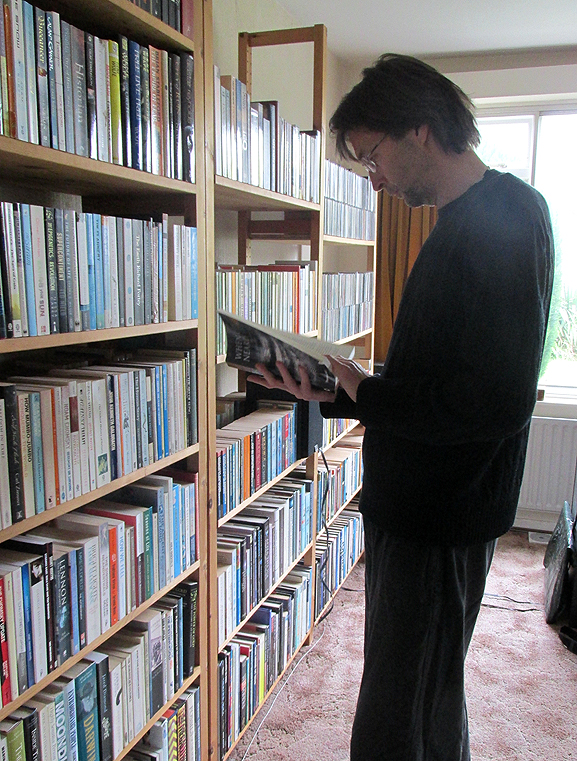
Stephen Palmer is the author of a number of Science Fiction and Fantasy novels and short stories, including the surreal slipstream steampunk Hairy London (Infinity Plus Books, 2014) and the cyberpunk tale Beautiful Intelligence (Infinity Plus Books, 2015). His soon-to-be-released Factory Girl trilogy (Infinity Plus Books, 2016) takes us on a journey to an alt-world Edwardian-era England where teenage Kora, the illegitimate daughter of an inventor, may hold the key to a terrible secret within the Factory that produces the automata which power the British Empire.
Hi Stephen! Kora’s story starts in a surprising place: the infamous Bedlam institution. Could you tell us a little more about your main character and why you chose Bedlam as the jumping off point for the first novel in the trilogy, The Girl With Two Souls?
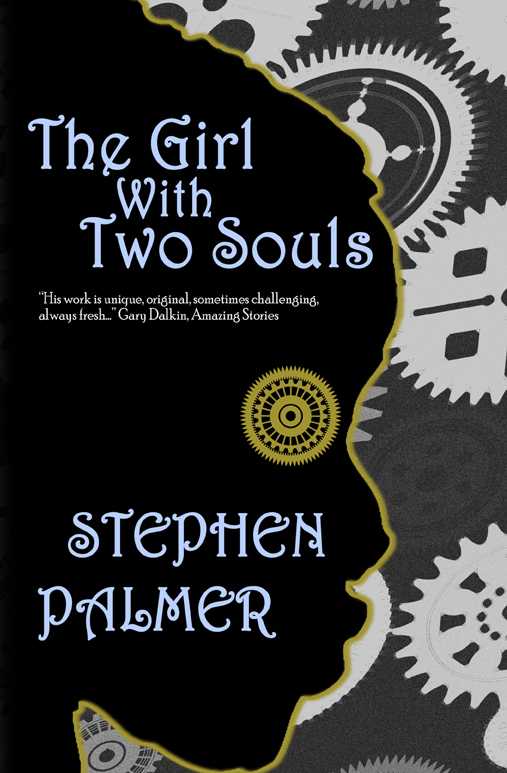
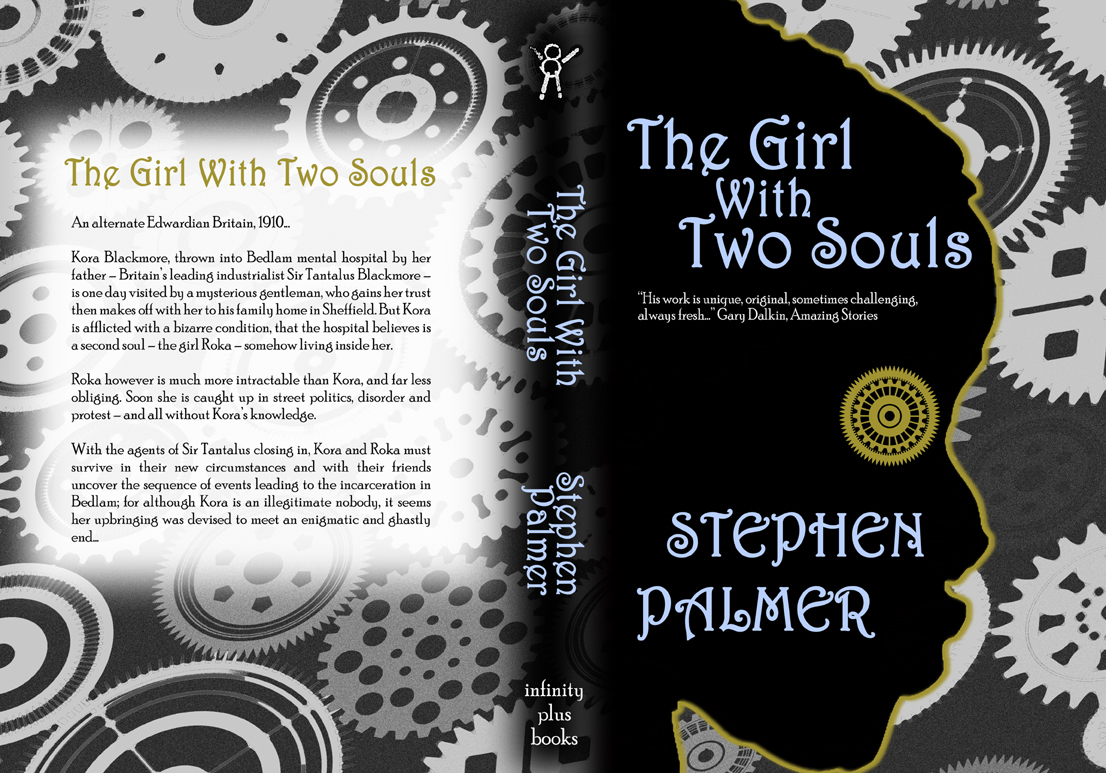
Kora is fourteen and the illegitimate daughter of Victorian Britain’s greatest industrialist and mechanic Sir Tantalus Blackmore, her mother being an African servant working in the Factory. The reader finds Kora in Bethlehem Mental Hospital, the notorious institution commonly known as Bedlam, where she was unceremoniously dumped four years earlier by her father. Kora has a bizarre affliction: every morning she wakes up as Roka, a different person, while Roka herself wakes up every morning as Kora. Thus the two girls alternate daily, and neither has much memory or understanding of the other.
The opening few scenes with Kora and her mysterious rescuer were absolutely crucial to me, and I spent more time than usual imagining them. Although Bedlam has a poor reputation in popular culture it actually has had a few humane periods, when more enlightened people managed it. In 1910, when my trilogy is set, I had it in one of its better phases. But there is no doubt that even a ‘better phase’ was primitive and brutal by modern standards. A mere decade or two had passed since Freud’s groundbreaking psychological discoveries – and of course Edwardian society was unforgiving to most who were not white, male and mentally balanced.
 What were the main themes that emerged as you worked on the Factory Girl trilogy?
The main narrative themes and the more philosophical themes were all set before I wrote a word. I think this whole trilogy was pre-formed in my unconscious long before I noticed it. I had the title The Girl With Two Souls for at least a year before 2013, when I began work, and that is unusual for me. For some reason that title resonated with me; possibly because of my interest in matters of religion. Then in autumn 2013 I had a “Eureka moment” sitting in front of the news one evening. A few ideas popped up into my mind, then more; then a flood of ideas. I’ve had this experience a couple of times before, so I grabbed a notebook and began writing it all down. When I looked up, two hours had passed (in a subjective 20 minutes) and I’d sketched out the structure of the entire work. That structure hardly changed during the actual writing of the trilogy, which lasted from December 2013 to January 2015.
These “Eureka” experiences are fantastic, of course, and must always be followed. So, the tale was set. The background was set. I knew I wanted to write a vaguely steampunk work, and I knew automata would feature. But there were other curiosities. Through the trilogy a second work is threaded, a children’s book called Amy’s Garden, by the Rev. Carolus Dodgson. For reasons made clear as the trilogy progresses, Kora is preoccupied with this work. Fans of Lewis Carroll will of course recognise my alternate take on author and book.
Your previous novel, Beautiful Intelligence, dealt with a far-future race to perfect artificial intelligence. In your upcoming release, you have early 1900s automata. What is it about robots that fascinates you?
I’ve thought for a while about this question, and I’m not really sure. It’s certainly been a theme in my work for decades. Even in Memory Seed, my debut, the genesis of which goes all the way back to 1988, there were artificial intelligences, which in Flowercrash became embodied. In Urbis Morpheos I made a more sophisticated artificial race, which was part of an entire artificial ecology.
I suppose the great thing about non-living robots, androids, AIs etc is that they are a way of viewing ourselves from the outside. That’s a good perspective to have for an author. The gynoids in Flowercrash, having failed in Memory Seed and failed again on a different planet in Glass, return to Earth to embody themselves, which they do by following human activity.
Your novels span a vast range of styles and settings, from the continent of Africa in a very distant future in Muezzinland, to the alt-Edwardian urbanity of Hairy London. How do you decide where and when you’re heading next?
I’m the sort of author who is incapable of doing anything except follow his muse. These scenarios choose me. I very much believe in letting the subconscious do all the important work. I listen to my subconscious whenever I can – I trust my intuition. For instance, I intend writing a new novel over the winter holiday, and there were three main contenders for that: a YA novel set in a “modern” Wales, a YA novel with animals as characters and a philosophical theme, and a YA/adult crossover novel set during WW1. As autumn began, the first contender seemed to drift away from me, while the last one I started to get excited about, although at first I wasn’t sure why. So that’s the one – Tommy Catkins, it’s called – which will be written next.
 Sometimes my novels start from tiny beginnings. In 1988 I was walking around Virginia Water park in Surrey (part of Windsor Great Park, and an area near where I was living at the time) when a couple of strong mental images came to mind: a number of moss-covered house roofs going down to the sea, and a luxurious bordello which was a cover for some other, unrelated activity. With my interest in environmental matters, and with all the trees and landscapes around me, it wasn’t long before Memory Seed took shape. Hairy London started off from a short story that I wrote – Xana-La for the Eibonvale Press anthology Where Are We Going? – which I wrote off the top of my head. At the time I thought there was more, possibly much more in the scenario and the surreal, almost nonsensical style, and for a time I had to resist the temptation to write the full novel, as I had other work to do. But in the end the lure was too strong, and it became my first work published by Infinity Plus Books.
Like all authors, I keep large numbers of notebooks. I write down all my ideas, and sometimes these grow into novels. Others fall by the wayside. Amy’s Garden was originally a separate book, but right from the outset on that autumn evening I knew it had to be part of the Factory Girl trilogy.
Following on from the previous question, what do you usually begin with: character, plot, or setting?
There’s no such word as “usually” in my world! Each novel is its own thing. Some of my novels are about the world as much as the characters – with The Rat & The Serpent and Urbis Morpheos I went through a phase of using characters both as real people and as ciphers for other things, which wasn’t terribly successful in some respects, as some of my readers found the characters a little remote. Others are much more character driven. Memory Seed for instance, although it was at first a vivid impression of an Earth at the very end of human existence, is very much about the four main characters, Zinina, Arrahaquen, deKray and Graaff-lin. Similarly for Nshalla and Mnada in Muezzinland, which was inspired (in theme at least) by the way Princess Diana was being treated by her acquired family.
I will say though that in most cases, when I’m putting together a new work, the plot comes last. First it’s either the characters or the world milieu. For The Rat & The Sepent, I was waiting at the end of the working day in Exeter to be picked up in the car when a massive thunderstorm began rolling in off the sea, leaching all the colour from the city around me. Then everyone began taking out and unfurling their umbrellas, and, faced with this weirdly monochrome scene, I suddenly found myself asking: what if I wrote an entire novel in black-and-white, like old films were made in black-and-white?
Tell us a little about your writing process: are you an outliner, or more of a ‘discovery’ writer?
Again, this varies, but more often than not I have the entire structure complete at some level. I’ve only ever written one novel completely off the top of my head, and that was Hairy London, which I don’t think I’d ever be able to replicate, though it was immense fun to do…
My outlines are basics of scene and plot. Below is an exact transcript of my Chapter One notes for The Girl With Two Souls; you’ll see they’re quite skimpy:
1. Kora + Dr S + Nurse Carder.
Dr S persuades her to escape. Leaves automaton.
Hansom cab > railway (vizard on).
Train trip > Sheffield.
And that’s it. There are six references to pages in my master notebook, which do have more detailed notes, but the above four lines are what I used on day one of the first draft writing (although see also my next answer).
What does your writing day typically look like?
Since Saturday 21 December 2013 I’ve used only one writing template.
I will never forget that day. Previously I’d been very excited about beginning work on the trilogy. My day job is in education, where I’m term-time only, so I get long holidays. On that first day the words flowed out as if pre-formed in my head. The following fifteen days (with an exception for Christmas Day afternoon, when I went for the family meal at my sister’s house) were exactly the same. The two following weekends in January I completed the work. I was aware at the time that the novel had a ‘different’ feel to it, which at the time I ascribed to the absolute peace and quiet I’d enjoyed over Christmas, though also to being entranced by the story I was writing. Volume two and three felt the same.
Since then I’ve stuck to the same template. My main writing time is over the winter holiday. I never had children when I was married, so I don’t have the understandable distractions of my own family. I’m aware that I’ve lost out in this regard to people with children, but, of course, if you’re creative being childless does have its compensations. I write with total concentration, beginning early in the morning and doing a 5,000 word chapter every day. If ever I get stuck, I go out for a walk in the Shropshire countryside surrounding me, then when I’m back the problem is always solved.
 Where do you usually write? And what would be your dream writing spot?
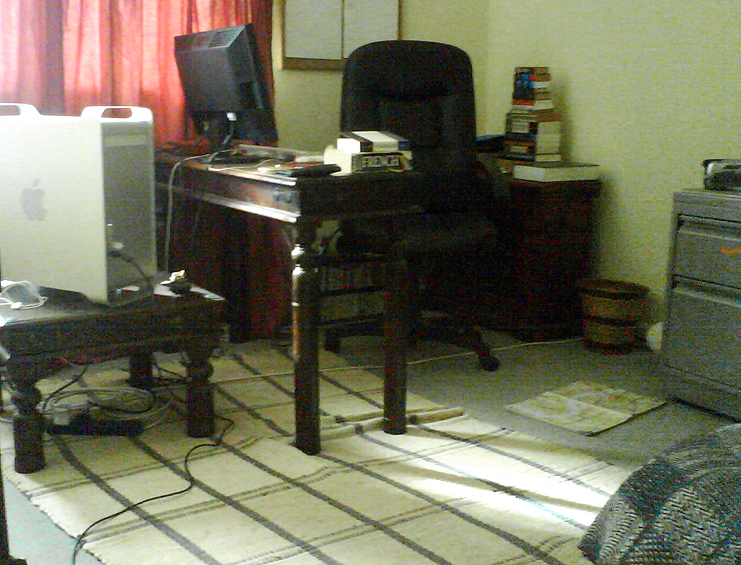
I have a studio where my Mac G5 lives, and that’s where I write. I need to have a good view out of my studio window, which is the one thing I’m lacking in my current house. Right now I can see some trees, a couple of bungalows, and the railway line, which is about a hundred yards or so from my home.
My dream writing spot would be a studio in a nice house somewhere south-west of Shrewsbury, which is my home town, and where the day job is. The land to the south and west of Shrewsbury is Shropshire hill country, and very beautiful. A good view of green things would be essential.
What’s sitting on the coaster beside your computer? Tea, coffee, red wine, absinthe…?
I’m British, so it’s tea!
 You’re a prolific author with a steady stream of published work. Could you share some of your organizational tricks and tips that help with productivity?
Nothing out of the ordinary, I think. I never go anywhere without a notebook, or at the very least a pen. I only use Mac computers, so I never have any tech hassles. I back up all amended files at the end of every day, and I also have multiple copies on a USB stick and in my email account, though that tends to be more on a weekly or fortnightly basis.
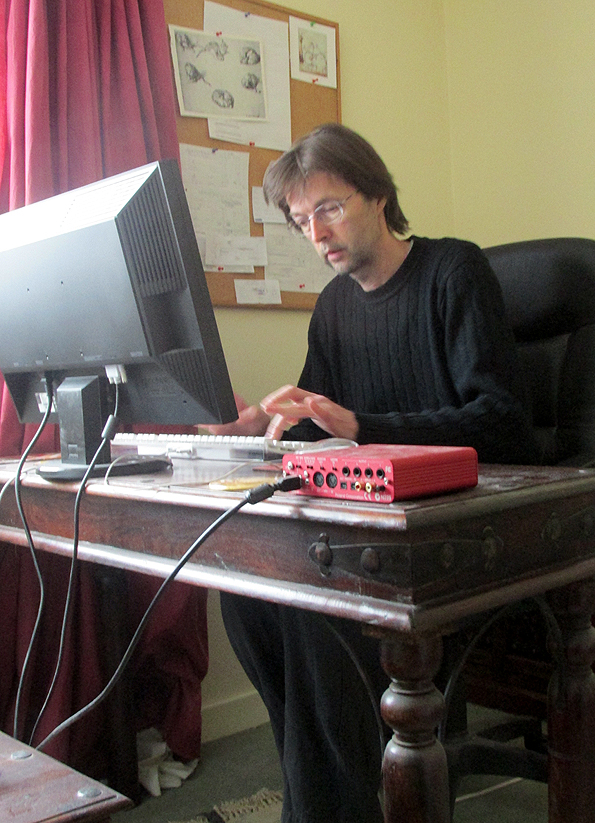
I never waste an idea. Everything gets written down and put in the “writing cabinet,” which is the low metal thing next to my chair in the photograph. As for productivity – I love what I do, it was hard-wired into me from birth. I listen to my subconscious and I trust my intuition.
Just for fun: you get one robot sidekick as your writing assistant. Who would you pick, and why?
Mmm… probably Shrike from Philip Reeve’s Mortal Engines. He’d be useful in times of crisis… 😉 Thanks for asking me these questions, Juliana! J
* * * * * * *
Interview by Juliana Spink Mills – SFFWorld.com © 2016