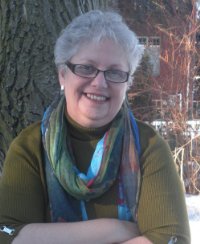
 Karen Dionne is the internationally published author of Boiling Point, an environmental thriller about an erupting volcano, a missing researcher, and a radical scheme to end global warming. Karen’s first science thriller, Freezing Point, was nominated by RT Book Reviews as Best First Mystery of 2008.
Q: Both in Freezing Point and Boiling Point you paint a rather grim future for mankind. Do you have a message to tell with your stories?
While my novels touch on serious themes such as the damage mankind is doing to the planet, I write primarily to entertain the reader. I think to some extent it’s inevitable that an author’s worldview creeps into their fiction and shapes the characters’ viewpoints and the story’s themes, but the message should never overwhelm the story.
If my novels convey a warning, I hope it’s in the same way that two of my all-time favorite novels, Michael Crichton’s Jurassic Park and The Andromeda Strain, carry a message. Science is not the end-all and be-all, and well-intentioned efforts can and often do go very wrong, but that’s something for readers to mull over later, after they’ve enjoyed the story.
Q: Do you do a lot of research into the topics you write about?
I do a great deal of research for my novels, both on the scientific topics touched on in my books, and the locations where the stories are set. Because I’m not a scientist, I also consult with experts as needed.
Regarding location, Freezing Point is set in Antarctica and though I’ve never been there, I lived for 30 years in Michigan’s Upper Peninsula, so I know snow and cold. I also read the online journals of people who lived and worked in the Antarctic.
To research Boiling Point, I traveled to Chaitén Volcano in Northern Patagonia, Chile a year after the volcano erupted. I found an English-speaking guide who arranged lodging for me in the town even though the volcano was on “Red Alert” and the town was evacuated and without electricity and running water. My guide took me to within one mile of the new lava dome, where I saw steam vents, heard explosions from the caldera and felt a small earthquake. It was an amazing and awe-inspiring experience, and no pun intended—I had a blast.
Q: You also had a story in “First Thrills” together with authors such as Lee Child. How did that come about?
I’ve been deeply involved with the International Thriller Writers, who put out the First Thrills anthology, almost from its inception, including overseeing their Debut Authors program and serving on the board of directors as VP Technology.
The First Thrills anthology was conceived as an opportunity to showcase short stories from new authors alongside more established authors, and I was fortunate enough to have my story accepted. “Calling the Shots” draws heavily on my Upper Peninsula experience, and is now available for free on Amazon and Barnes and Noble.
Q: You have a new crime novel based on the TV series The Killing being released next year. Can you tell us a bit about it?
It’s a little early to get into specifics about the story, but I can say that I really enjoyed writing this book. This project is what’s called “work for hire,” meaning that I was hired by Fox Studios through my publisher to write an original novel using the characters from the television series.
It was interesting and challenging to bring the characters from the show to life on the page. There was also a great deal of research involved, since I was acutely aware as I was working that I was writing for fans of the show—many of whom were also my writer friends whose work I admire. I watched all of the episodes multiple times and took extensive notes. I also took notes on the cast interviews on The Killing’s website, particularly when the actors and the show’s producer discussed their characters.
Fox sent me the scripts before the episodes aired, and set me up at a passworded website where I could watch the episodes from all three seasons whenever I needed to. I frequently looked up an episode and froze a scene on the screen so I could find out what kind of car the main character drove, for instance, or otherwise describe the scene accurately and in detail.
So to research my previous novel, I traveled to an active volcano in Northern Patagonia, Chile. While to research The Killing novel, I watched television!
Q: Have you had a chance to see the original Danish series, Forbrydelsen?
Not yet. The U.S. and the Danish versions parallel each other, but the differences are significant enough that I felt couldn’t watch the Danish version without risking that story’s details finding their way into mine.
Interestingly, at ThrillerFest in New York City I had a chat with UK thriller author David Hewson, who at the time was writing a novelization of the Danish version. David told me that he hadn’t yet watched the U.S. version for the same reason.
Now that I’ve turned in the manuscript to my editor I’m looking forward to watching the Danish version—I’ve heard so many good things about it.
Q: Tell us a little bit about the cover art for your books. What makes you choose a particular cover?
My novels have had two sets of covers. The first were created by the art department at my original publisher. Now that I have the rights back to both novels, they have a new set of covers created by my book cover designer daughter.
I may be prejudiced in her favor, but I love my daughter’s covers. I always felt that the original covers, one with an iceberg and the other with a volcano, were too literal. A book cover is more than just an illustration—it needs to evoke a mood.
Q: How do you market your books?
I’m one of those rare authors who enjoys both writing novels, and promoting them. I love trying out new ideas and seeing if they work. My online book launch party for Freezing Point included video welcomes and congratulations from the bestselling authors who endorsed the novel, including James, Rollins, David Morrell and Douglas Preston. The party was a great success, with 2,700 visitors over 4 days and 600 comments in the guest book.
For Boiling Point, I knew that I could use my trip to the volcano to market the book, so I intentionally wore a red raincoat knowing it would stand out in the photos, and brought back rocks from the volcano to give away as contest prizes. Both RT Book Reviews and The Detroit News ran stories about my trip. “Local author writes book” isn’t particularly newsworthy, but “local author visits active volcano to research novel” has a whole other flavor!
Speaking more generally about book promotion, I think every author’s story has something unique about it that can be used to interest potential readers in their book.
Q: What is the hardest thing about writing?
Without a doubt the hardest thing about writing is writing. I’m not being flippant. Ideas are the easy part. I can come up with a full-blown book synopsis in a matter of hours—sometimes even minutes. But the discipline and the skill set required to bring the stories to the page can be daunting.
I’ve always loved what Donald Maass said in his how-to Writing the Breakout Novel: “A novel is a large, complex, fluid and difficult-to-manage undertaking. It is a tough art form to get right, one tougher still to master.”
Certainly that’s been my experience. After a dozen years, I now have a pretty good sense of how to write a novel, but it’s still a matter of putting pencil to paper and getting the story down one word at a time.
Q: For your own reading, do you prefer e-books or traditional paper/hard back books?
I prefer reading on paper—probably because I spend so much of my time in front of the computer. Nothing beats curling up in a comfortable chair with a good book. I prefer paperbacks to hardcovers, but happily read both.
Q: What kind of books do you read, any favourite authors?
I read everything by Douglas Preston & Lincoln Child, Lee Child, Joseph Finder, Marcus Sakey, and Karin Slaughter, to name a few, so as you can no doubt tell, my reading tastes run toward thrillers. I also read “up,” meaning that I try to read a handful of Pulitzer and Booker award-winning fiction every year in order to keep the quality of my writing high. To that end, I just finished Khaled Hosseini’s And The Mountains Echoed and Neil Gaiman’s The Ocean at the End of the Lane Currently I’m reading Daniel Silva’s The English Girl and looking forward to debut author Barry Lancet’s Japantown.
Q: Any hobbies?
I love to travel—especially when it’s for research or to attend a writers conference, because then I can combine my two great loves. Next up is the week-long Salt Cay Writers Retreat I’m organizing for the end of October in the Bahamas. I’ll get to hang out with authors, agents, and editors and talk shop, plus I’ll have time to write in a beautiful and inspiring setting. What could be better?
Q: What’s next, do you have any other upcoming projects you are working on?
I’m currently working on a third book in the Point series titled Breaking Point. This novel will feature Rebecca Sweet from Boiling Point as an environmental activist who enlists the help of a billionaire philanthropist to carry out what may well be the world’s largest environmental cleanup: 3.5 tons of detritus roughly the size of Texas floating halfway between San Francisco and Hawaii in an area of slack winds and currents known as the North Pacific Garbage Dump.
Of course, as in all my novels, my characters’ well-intentioned efforts go horribly wrong . . .