

 Frank Herbert’s Dune and I begin in the same place: the central Oregon coast. The sand dunes blanketing the forty-mile stretch between the towns of North Bend and Florence were once world-eaters. A big storm could drive them over houses, barns, even whole forests. There’s a legendary stretch outside of Florence where the shifting sands will sometimes reveal the rooftops of a subdivision that was swallowed up in the 1960s. The Oregon dunes are a strange place, the largest stretch of coastal sand dunes in North America, and they inspired the novel that turned me into a science fiction writer.
Sent to write an article about attempts to stabilize the dunes, Frank Herbert found himself fascinated by them. Walking their sands feels nothing like a trip to the beach, despite the presence of the Pacific Ocean someplace over the massive flanks of the sandy hills. Patches of quicksand dot the low places, and islands of contorted, salt-parched vegetation add a rare touch of color to the endless golden landscape. It all has the feel of an ancient, unfriendly desert, a place hostile to the humans who would traverse its wastes.
The miles of coastline to the north and south of the Oregon dunes are picturesque to the extreme, but not the arid dunes. Growing up there, I resented that. My hometown had none of the miraculous, wave-carved rocks that drew tourists to beach towns like Cannon Beach or Bandon. It lacked breathtaking views of waterspouts and tidal churns. There were no moody cliffs to perch upon and watch the storms roll in. It had … sand. A walk in the stuff was laborious, the hills shifting underfoot and spilling you backward a foot for every two you managed to climb. The signs warning of quicksand gave every trailhead the weird and gloomy atmosphere of a Scooby Doo episode. And the scenic vistas usually promised by an exhausting hike up a hill consisted of a never-ending expanse of something so prosaic it could be bought at the hardware store.
It took Dune to make me see the potential of the dunes. Frank Herbert saw through the sandy veneer, beyond the dune buggies racing along the surface, all the way down to the quiet menace of the place. The meaning of Dune, like the dunes, lies beneath the surface. It’s not the gritty sand that provides the real story of Arrakis. It’s the worms hiding far below—great world-eating monsters that can be lived with as a kind of enemy or, with understanding, turned into an unbeatable ally.
When I first read about the worms and their relationship to the planet and societies around them, it flipped a switch in my head. I was twelve years old, the United States was on the brink of war in the Persian Gulf, and the spotted owl had just been added to the endangered species list, sending rural Oregon communities into ideological turmoil. All around me, I could see the way animals, natural resources, and economies collided, and the way people who had once been happy neighbors could battle each other for control of coveted natural resources. Frank Herbert’s Dune showed people struggling to live in difficult conditions while those in charge manipulated human lives to maximize profits and power for the elite. It matched the world I was beginning to understand.
 Perhaps because I came out of childhood in that particular time and that particular place, I can’t help but see culture and society as constructs of ecology and economics. And because of that, Dune remains the science fiction novel that most speaks to me. It takes genre concepts that could feel far out and woo-woo—like seeing the future and folding space—and roots them in an economic structure that feels as inescapable as our own. Spice might be more delicious than oil, but both are absolutely critical to transportation. Water might not be the basis of the American banking system, but financiers in both the fictional world and our own work hard to control as many politicians as they can. Gigantic underground monsters may not restrict the production of any Earthly commodity, but corporations are still eager to do away with any animal that stands in the way of profits, no matter the possible effects on the environment.
Because of all this, it’s nearly impossible for me to talk about my own work without bringing up Dune. It’s a book that smashes together both exciting adventure and ecology, interweaves a coming-of-age story with a discussion of economic structure, and combines talk of superpowers with a sincere discussion of dry civic concerns like the processing of human wastes. It mixes the boring with the thrilling and makes it all more important than it ought to be. If my books could be anything like Dune when they grew up, I would be thrilled.
As for me, I have grown up and gone inland. I no longer live only a short hike from the seashore, and I haven’t walked on the dunes in over twenty years. The quiet little town where I grew up has found its niche for tourism, encouraging dune buggy enthusiasts to arrive in droves. If Frank Herbert had visited the Oregon dunes in this era, he might have been inspired to write something more akin to Mad Max: Fury Road. It’s not the kind of adventure I enjoy having when I vacation, so I rarely visit.
But I am more than glad I grew up in that strange region of sand and fog. It’s not everyone who can say they evaded a patch of quicksand or that they walked on the tops of trees smothered and dehydrated for hundreds of years. There is a special place in my heart for that feeling of absolute loneliness and isolation that takes you when you are walking in the dunes and you can no longer see anything but sand, mile after golden mile, obscuring everything else in all directions. It must be how Paul felt, surrounded in his mind by endless choices and possibilities, the future closing in around him like wind-driven sand.
There is no place quite like the dunes, and no book quite like Dune. I feel lucky to have spent time in both.
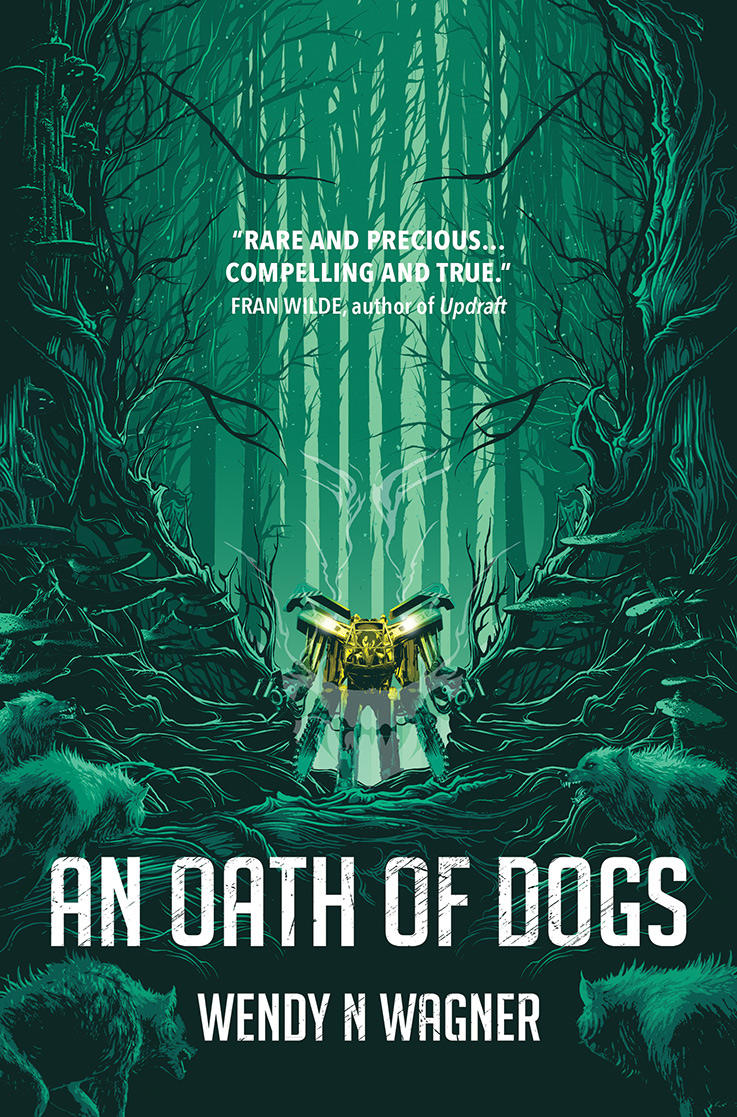
About An Oath of Dogs
Kate Standish has been on the forest-world of Huginn less than a week and she’s already pretty sure her new company murdered her boss. But the little town of mill workers and farmers is more worried about eco-terrorism and a series of attacks by the bizarre, sentient dogs of this planet, than a death most people would like to believe is an accident. That is, until Kate’s investigation uncovers a conspiracy which threatens them all.
Wendy N. Wagner is a full-time science fiction and fantasy nerd. Her first two novels, Skinwalkers and Starspawn, are set in the world of the Pathfinder role-playing game, and she has written over thirty short stories about monsters, heroes, and unsettling stuff. An avid gamer and gardener, she lives in Portland, Oregon, with her very understanding family.





Thanks for this article. I grew up in the Chicago area, so we went to the Indiana Dunes (along Lake Michigan) often. I went back this summer and in the distance viewed the factories along that southern edge of Lake Michigan, but still am impressed by all the tall sand dunes there. It’s such an interesting geology in an area that’s mostly flat and full of cornfields.
Anyway, Dune is one of my favorite novels of all times!