Here's where you tell us what Fantasy and Horror you've been reading this month. Whether good or bad, we want to hear what you think.
And as it is October, we've started our now-traditional Countdown to Hallowe'en. For the last few years Randy M has compiled a list of things to see and do as we approach my favourite time of October!
Started reading The Chronicles of Amber by Zelazny, (I think I saw it mentioned in the "Unique Fantasy" thread) and it's got me fully hooked!
There's something about his direct writing style and the first person POV that's makes it such a fluent read. Some of the writing seems much simpler in style than other writers, but it's very effective.
Only finished the first part Nine Princes in Amber but have put it on hold so I can string it out a bit.
I'm reading The Widow's House by Daniel Abraham. I have no idea yeat who the widow in the title is (possibly Clara Kalliam?) but I love the possiblities introduced by the addition of the flying lizard. I'm also liking the characters and the prose a little better than last month's Tower Lord, which was a step down for me after Blood Song.
Also read a wonderful fairytale by Patricia McKillip : The Bell at Sealey Head, one of her funnier and more romantically inclined stories.
edit: I forgot to add a fantasy themed comic book series : Thorgal written by Jean Van Hamme and illustrated by Roszinsky (spelling?) . I enjoyed it very much with its mix of historical viking adventure, mythology involving Norse Gods and a bit of science-fiction. Great characters and artwork.
I've started two, but haven't settled on which one to settle in with yet:
The Falcon Throne by Karen Miller The Age of Iron by Angus Watson
The Miller book has a very different feel than her previous works, thanks mostly to the liberal use of the 'F' word in the first 30-40 pages. But I seem to be enjoying it so far despite that. And I'm just 30 pages in the Watson book, but I like the sense of humor in it so far. I seem to dig his writing style, and the main character as well.
Getting near the end of Fool's Fate and my Tawny Man re-read. Excited to read the new book afterwards. This re-read has reminded me that Robin Hobb is undoubtedly one of my favourite fantasy authors ever.
Unfortunately, I had to return a half-read book (McKillip's Bards of Bone Plain) to the library yesterday. Maybe I'll be able to check it back out yet this month... In the meantime I checked out Crowley's Solitudes, which has been on my to-read list since reading Little, Big five or six years ago. I always tend to overestimate how much time I'll have for library books...
In non-library books, I'm reading VanderMeer's third Southern Reach novel, Acceptance. And The Stone Boatmen by Sarah Tolmie. Plus a bunch of other partially read books that I might choose to pick up at any given time...
Be interested to read what you think, bossfan, when you're done. I have tried both myself but not liked either. Miller's books I've struggled with in the past and this seemed no better; and the Watson seemed like a very generic debut novel: nothing really new (seems to be trying very hard to be Joe Abercrombie), and names like Dug Sealskinner just killed it for me.
Be interested to read what you think, bossfan, when you're done. I have tried both myself but not liked either. Miller's books I've struggled with in the past and this seemed no better; and the Watson seemed like a very generic debut novel: nothing really new (seems to be trying very hard to be Joe Abercrombie), and names like Dug Sealskinner just killed it for me.
agreed about both the above - the Miller one had potential but the writing did not really work out for me and I read the ending which did nothing either; the other one (Watson Age of iron) read even worse than Miller
Now reading Unholy War, the 3rd Moontide novel by David Hair; for some reason this series has grown into a huge favorite and last year's Scarlet Tides was my top fantasy/sff novel and #3 overall, so huge expectations for this one too - actually read just the prologue and started rereading Scarlet tides for the 3rd or 4th time just to get into the mood - and I still love it - so only tonight or tomorrow I will get into Unholy War proper; right now Broken Eye is my top fantasy/sff/overall novel of the year with Seal of the Worm and dark Defiles next in fantasy, and looking at what remains for the rest of the year, Unholy War is the only novel I see with a chance to top my fantasy/sff list, but we will see if the author can repeat the mixture of twists and non-stop action of volume 2
Be interested to read what you think, bossfan, when you're done. I have tried both myself but not liked either. Miller's books I've struggled with in the past and this seemed no better; and the Watson seemed like a very generic debut novel: nothing really new (seems to be trying very hard to be Joe Abercrombie), and names like Dug Sealskinner just killed it for me.
Well, I might be done with Watson's book (Age of Iron). While I liked the sense of humor and even the writing style initially, it quickly went the other way for me. I have a lower threshold for the darker, gruesome stuff...and seeing kids disemboweled, one of the main characters leave a kid behind, one character using a girl's bladder to hold hair gel...quickly grew tiresome. I just don't have a high tolerance for that kinda stuff during my "fun" reading time.
I might just return to The Gathering Storm by Jordan/Sanderson (after skipping Knife of Dreams and Crossroads of Twilight due to boredom. I decided to read the book summaries on one of the WoT sites to catch up).
This month, I'm continuing my Wheel of Time reread with The Path of Daggers. Even though not much is really happening, Jordan has a way to keep me completely interested. I love this series.
After that I'll be hopping off-genre and reading something non-fiction/historical I think.
Still (or should that be STILL!) on my 'determined-to-finish-before-I-die' list, but nothing happening at the moment.
And thanks for the heads-up, bossfan and suciul: don't think I've missed too much there. And yes, you've hit the nail on the head for me, the violence and the humour makes me think Abercrombie-like, without the intelligence or style. Might explain why those didn't come from the publishers!
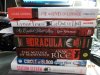
Some of you may have noticed it's October, which is a month I love, not just because it's Halloween! Here's what I've received this week for me to read (the image is bigger if you click on it):
I'm currently halfway through Mark Morris' Wolves of London, which I'm really enjoying. Kim Newman's an old favourite... but then there's that Phil Rickman ghost story... hmm.
It's been awhile since I posted here, a combination of some technical difficulties and personal matters. At the same time, there were some real disappointments that I am reluctant to have to elaborate on. But these posts don't write themselves, so I guess I'd best just get to it, and it's not like anyone will actually read what I say here, right?
Some real disappointments here, among them The Shadow Throne (The Shadow Campaigns #2) by Django Wexler. I bought and read the first in the series when it came out last year, thought it very enjoyable, was early on the bandwagon and in a lackluster year made it my #1 published book in 2013. I've really respected all the comments that I've read by Mr. Wexler, from his wonderful interview at this site to his comments on the likes of the Civilization games. So, it was one of my most anticipated books of 2014, with the caveat that I knew that the series was going in a different direction and it was impossible to foresee how that would go over. After all of that, the bottom line is that while I didn't hate it, in a way I sort of did. For several reasons.
1. The last book presented a Big Bad Guy with a major rep. The reality was a villain who was bad, at least to the extent that we are shown, because he was short and bespectacled. And...that's it. *headdesk* For those who don't immediately see my concern then change that to, say, the villain being a villain because they were black and a woman. Can a black woman be a villain? Of course. Someone short and who wears glasses? The same. But, speaking as someone who would never be considered short, and who has also never worn glasses, I loathe seeing traits being considered sufficient cause to explain the content of a character's, um, character. Make the villain tall, broad shouldered, devastatingly handsome with excellent posture, an amiable nature and a full head of hair and then try to pass off to the reader that of course he's a villain because people "like that" are more inclined to be so and for no other cause. Except it doesn't work because there is a legacy of cultural assumptions about people with those characteristics, just as there are with women and people who are not white and people who are short, and wear glasses, and men who are balding and women with facial hair and those who are missing limbs and so many more. If a writer wants to make their villain someone with historically "less desirable" traits then of course they're free to do so, but please please please make them a character, make an extra effort to go above and beyond and not just fall back on blatant historical discrimination based on stereotypes.
And then to make it so much worse...
The character's lacking in competence inversely proportional to how he's advertised. So the reader thinks that the guy's short and wears glasses, but hey, at least he's tremendously intelligent and able to read people and predict results prior to the actions that cause them. Except of course he's not, and the author proceeds to tear him down, and what we're left with is more of a caricature who's only defining features are the stereotypes, the incompetence and that he was THE BAD GUY" dun dun dun dun, but he's really more a lackey who got lucky, which might beg the question of why our heroes, if they were competent, would even a have a little bit of trouble with him, but I'm too distracted to even be bothered by that one. I don't know whether or not some will give the author extra credit since one of the two main characters in the book is a woman and a lesbian, but to me that positive depiction just makes it all the more inexplicable that there would be so much discrimination elsewhere in the same novel.
So that's enough to really disappoint me in a serious way (ymmv), but it's far from all that does so.
2. The author has a hugely ambitious premise that he can only fail to meet. I love what he wants to do in terms of the storyline, but there's not nearly enough pages and characters to really explore that in a serious way afaic. He'd need thousands of pages and a lot more groups and arguments and more forces at play. To at least some extent he tries to explain that away, and he does an okay job of simplifying it all for what some might call a "Disney" version of this plot, but for me the heights of the possibility that he foreshadowed are always in sight and I can't help but feel that the "pleasant" reality is a sad shadow of that which could have been. For my tastes at least, then either constrain those ambitions and dial back the plot please, or do what needs to be done to really dig deep and make this into a 3,000 or 5,0000 or even 10,000 page work.
To clarify:
I'm speaking about the various groups at play before, during and after the "revolution". There not only should have been more, but we were told that there were more. Also, the absence of law enforcement and what it would take to keep them all out of play should have been better explained (i.e. written), especially given how often we are later told that our "Big Bad" is incompetent. Mutually exclusive much?
3. Speaking of expectations that the author fails to meet, we already have a pattern here and it's not a good one. Book 1 contained a character that was, at least afaic, really interesting. She had hidden depths, was very compelling and not what she seemed, and presented a real potential problem both for some other characters and the writer. But then the writer wrote her out in a quick and convenient way that I felt paid off little of that. That can be realistic, but I felt it unsatisfying and was one of my few disappointments in Book 1. But hey, maybe she'd return in Book 2? But she didn't, which can also be realistic, except that then the author repeated the exact same pattern here afaic. Introduced a really different sort of character with all sorts of messy complications that could make for some truly interesting reading, and then...it would be a spoiler, but to suffice it to say that I was tremendously unsatisfied with how that worked out. So, fool me once shame on you, fool me twice...And I'm feeling a bit of a fool for having liked this series as much as I did.
4. Also, I think that I have gleaned a massive spoiler from the text, and if I am correct, then some may really appreciate it, but the implications for me would be far too coincidental for comfort. That theory is (and you can't unsee this if you look)
That Winter is Marcus' "dead" sister who didn't die in the fire but grew up in an orphanage instead. Based on the facts, his research, the timeline and their history then it fits perfectly as near as I can tell, and of course she doesn't think to ponder it and he would never do so because it was his sister who died and he will be the only one left now who thinks her to be a man. So they will likely only figure it out at the end in a truly tragic way, probably as he lays dying in the final book after sacrificing himself for her sake heroically. Maybe not the very last part, but I'd bet on the rest unless/until the off-chance that Mr. Wexler sees this theory and maybe changes it, but I'd bet significantly that it's currently the plan. Maybe some will appreciate that plot, but it's just not for me.
*Other* than that then I liked the book. Heh, yeah.
At least all of the above takes the edge off before I try to tackle my other new "favorite", which is Robert Jackson Bennet's City of Stairs. As opposed to the last one, I had zero expectations going in other than that Amazon had a decent pre-order discount for the PB and I needed to make $35 for free shipping on some other items. The excerpt looked promising, but is a great example of how even research can be misleading and sometimes just isn't enough.
This book isn't all bad afaic, the main character was okay, as was the use of language and some of the plot at it's most basic. But I think that was about it for me. I found the discussion of culture calculated and superficial, and very much lacking in depth. At first I noticed that practically all of the "Continentals" (which seemed to me to be intended as thinly veiled "white" people) were portrayed as one dimensional caricatures. But quickly my view changed to the realization that no, most everyone here, regardless of race gender or sexuality were shallow and superficial, with as little depth and complexity as the least impressive of any other book I can think of, and less than many animated cartoons that I recall from my youth. I'm not sure if this sort of "characterization" (pun intended with "sort of") is something that some find acceptable, but for me it was as if the author cared about that sort of thing not at all, or is very unskilled in that area, or even worse, it may be that it was a calculated move. There are two possible reasons that I can think of for this last.
Some people enjoy watching really stupid people acting stupidly in reality shows, think Jersey Shore, the Kardashians, Paris Hilton, etc. and some of them say that they do it because they compare themselves to those, er, people, and then feel better about themselves by that comparison. By making so many characters so completely flat, little more than mouthpieces for stupidity and, sometimes, arrogance, then the author props up his own "genius" character and makes her shine by comparison (the Gods know that she missed some incredibly obvious plot developments in the meantime and if I were the author then I would want to distract from that too). It's also a way to include incredibly (imho) heavy-handed messages about how ignorant and contemptible are those people who discriminate against other cultures and sexual orientations (the latter a subject that got welded onto the plot in a way that felt as inorganic as possible to me[and was done here in a way that I felt completely hypocritical but that's another discussion]). By the time the action reached it's "climax" and the villain, who was of course utterly an incompetent idiot, started monologuing then I was truly drawn out of the story (to the extent that I had been in it), by wondering why he didn't have a mustache to twirl, and some train tracks handy to tie the plucky heroine to. Does the author really expect the audience to believe that he, and so many other "characters" are that deeply, terribly and tragically stupid? If an author wants to incorporate issues of race, gender and sexuality into their story then great, I've read more than a few books that deal with those issues this year, and at least two, that depict realistic women, non-straight and non-"white" people in starring and/or significant roles, will be making my Top 5 for the year. Before anyone assumes, I have no issues in any way at all with these characters, it's only when the topics are handled in such a shallow, ham-fisted way, where the message is ALL that matters. I remember back to the Breast Cancer lobby of the 90's wherein they wanted all medical research monies to go to them and only them. So they said that any money that went anywhere else, even if it be to diseases that killed larger numbers of women or even something that affected only women such as ovarian-cancer research, was discrimination against women. Yeah.
I'm sorry for the rant, but I feel that this much idiocy does a huge disservice to all those other authors out there who take the time and make the effort to characterize well, and not utterly insult the audience's intelligence (afaic at least). Speaking of which, I only hinted at the glaringly obvious questions and plot developments that the genius character, the only real character at all here, completely misses. Obvious answers are obvious, especially so when we are told by the end that she already knew some of them.
And I must take a minute to mention Sigrud, the perfect unkillable machine, who reminds me of a comic book where Wolverine was killed, but a single splash of his blood landed on a powerful enough energy so that he could use that single drop to regenerate himself completely and immediately and go right on back to being the best there is at absolutely everything in the universe, and in other universes too. Sigrud was kind of like that, just with less personality.
Some of the details in this book are new, and some of then I've seen elsewhere, but I (almost) wept for humanity to think that anyone might find this insightful in any way, shape or form.
I've read several more books, but I think that I'm depressed enough for now and will have to write those up later.
Wow! I really feel honoured just in that you would recall that my birthday comes later in October, but to refer to it as your "favourite time"? That means so so much, and after all that's been going on with me and my not having really been around, and with some of the extremely depressing reading that I've had? I can't tell you how genuinely touched I am, and appreciative. My sincerest thanks. If ever you need my help friend, you have but to ask, thanks again.
Yes, I'm trying to pull a bit of a prank, but did I make you believe it even for a second? *grin*
Still (or should that be STILL!) on my 'determined-to-finish-before-I-die' list, but nothing happening at the moment.
And thanks for the heads-up, bossfan and suciul: don't think I've missed too much there. And yes, you've hit the nail on the head for me, the violence and the humour makes me think Abercrombie-like, without the intelligence or style. Might explain why those didn't come from the publishers!
Some of you may have noticed it's October, which is a month I love, not just because it's Halloween! Here's what I've received this week for me to read (the image is bigger if you click on it):
I'm currently halfway through Mark Morris' Wolves of London, which I'm really enjoying. Kim Newman's an old favourite... but then there's that Phil Rickman ghost story... hmm.
I highly recommend Station Eleven; the best apocalyptic/post-apocalyptic novel in a long time in a market flooded with such and a top 10 of mine for the year; back on topic, finished my 4th read of scarlet Tides and started Unholy War and read some 150 pages or so; very good stuff so far, immediate continuation of Scarlet Tides, though mostly positioning for now; same structure jumping between various theaters of action and the corresponding main characters
Last month I said that after finishing Jonathon Strange and Dr Norrel I was going to read Assail by Ian Esselmount but after reading the prologue I put it down, which is a first for a Malazan book. I'm not really sure why. I've enjoyed Esselmount's books but I've always thought they lacked something compared to Erikson, and, maybe after loving JS and DN so much, I felt that Assail would be an odd mixture of disappointment, frustration and enjoyment. I don't know, I just wasn't in the mood.
I read Marie Brennan's A Natural History of Dragons: A Memoir by Lady Trent instead. It's a first person POV in a secondary world based on Victorian society but with dragons. The basic plot is about Lady Isabella Trent's love of dragons and her desire to find out more about these creatures but Marie Brennan weaves in class, gender and race issues which confront Isabella and which she has to confront in herself as well. Really enjoyed it. Now reading the follow up, The Tropic of Servants.
Serpents. It's the Tropic of Serpents. No excuses, I had the book in front of me when I typed this. Facepalm.
LOL. Good to see you back, Amethyst: and Happy Birthday for later in the month.
Sorry you've had some books there that didn't work for you, especially City of Stairs, which Rob really really rates. I bought a copy at Worldcon on the strength of Rob's feeling, though I'm not sure when I'll get chance to read it. Be interesting to compare both your comments and Robs.
Thanks, also suciul: you're not the only person to tell me how good Station Eleven is: which is why I bought it, and a signed copy at that.
After a good solid weekend's read (haven't had chance to do that in a while!), I can say that I really enjoyed Wolves of London, with one big issue; and that Lynne Truss' Cat Out of Hell turned into something much more interesting than I was expecting. Always pleased when a book turns out better than you expect, all too often it's the other way (eg: Amethyst's post above.)
One of the best books of the year that you're not reading is Magic Breaks (Kate Daniels #7) by Ilona Andrews. When people talk about non-stop thrill rides that pull out all the stops then this is EXACTLY what they mean, unless they're talking about something that doesn't do it as well. Because there's very little that could do it better.
This series began with promise, but needed work. Each book, except arguably the last which in some ways was an odd transitional one, has been an improvement on the last and here the authors perfected the formula, pulled it all together and excellently balanced relentless action, numerous characters (while never losing sight of the main one) and eminently sensible, but often surprising, plot developments. Mysteries, politics, history, religion, psychology and so much else are at play, but always in the service of the story rather than ever dominating it.
The authors even made the obligatory sex scene, as this was originally meant to be UF rather than ever Paranormal Romance, a few pages that encompass their own chapter, which is a great solution I think, as the people who want to skip that material can very conveniently do so.
I wouldn't call this a perfect book. There were a few character developments that were somewhat predictable for those who have followed the series, and of course everyone has their own tastes and all, but for what this book is, and what it's trying to be, then it absolutely excels and that's a very good thing.
Speaking of thrill rides, Hidden (Alex Verus #5) by Benedict Jacka follows the previous installment, which very much was one. This one wasn't though. Which is okay of course, but I found it an odd mix of the last, which was quite a break from came before (which had somewhat underwhelmed me) and the initial three, which were of a different style. This one kept the plot going, but still had much less urgency. And not just because it wasn't designed in the same way as the last, but in that I felt a distance or separation from the characters and events. Some of that was that this seemed more designed to be introspective on part of the main character, who's the sole pov, but I don't think that that was the entirety of what I was feeling. By no means a bad book, and in many ways solid and sometimes good, but imo it never really excelled and certainly wasn't as good as the last.
I also read Tower Lord (Raven's Shadow #2) by Anthony Ryan. I liked the first one well enough, giving it 3.5 out of 5 stars, while this one a bit less, probably 2.75. But I found the book interesting (for good or bad) in that it was a change of pace from the first, with a different focus.
This book had an intro that once again forced me to guess at what the end would hold, and in some key plot details I was quite right. Which is something that I hate personally, but would (I hope) better appeals to some others. As has been widely discussed, the pov's are different. There's a new character who seems super-humanly brilliant in all that she tries. We are told that she spent years studying with the knife, so there's some explanation there, but she quickly is brilliant in all else that she attempts too. There's the princess of the Realm, who I found the most interesting, despite her plot line seeming very predictable. There's one of the Brothers of the main character, who lacks agency for half the novel and also has a very predictable plot. Finally, we have the main character, who is in much more of a passive role that allows others who are featured in his pov to shine. To some extent I wondered if the author didn't even want to write the previously main character.
Some readers don't like to read about female characters to begin with (see poll by Mark Lawrence http://mark---lawrence.blogspot.com/2014/02/whats-in-name.html ) and so they might be put off by the switch from a very "male" centered book to one that is predominantly female, or some might dislike that the characters that appealed to them in Book 1 are absent, or much less present here. I don't know, but more than anything I was struck by how everything seemed to pleasantly flow along, with little in the way that surprised me, but moreover nothing much that really affected me. Ultimately, I felt that I was reading a (very) lengthy plot outline, wherein the characters would be called Mary Sue's by some. But it was nice enough, but not moreso in any way, shape, or form.
The Girl with All the Gifts by Mike Carey, or M.R. Carey, as it says on the jacket. This is a tough one as I've been a very long time fan of Carey's, much like Gaiman back in the late 80's (they share several things in common), and have often championed his UF Felix Castor series. For him and Ilona Andrews alone then I bought a HC anthology when it came out that contained the short story "Iphigenia in Aulis", upon which this book is based. I very much loved that one, set in the horror genre that I usually do my best to ignore. I gushed about it briefly, was mostly ignored, and moved on (though it was nice to see the story win at least one award). But then word came that the story was being reworked and expanded and so I tried to spread the word again and had some very lofty expectations. Those can always get you into trouble of course, and here again they did so.
Ultimately, I strongly liked this one, but didn't love it in the same way that I did the original story. I think that the first ended in a viscerally stronger manner, while this focused on some different strengths, that while I appreciated, weren't as powerful afaic. I can't know how differently I might have felt if I had read them the other way around, but I am terrifically glad that so many people have liked-to-loved this book, and that hopefully at least some will take the time to try out some of the writer's other great works.
I'm still not nearly done in catching up in all that I'm behind, but I think that this is a good place to stop for now.
Thank you very much Hobbit, and thanks again. Glad that my poor attempt at humour went over alright (by which I mean that I made it comprehensible enough so that I didn't get banned. lol).
Sorry you've had some books there that didn't work for you, especially City of Stairs, which Rob really really rates. I bought a copy at Worldcon on the strength of Rob's feeling, though I'm not sure when I'll get chance to read it. Be interesting to compare both your comments and Robs.
Thank you once again. Perils of the reading habit, I guess. It is, as always, interesting to see how my impression differed from Rob's (or anyoner else's of course). Generally speaking, I think that we've had some overlap in our other impressions, though I've always known of some differences too. In this case I read his thoughts after forming my own and clearly this is quite a divide between us, hopefully it'll add something to your experience.
After a good solid weekend's read (haven't had chance to do that in a while!), I can say that I really enjoyed Wolves of London, with one big issue; and that Lynne Truss' Cat Out of Hell turned into something much more interesting than I was expecting. Always pleased when a book turns out better than you expect, all too often it's the other way (eg: Amethyst's post above.)
Sounds interesting, I haven't heard much of anything about either of those. Thanks as ever to you as well, and I look forward to reading what else you have to say.
Just because views are opposite doesn't make them wrong, btw: if anything, it just shows how subjective people's views of the same material can be. That's what makes the discussion fun! The way this normally ends up is that I will end up between the two of you in terms of my view.
But it is mystifying sometimes. What I often don't like, others really like - John Gwynne's Malice, Brent Weeks' Way of Shadows series, for example, both of which I didn't like, whilst others raved about them. We are all allowed our opinions - even when the rest of you are all wrong!
You remind me, also: I really must try the Benedict Jacka books again. The first one was a bit Meh for me, and not a patch on Dresden, at least for me.
Just because views are opposite doesn't make them wrong, btw: if anything, it just shows how subjective people's views of the same material can be. That's what makes the discussion fun! The way this normally ends up is that I will end up between the two of you in terms of my view.
Definitely good advice. I was trying to convey that understanding with what I wrote, but perhaps didn't do quite so good of a job as I thought. But I certainly agree. And in this case I think it won't be a terrible challenge for your thoughts to fall somewhere in the vast vast middle ground that's been left open on this one.
But it is mystifying sometimes. What I often don't like, others really like - John Gwynne's Malice, Brent Weeks' Way of Shadows series, for example, both of which I didn't like, whilst others raved about them. We are all allowed our opinions - even when the rest of you are all wrong!
I can certainly see that, but ultimately it's part of the fun (or at least that's what I tell myself) in trying to figure out just what aspects others are looking at that I'm not and that I'm looking at that they're not, and so on and so forth. For example, I give little to no thought to how realistic a fight scene is, or whether modern language such as "telegraphing" is being used, but I've seen some readers for whom such things are a huge deal. In order to really evaluate a book I think that we haver to try to figure out quite a lot, both where our preferences and biases lie, as well as where others' might that we may otherwise not even give any consideration to. It can be tough.
And I'm not. Perhaps unpredictable and enigmatic though.
You remind me, also: I really must try the Benedict Jacka books again. The first one was a bit Meh for me, and not a patch on Dresden, at least for me.
Well, I would be interested in your thoughts of course, but my recollection is that you liked Book 1 a bit less than I did, but I only sort of enjoyed it, saw some potential and kept in mind the fact that nearly every UF that I've seen needs some time to hit it's stride. And then wasn't terribly impressed by Books 2 & 3 either. Imho #4 was the one worth (some) raving about. So if you're going to give it another go, then please keep that in mind. And that perhaps you might be better served by that very nice Felix Castor series.


 to his comments on the likes of the Civilization games. So, it was one of my most anticipated books of 2014, with the caveat that I knew that the series was going in a different direction and it was impossible to foresee how that would go over. After all of that, the bottom line is that while I didn't hate it, in a way I sort of did. For several reasons.



