Countdown to Hallowe'en 2016

Just an added thought: I transcribed a recorded interview with Gordon Dickson from the late '70s in which he praised Kipling. I think, especially for the generation or so of s.f. writers including Heinlein, Anderson and Dickson, Kipling was a powerful influence. More recently I've read Michael Dirda championing Kim as a great and underappreciated work.

More tangentially, I noticed a while back that Kipling wasn't the only one Heinlein borrowed from. His "The Unpleasant Profession of Jonathan Hoag" roughly parallels G. K. Chesterton's The Man Who Was Thursday. And that does, kinda, bring us back to topic: "The Unpleasant Profession of Jonathan Hoag".


Randy M.
 
Heinlein did not do a lot in the Fantasy and horror areas but I think we should include his Magic Inc. Magic, Inc.(normally found in a volume with another novella Waldo) it was published in 1940 and from time to time i do wish RAH had done a few more stories in that world (how many did he do? to this day his The Man Who Traveled in Elephants short story will bring a tear to my eye and Glory Road is just a plain fun novel)
 
Just an added thought: I transcribed a recorded interview with Gordon Dickson from the late '70s in which he praised Kipling. I think, especially for the generation or so of s.f. writers including Heinlein, Anderson and Dickson, Kipling was a powerful influence. More recently I've read Michael Dirda championing Kim as a great and underappreciated work.

More tangentially, I noticed a while back that Kipling wasn't the only one Heinlein borrowed from. His "The Unpleasant Profession of Jonathan Hoag" roughly parallels G. K. Chesterton's The Man Who Was Thursday. And that does, kinda, bring us back to topic: "The Unpleasant Profession of Jonathan Hoag". Randy M.

is that Transcribed interview with Dickson on line somewhere? it sounds interesting.

I recall a review of Kim written by an academic from the sub continent that referred to Kim as " the finest novel ever written about India in english.... further as Kippling was born in Bombay and was fluent in several of the subcontinents languages he was quite happy to claim him as an Indian author.... I just wish i could fit a name to this reviewer.... I can't even place it in time could be any date from the 1960s to the 1990s
 
Just an added thought: I transcribed a recorded interview with Gordon Dickson from the late '70s in which he praised Kipling. I think, especially for the generation or so of s.f. writers including Heinlein, Anderson and Dickson, Kipling was a powerful influence. More recently I've read Michael Dirda championing Kim as a great and underappreciated work.
Neil Gaiman has also praised Kipling. In his introduction to this edition of collected Kipling Fantasy stories,

0575077913.02.LZZZZZZZ.jpg


Gaiman wrote about a letter he had received after he had said that Kipling was a favourite author of his.

upload_2016-10-4_23-37-38.png
 
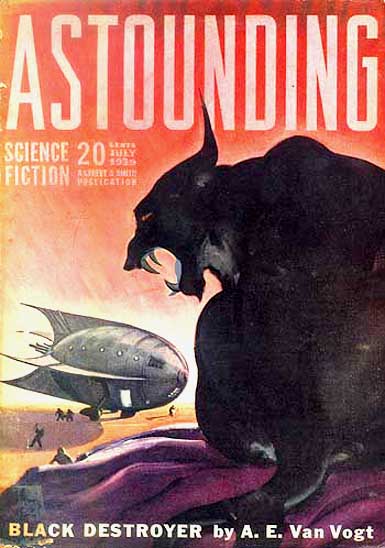
“BLACK DESTROYER” by A. E. VAN VOGT ( Astounding Science-Fiction, 1939; Adventures in Time and Space, ed. Raymond J. Healy and Francis McComas, 1946; for further publication information see, http://www.isfdb.org/cgi-bin/title.cgi?41604;
on-line version: http://www.freesfonline.de/authors/A. E._van Vogt.html)

On and on Coeurl prowled!

It has been a long time since I have thought about Coeurl! I read the story in Voyage of the Space Beagle in a paperback edition that featured Coeurl on the cover (below). I wouldn't have initially thought about a Van Vogt story as having horror elements, but of course it does. Van Vogt was always so odd, with his Weapons Shops Series, Slan, and The Silkie. His works are becoming less known these days, thanks for reminding us of one of them.

voyage_pocket_1981_gerrydaly_large.jpg
 
Last edited:
That is a wonderfully weird cover, PD!
Personally I like the original Astounding cover, which I've used on the website version of Randy's review. This was the edition of Astounding that is often seen as heralding the so-called "Golden Age" of pulp SF. The issue also contained stories by a certain Isaac Asimov and C.L. Moore.

ast_3907.jpg


Jamie Rubin discusses it here: http://www.jamierubin.net/2011/01/23/vacation-in-the-golden-age-episode-1-july-1939/

I wouldn't have initially thought about a Van Vogt story as having horror elements, but of course it does.

As you've said, PD, (and Randy as well) there's a vein of Horror throughout SF that we're clearly tapping into here. It's fun, and more than I realised.
 
Here's an old ghostly poem my Mother used to read to us a kids at Hallowe'en. It's an old Lancashire ballad in the Lancashire dialect.
I.
Old Grindrod was hanged on a gibbet high,
On the spot where the dark deed was done;
’Twas a desolate place, on the edge of a moor, —
A place for the timid to shun.
II.
Chains round his middle, and chains round his neck,
And chains round his ankles were hung:
And there in all weathers, in sunshine and rain,
Old Grindrod, the murderer, swung.
III.
Old Grindrod had long been the banquet of crows,
Who flocked on his carcase to batten;
And the unctuous morsels that fell from their feast
Served the rank weeds beneath him to fatten!
IV.
All that’s now left of him is a skeleton grim,
The stoutest to strike with dismay;
So ghastly the sight, that no urchin, at night,
Who can help it, will pass by that way.
V.
All such as had dared, had sadly been scared,
And soon ’twas the general talk,
That the wretch in his chains, each night took the pains,
To come down from the gibbet ― and walk!
VI.
The story was told to a Traveller bold,
At an inn, near the moor, by the Host;
He appeals to each guest, and its truth they attest,
But the Traveller laughs at the Ghost.
VII.
“Now, to show you,” quoth he, “how afraid I must be,
A rump and a dozen I’ll lay;
That before it strikes One, I will go forth alone,
Old Grindrod a visit to pay.
VIII.
“To the gibbet I’ll go, and this I will do,
As sure as I stand in my shoes;
Some address I’ll devise, and if Grinny replies,
My wager, of course, I shall lose.”
IX.
“Accepted the bet; but the night it is wet,”
Quoth the Host. “Never mind!” says the Guest;
“From darkness and rain, the adventure will gain,
To my mind an additional zest.”
X.
Now midnight had toll’d, and the Traveller bold
Set out from the inn, all alone;
’Twas a night black as ink, and our friend ’gan to think,
That uncommonly cold it had grown.
XI.
But of nothing afraid, and by nothing delayed;
Plunging onward through bog and through wood;
Wind and rain in his face, he ne’er slackened his pace,
Till under the gibbet he stood.
XII.
Though dark as could be, yet he thought he could see
The skeleton hanging on high;
The gibbet it creaked; and the rusty chains squeaked;
And a screech-owl flew solemnly by.
XIII.
The heavy rain pattered, the hollow bones clattered,
The Traveller’s teeth chattered — with cold —
not with fright;
The wind it blew lustily, piercingly, gustily;
Certainly not an agreeable night!
XIV.
“Ho! Grindrod, old fellow!” thus loudly did bellow,
The Traveller mellow, — “How are ye, my blade?” —
“I’m cold and I’m dreary; I’m wet and I’m weary;
But soon I’ll be near ye!” the Skeleton said.
XV.
The grisly bones rattled, and with the chains battled,
The gibbet appallingly shook;
On the ground something stirr’d, but no more the man heard, —
To his heels, on the instant, he took.
XVI.
Over moorland he dashed, and through quagmire he plashed;
His pace never daring to slack;
Till the hostel he neared, for greatly he feared
Old Grindrod would leap on his back.
XVII.
His wager he lost, and a trifle it cost;
But that which annoyed him the most,
Was to find out too late, that certain as fate,
The Landlord had acted the Ghost.

W. Harrison Ainsworth (1805-82)
 
Not read that one before, Ochos: thank you for sharing!
 
TO WALK THE NIGHT by William Sloane (1937; Del Rey/Ballantine, 1980; included in The Rim of Morning, NYRB Press, 2015)

Certainly this was one of the “high places” that men of the ancient world had felt to be holy, whether in Palestine or in the American desert. Even when houses had stood on the mesa top, this must have been a still place, aloof and plainly not a part of the business of human living at all. So they had hewed a stone and put it where I could lie for century upon century, here on this height, under the sky and swept clean forever by the great winds. An altar, yes, and in a place where they had felt that the immensity of the universe touched the immediacies of the earth on which they live. This stone was their ebenezer; it marked their recognition of the something more than they could put a name to, a memorial to the tremendous force or will that had created the earth and the stars.
-- from To Walk the Night


Different people, different reactions: On first meeting Selena, Jerry Lister is drawn to her beauty and held by her intelligence and intensity. His friend, Berkeley Jones, Bark to his friends, has a different reaction: Fear.

Alumni visiting campus for their team’s football game against their biggest rivals, after the win Jerry and Bark walk to the observatory, certain the confirmed bachelor, math professor, Walter LeNormand would be there. Jerry, a math whiz himself, had studied under LeNormand, eventually becoming his student assistant and friend about the time LeNormand published a radical theorem that challenged common belief, even Einstein’s theory of relativity. No one answers their calls when they enter but on reaching the upper floor of the building they see LeNormand sitting in a chair, head back, engulfed in flames. And neither is certain LeNormand is already dead.

Their efforts to save LeNormand fail. The investigation into cause of death indicates homicide, but no evidence suggests how or, really, why.

And then they meet LeNormand’s bride of three months. Physically perfect as a statue, Selena’s expression and behavior also seem statue-like and she appears unaffected by her husband’s death.
Not long after meeting her, Jerry brings her to New York with the ultimate goal of marrying her. Studying her, Bark finds she watches how others behave and adopts their gestures and inflections, she seems able to tell what someone is thinking, and she is acutely aware he doesn’t like her. Something about Selena doesn’t seem natural. No one on campus had met her before the marriage, no one knows her history and she doesn’t talk about her past.

The more Bark sees of Selena, the more difficult it is to not recall the fate of her first husband.


I first read To Walk the Night when Ballantine (Del Rey imprint) reissued it in 1980. After years of reading Lovecraft and some of his early imitators, I found it rather slow; okay, but nothing more. Distanced from my younger self and his influences, I like it more, drawn in by Sloane’s use of conversational English to propel his narrative and, when he determined to do so, his creation of what Lovecraft called “cosmic awe,” as demonstrated by the quote above. Further, the romance between Jerry and Selena moves at a reasonable pace and isn’t hobbled by the romantic conventions of 1940’s fiction, if anything working against those conventions to a degree, and affords a chance for the reader to watch Selena develop. Further I find Sloane’s humor entertaining and his observations interesting: Maybe I’m underestimating s.f. writers of the ‘40s, but with the possible exception of C. L. Moore, I can’t think of one I’ve read who would have framed Bark’s observations of Selena when he and Jerry first meet her in quite the same way. His assessment of her clothing and her presentation of herself seems on point for the time period, and his disquiet at the conclusions he tries not to draw comes across convincingly and, whether or not Sloane meant it as such, come across as a critique of then current conventions. Lastly, the flow of Bark’s earnest recreation for Dr. Lister of all he’s experienced pulled me along, his anxiety for the safety of Jerry and now for Dr. Lister palpable and real.


According to IMDB, To Walk the Night was adapted with the same title for the TV show Robert Montgomery Presents in 1951. I haven’t seen it but Geraldine Fitzgerald was one of the stars which makes seeing it appealing.


Also by William Sloane:
The Edge of Running Water (Del Rey/Ballantine, 1980; included in The Rim of Morning, NYRB Press, 2015)

Other horror novels from the 1930s and 1940s:
Night Has a Thousand Eyes by Cornell Woolrich
Conjure Wife by Fritz Leiber
Darker Than You Think by Jack Williamson
 
It's a good, solid sf/horror hybrid, Mark, maybe a bit slow for contemporary readers who crave fast action, but well-paced by the standards of the time. The cover for the old Ballantine edition was pretty good, too, if you can find it.

Ochos: Fun poem and Ainsworth's name is familiar. A little digging around on-line and I'm pretty sure I have a story or two by him in some collection(s).

You and Windshadow have reminded me that there's a good deal of eerie poetry, maybe something we could all consider about as the month goes on.


Randy M.
 
The cover for the old Ballantine edition was pretty good, too, if you can find it.
This one, Randy?
walk the night.jpg

I've added it to the website version of the review. I quite like the understated nature of the original hardback, though:

md19117043927.jpg


And here's the Kindle cover:

51z8xIHdwyL.jpg
 
Nice, Mark. Yeah, I like that hard-cover, too, and the Kindle isn't bad though I'm not sure the green (turquoise?) hair really conveys anything of the novel.

Thinking more about eerie poetry, I looked up an obvious one. Not quite story-telling like the Kipling and Ainsworth, but dripping mood:

The Haunted Palace
By Edgar Allan Poe

In the greenest of our valleys
By good angels tenanted,
Once a fair and stately palace—
Radiant palace—reared its head.
In the monarch Thought’s dominion,
It stood there!
Never seraph spread a pinion
Over fabric half so fair!

Banners yellow, glorious, golden,
On its roof did float and flow
(This—all this—was in the olden
Time long ago)
And every gentle air that dallied,
In that sweet day,
Along the ramparts plumed and pallid,
A wingèd odor went away.

Wanderers in that happy valley,
Through two luminous windows, saw
Spirits moving musically
To a lute’s well-tunèd law,
Round about a throne where, sitting,
Porphyrogene!
In state his glory well befitting,
The ruler of the realm was seen.

And all with pearl and ruby glowing
Was the fair palace door,
Through which came flowing, flowing, flowing
And sparkling evermore,
A troop of Echoes, whose sweet duty
Was but to sing,
In voices of surpassing beauty,
The wit and wisdom of their king.

But evil things, in robes of sorrow,
Assailed the monarch’s high estate;
(Ah, let us mourn!—for never morrow
Shall dawn upon him, desolate!)
And round about his home the glory
That blushed and bloomed
Is but a dim-remembered story
Of the old time entombed.

And travellers, now, within that valley,
Through the red-litten windows see
Vast forms that move fantastically
To a discordant melody;
While, like a ghastly rapid river,
Through the pale door
A hideous throng rush out forever,
And laugh—but smile no more.
 
It is National Poetry Day here in the UK: so even though Poe is an American, I'll take that, quite happily. :) Must admit, though, I'm not a huge fan of Poe's poetry. Nor Robert E. Howard's, for that matter!
 
Ah! It's Brits you want! Well, a bit late for Poetry Day, here's an oldie but goodie I may have posted before but which deserves another reading ...

(By the way, found the Poe and this one at https://www.poetryfoundation.org/)


The Listeners
By Walter de La Mare

‘Is there anybody there?’ said the Traveller,
Knocking on the moonlit door;​
And his horse in the silence champed the grasses
Of the forest’s ferny floor:​
And a bird flew up out of the turret,
Above the Traveller’s head:​
And he smote upon the door again a second time;
‘Is there anybody there?’ he said.​
But no one descended to the Traveller;
No head from the leaf-fringed sill​
Leaned over and looked into his grey eyes,
Where he stood perplexed and still.​
But only a host of phantom listeners
That dwelt in the lone house then​
Stood listening in the quiet of the moonlight
To that voice from the world of men:​
Stood thronging the faint moonbeams on the dark stair,
That goes down to the empty hall,​
Hearkening in an air stirred and shaken
By the lonely Traveller’s call.​
And he felt in his heart their strangeness,
Their stillness answering his cry,​
While his horse moved, cropping the dark turf,
’Neath the starred and leafy sky;​
For he suddenly smote on the door, even
Louder, and lifted his head:—​
‘Tell them I came, and no one answered,
That I kept my word,’ he said.​
Never the least stir made the listeners,
Though every word he spake​
Fell echoing through the shadowiness of the still house
From the one man left awake:​
Ay, they heard his foot upon the stirrup,
And the sound of iron on stone,​
And how the silence surged softly backward,
When the plunging hoofs were gone.​
 
The Edge of Running Water by William Sloane (1939; Del Rey/Ballantine, 1980; included in The Rim of Morning, 2015, NYRB Press; chosen by Robert Weinberg for inclusion in Horror: Another 100 Best Books)

The man for whom this story is told may or may not be alive. If he is, I do not know his name, where he lives, or anything at all about him, except that there is something which it is vital for me to tell him. It is a strange, clumsy method of communication, this expedient of writing an entire book without even the certainty that it will come into his hands, and yet I can see no other way of warning him. There is, I think, a good chance that it will succeed. Someday, perhaps in a bookstore, perhaps in a library, he may come on a copy of this narrative. Or someone he knows will innocently mention it in his hearing, and he will be impelled to seek the book out and read it. People somehow manage to learn of the things that are supremely important to their lives or work. What troubles me is not so much the possibility that he will never come on this message as that it may already be too late.
-- first paragraph​


When middle-aged electrophysicist Julian Blair loses his young wife, Helen, he cannot bear that he will never see her again and delves into dangerous research. Years later, after leaving his position and secluding himself, he summons his friend and former protégé, Richard Sayles, to Setauket Point in Maine to tap into Sayles background in investigating the electric currents of the brain. Unable to find previously recorded empirical evidence for the existence of life after death, Blair has done his own research and with information from Sayles his work reaches its final stages.

Drawn into his mentor’s apparent insanity, Sayles and Blair’s young sister-in-law, Anne, try to deflect Blair from his course. But Blair is adamant and Sayles and Anne are left to contend with the locals, already put off by the outsider with strange ways, now outraged by the suspicious death of one of their own, a woman who had been Blair’s housekeeper.

Parts of The Edge of Running Water follow the trajectory of typical commercial fiction of the 1930s and 1940s, including a rather sweet romance between Richard and Anne. In some fiction from that time period the love story intrudes and annoys contemporary readers, but Sloane wasn’t one to get sappy, keeping it at a low-boil and sometimes finding charming ways of portraying it:

I watched the flash and lift of her arm as it came out of the water, and the arc of ripples that pushed along in front of her bathing cap. The sun caught the wet rubber and made a point of fire on it. I found myself matching my strokes to hers, so that we were swimming beside each other in the same rhythm, sliding through the water like parts of a single entity.

Anyone else reminded of a scene in The Creature from the Black Lagoon?

Mainly the novel revolves around its mysteries: What caused the death of the local woman? Who is Mrs. Walters and what hold does she have on Blair? What is Blair doing in his lab? What does he expect from the machine he is building? Only in the final pages do we see the potential of Blair’s machine, and those scenes, written in Sloane’s plain, direct prose are quite effective.


With only two published novels, it’s probably too much to say Sloane had a pattern, but the novels have some parallels: For instance, each begins with the narrator travelling, by train in The Edge of Running Water, Richard Sayles having been summoned by his friend, and by chauffeured car in To Walk the Night as Bark returns home to tell Dr. Lister the details of Jerry’s death. We enter the world of each novel after some significant events have already happened, Sloane drawing us in as his protagonists try to piece together a picture of what they have faced and are facing.

More importantly both novels take the form of mysteries the reader is likely to solve ahead of the protagonist. Besides Sloane’s narrative hints, for contemporary readers this stems from growing up in an s.f. world, having seen or read works using similar narrative strategies. Sloane was writing for an audience on the brink of that world, Edge published nine years after the discovery of Pluto, a year before the first use of penicillin on a human, and six years before the first use of an atomic bomb. While Sloane may have been aware of pulp magazines, I haven’t come across anything suggesting an affiliation at that time and his books were published for a general audience, not just the s.f. readers of the day. Set in the time of publication, the characters in his stories make the kind of assumptions and intuitive leaps that would have been common then.

I’m at a loss to guess how contemporary s.f. and/or horror readers will react to Sloane’s novels, but I found both enjoyable, older works that weren’t written for sixteen-year-olds of the time, and dealing intelligently with their premises while building to their final scenes and executing them effectively.


The Edge of Running Water was adapted into the movie, The Devil Commands released in 1941, directed by Edward Dmytryk and starring Boris Karloff. I haven’t seen it but I'd like to hear if anyone else has and what they thought of it.

Another novel of similar interest:
The Case of Charles Dexter Ward by H. P. Lovecraft


While several publishers have been reissuing older horror novels and collections – NYRB Press with the Sloane novels and The Other by Thomas Tryon (a fine novel), Penguin with works by Shirley Jackson, Ray Russell, Charles Beaumont, Clark Ashton Smith and Thomas Ligotti – Valancourt Books have been reissuing a good deal of obscure horror (and some s.f., notably Christopher Priestly). I haven’t read any of the following, all originally published around the same time as Sloane’s novels, but their reputations make them of interest:
Benighted by J. B. Priestley (1927; basis for The Old Dark House (1932), directed by James Whale and starring Melvyn Douglas, Charles Laughton and Boris Karloff)
Hell! Said the Duchess: A Bedtime Story by Michael Arlen (1934; included in Karl Edward Wagner’s list of 13 best supernatural horror novels)
The Cadaver of Gideon Wyck by Alexander Laing (1934) [I’ve just started this, and it looks to be s.f./horror; chosen by Robert Bloch for Horror: 100 Best Books; included in Karl Edward Wagner’s list of 13 best science fiction/horror novels.]
The Birds by Frank Baker (1936; not the basis for the Hitchcock movie)
Fingers of Fear by J. U. Nicolson (1937; included in Karl Edward Wagner’s list of 13 best supernatural horror novels)​
 
For interest:
Original hardback Cover:
edge of running.jpg

Ballantine Cover:

edge of running 3.jpg

New Kindle Cover:

edge of running 2.jpg
 
Hi, Mark. I read the second one but I like the others more.

Speaking of covers, I just started this,

130342.jpg


Lynd Ward specialized in wood cuts, even producing 6 wordless novels with them, essentially forerunners of the graphic novel. Check out some of his work on the Internet, for instance, Pagan Press Books, Lynd Ward, Frankenstein.

Valancourt recently re-published this title as a paperback with the same cover. 30 pages in and the novel's interesting, looks like a mix of s.f./horror and I'm expecting at least one disgruntled scientist if not a mad one. I'm a little sorry I hadn't already read it for this month.


Randy M.
 
Last edited:
The Midwich Cuckoos by John Wyndham (1957; Ballantine/Del Rey, 1980)

One of the luckiest accidents of my wife’s life is that she happened to marry a man who was born on the 26th of September. But for that, we should both of us undoubtedly have been at home in Midwich on the night of the 26th-27th, with consequences which, I have never ceased to be thankful, she was spared.
-- first paragraph
Sometime after 10:17pm on the 26th of September everyone in Midwich falls asleep. At about 5:30pm on the 28th, the residents begin to wake up. Between these times, people entering within a defined area around the town fall asleep instantly, which causes several traffic accidents and eleven deaths, at least by exposure. Janet and Richard Gayford are among those who enter the area the next day and are immediately stricken. A passing military officer sees them drop and has them pulled out with a pole. Richard is our narrator.

A retired military Major living outside of Midwich had discovered and reported this as a probable gas attack and so the military came to Midwich, notably Richard’s old army friend, Major Bernard Wescott, to determine the extent of what is happening and its probable cause. Included in the military investigation are fly-overs determining how high the affected area reaches, pictures from which indicate something of unusual shape, something that had registered on radar, on the ground near the Abbey ruins; something that isn’t there by the time everyone awakens.

Even after Midwich returns to normal, or as close as possible after such an incident, Military Intelligence continues to take interest in the town, and more so when it becomes clear that all women who were within the area affected and of child-bearing age are bearing children.

John Wyndham is best known for this novel, The Day of the Triffids and The Chrysalids. In the 1960s these, among other works, came to be called, “cozy catastrophes,” a derogatory term for those British novels from the late 1940s through the 1950s whose premise was a catastrophic event that demonstrated how the British would bear up under them. Arguably products of reaction to World War II – perhaps similarly to the Japanese monster movies in which monsters destroy Tokyo – the characters in Wyndham’s Cuckoos and Triffids display the stiff-upper-lip that allowed Brits to survive the war but which was part of what the later New Wave writers reacted against.

But calling them “cozy” glosses over the step-by-step logic detailing the probable actions and behaviors, repercussions and consequences of Wyndham’s premise: In my edition, in less than 190 pages Wyndham convincingly portrays the British government stifling news of the event (reasonable given the forms of communication at the time and the location of the town), Midwich residents accepting the event and moving on, then coping with the mass pregnancies as leaders of the community manage the situation and help unmarried women who, true to the time, felt shame, some even acting self-destructively in reaction to that shame. The eventual births of the babies, their rearing and accelerated growth are rendered economically, and their difference from us fully displayed. Moreover, Wyndham manages this with a good deal of wit, letting the humor of the characters play with the oddness of the event, then gradually darkening the tone as the full import of these children, who communicate with each other without speech and who can force adults to do their bidding, become more threatening.

Aside from the Gayfords, Wyndham’s characters more or less fit types, from the British eccentric to the high-hat old lady to military stiffs, but the characters are well-rendered all the same, from Major Wescott (comic relief) to Dr. Willers (sensible doctor, and his progression through the book rings true) and Reverend Hubert (ineffectual, mostly, but struggling to keep his flock together and help them) to Gordon Zellaby and his wife, Anthea. Zellaby, who becomes the main protagonist, is one of the British eccentrics, introduced as erudite but perhaps a bit flighty, his frothy conversation hiding an observant and thoughtful mind; in my reading experience he seems distantly related to Lord Peter Wimsey. Within the scope of the story these characters convince and compel, their conclusions and actions believable and believably portrayed. Another thing that struck me about the book is that while the wives of the main male characters have roles within the social limitations of the era, Wyndham treats them as individuals, some less able to cope with the situation, some more so, and several intelligent, brave and insightful.


The Midwich Cuckoos has been filmed twice under the title, Village of the Damned (1960; 1995) I haven’t seen the second version, directed by John Carpenter and starring Christopher Reeve and Kirstie Alley. The 1960 version, in black and white, starred George Sanders and Barbara Steele and was directed by Wolf Rilla, a name I don’t recognize at all, but who did a fine job. As I recall the movie, there are some changes, but the adaptation catches the tone of the book, its occasional humor but also the growing sense of unease the villagers feel around the children, and the children’s lack of emotion.


More dark s.f.:
Mimic; 1997, dir. Guillermo del Toro; starring Mira Sorvino, Jeremy Northam; based on “Mimic” by Donald Wollheim (a truly weird short s.f. story; while the scan goes past page 129, the story ends at the bottom of page 122)
They Live!; 1988,dir. John Carpenter; starring Roddy Piper, Keith David, Meg Foster
Unearthly Stranger; 1963, dir. John Krish; starring John Neville
I Married a Monster from Outer Space; 1958, dir. Gene Fowler Jr.; starring Tom Tryon, Gloria Talbott (Married is better than the title sounds)
The Crystal World by J. G. Ballard
Cat’s Cradle by Kurt Vonnegut

Other Titles and reading ideas
 
Last edited:
Back
Top