The Written Fiction Market, Marketing and Promotion Issues

Yeah, I know I'm no ray of sunshine. But when I write, I don't "hold back," I write. And as far as my priorities are concerned, my intention was always to profit from my writing. Not sure how I should be positive about that... but I'll try to avoid hanging around and bringing everyone else down.
 
Yeah, I know I'm no ray of sunshine. But when I write, I don't "hold back," I write. And as far as my priorities are concerned, my intention was always to profit from my writing. Not sure how I should be positive about that... but I'll try to avoid hanging around and bringing everyone else down.

This whole thread is about ways to profit from your writing. Lots of writers here are sharing advice and examples from their experience on how to do that.
Isn't that lucky?
 
Andrew said:
Do you think so? I've only read the first, but the overwhelming prevalence of the pronoun just made me take this as a "female" universe generally. I'd imagine it takes real mental gymnastics to simply *decide* not to respond to it for some particular character; regardless of the story world's set-up, ours slaps major meaning on a "he" or "she" that is tough to look past.

Leckie gives info that Breq is in a female body, but Breq is an it. Breq’s sidekick is, as we find out, a guy. Except for the characters on the planet that does use gender identities in language, though, we don’t know the gender identities of anyone else in the Empire because they don’t use them in language. So you just pick. You can imagine all of them as women or a mix of people. But in our culture, many readers will imagine the characters in important and/or high action roles as men as the default minus any other clues. It’s not as often a thing as race or assuming characters are straight because we seldom have gender identity kept vague in stories but it is a social default. (See the riddle about the doctor whose son is in a car accident.)

Robert said:
Amazon can change the terms of its sales contract whenever it wants and has done so frequently. That's a contract that isn't a contract, that's straight out of the spirit of Catch 22.

It is a contract; it’s a sales vendor contract. They set the terms for what they want for you to be allowed to sell on and through their platform and those terms change as business circumstances for them change. And because self-pub authors don’t have a lot of leverage, being only one author, the contract operates basically more like a Terms of Service agreement than what they do with the publishers that is more set and is renegotiated to make changes.

Robert said:
At the moment I am using free downloads through smashwords to get my product out as a means of advertising. The numbers on amazon are around 1 percent of the activity I get on smashwords. The thing about free downloads is you got the book onto the playing field but people are very slow to bring it home and actually read it. I use instagram but that is built on a one one interaction until you reach a critical number which is in the stratosphere so far as I am concerned. Probably 1 percent of my contacts turn into repeat readers.

JamesM said:
I'm not a huge fan of the free downloads. From what I've read, when you do a free, or even 99 cent, promotion, people use it to load up their kindle. They snag the book but most don't read it, thus no word of mouth for it. I don't know, are the few who actually read it worth giving away a bunch? Maybe. And I have done 99 cent promotions with varying degrees of success, just breaking even on my best one. Do other people have different thoughts on this?

Steven said:
I've tried it a few times as well, with no success. Even the readers on my newsletter mostly avoided my last free giveaway, and the few that did check it out left no reviews behind, good or bad. I chalk this up as another strategy that worked at first, but lost traction quickly as the other billion authors tried it out.

Robert said:
Free books are a long term proposition, people find them when they find them. They seem to work best when they are used to advertise another book that isn't free.

It made a lot of sense initially for self-pub authors to offer some stuff for free since they were completely unknown to readers and it was a way to get some to read the work and then maybe buy or spread word of mouth. However, the sheer number of self-published works does result in a glut of freebies that readers do look through, pick out things that sound interesting and download – but don’t necessarily get around to reading.

So authors have been experimenting. Short fiction offered for free and novels for payment is a combo a lot of them do. Setting a temporary sales price of 99 cents, while it works better for established authors with followings, can have a better rate of success while getting people to try work out for the cheap price. This type of promotion is very dependent on word of mouth. If word of mouth happens, it can take off. Free fiction offerings can also let you play around with stuff that you might otherwise not be willing to attempt and see if it stirs any interest.

Luka said:
But my next question is; Do you think there is a market for conservative authors?

There are lots of conservative authors and there are conservative readers. However, those readers don’t necessarily all have the same views and preferences. They are not a hive mind. Younger readers on average are less likely to be conservative and the ones who do identify as such don’t necessarily hold to old conservative ideas like segregation or that a married woman can’t open a checking account without her husband’s permission. And you don’t really have any control over who might end up being your readers or whether they will fit themselves into neat boxes for you. Usually they don’t and authors are often surprised by who their fans turn out to be. The majority of readers are also not going to know if you are a conservative author or not, (remember most of them don’t read author interviews, etc.)

Military SF does have some conservative authors (because guns) and it also has liberal authors.

Steven said:
I just wish I could find something encouraging in all this; but the more I read, the more I'm convinced that I was a Type-1 Grade-A MORON to ever think I could make this fiction writing thing work out for me.

It can, but it tends to be a long haul sort of thing. And even lead title mid-listers keep their day jobs. Most of the time, building up an audience takes time and one project may pop out as the one that gets attention. It’s very open and books can succeed without any real publicity, but it is casting bread on the waters. It is a low money business, which a lot of people don’t realize till they get into it. For authors who are self-publishing, having to be the publisher and do all the publisher things when you might not feel that’s your set of skills can be daunting. But you don’t have to make a big splash to make some sales.

One thing you can look at if making money from the writing is the key goal is writing-for-hire tie-in work. The big franchises have settled in to having established authors write for them but some of the others still use new authors. Other writers do still try to get some short fiction published in magazines so that the very dedicated readers who read magazines get a sample and might check out the author’s longer work and it might attract editorial attention. But people have to make time decisions that work for them.

I believe that I have finally caught up on the conversation. See what else we can come up with on promotion stuff specifically.
 
These degrees of separation not only affect authentic male by female/ female by male portrayals but also cross-cultural or cross-racial ones
.
I think there are occasions when women get the short end of the stick but realistically, if word of mouth is the biggest seller of fiction and women are the most inclined to join book clubs due to their reading more than men, maybe the short end of the stick in this case is one they're beating themselves with... maybe they get woman burnout and they may get a bit over excited when they see a different perspective.

Everyone has to work hard to write someone who isn't themselves, that's true.

But women are not beating themselves with a stick or getting 'woman burnout'. The fact is that most women read books by women and men, but I can't even keep count of the men I've met (used to work in a bookshop but also in day to day life) who say 'oh I don't read women'. There have been several 'best of' lists in the SFF world, this year alone, that have excluded women completely (or only included Robin Hobb/JK Rowling). This happens all the time. Most book reviews are by men, about men, and that's a large part of word of mouth. I promise you, I have never seen a woman in a book group get excited about a different ie 'man's' perspective. We've been reading books about and by men our whole lives. Nearly all our media is written from a male gaze.

So women are going to naturally recommend male and female authors in reading groups. That's not beating themselves with a stick. However, I do think that Goodreads and the like are creating spaces where more readers feel able to champion the underrepresented books that otherwise might get overlooked, which is nice. Recently I've seen things like all-female grimdark lists published, and that's good progress too.
 
But women are not beating themselves with a stick or getting 'woman burnout'. The fact is that most women read books by women and men, but I can't even keep count of the men I've met (used to work in a bookshop but also in day to day life) who say 'oh I don't read women'. There have been several 'best of' lists in the SFF world, this year alone, that have excluded women completely (or only included Robin Hobb/JK Rowling). This happens all the time. Most book reviews are by men, about men, and that's a large part of word of mouth. I promise you, I have never seen a woman in a book group get excited about a different ie 'man's' perspective. We've been reading books about and by men our whole lives. Nearly all our media is written from a male gaze.

I'll read the basic plot outline on the book cover and if it appeals to me, the book isn't too thick and if I have the money... I'll get it regardless of the sex of the writer. Oddly though, I do tend to read more male writers probably due to my preference for relatability between the author's perspective and my own.

Things that don't appeal to me are what I see as an excessively raw emotionality, (y'know like characters in manga cartoons with all their overwrought wailing and moaning for no apparent reason). Or a main character who seems to be written as an adult born victim, whose low station in life was in no way the result of their own poor choices... characters that lack self-actualization IOW.

I don't watch sports so generally speaking I don't see the man's world you're referring to here almost ever. I walk into a shop and the women's magazines are front and center... with their anal fixations on what diet which famous person is recommending or which are getting divorced or getting back together. Often two women's mags can be side by side and they have totally contradictory stories about the same break-up/ reunion or weight gain/ diet success. Men's mags are also largely dedicated to women, although perhaps not in a way many vocal women would prefer they were seen, so of course these get wrapped in plastic and are kept behind counters. This isn't just in woman's hunting grounds like supermarkets. It's also at petrol stations, delis, corner stores... I turn on the radio and the majority of radio shows have female DJs or co-hosts. On TV, in panel shows, men regularly defer to women in segments that are opinion pieces but slightly more geared toward the females' wheelhouse. Men's issues, not so much.

For decades women have used their political heft to bring reality around to their tastes... and in the process saturated the world, at least as far as I can see, in the female gaze. It's a viewpoint that can be discouraging and confusing to me sometimes when I try to make sense of it.

I'm sure these women only booklists you've mentioned (and all female music awards I heard about recently) will eventually help to keep male authors off bookshelves in bookstores too. It's inevitable. I mean, women have the numbers on their side; they work fewer hours on average, they have maternity leave, they outnumber males as new enrolments at universities, they make up the majority and take most of the leadership roles in writer's groups and book clubs, they speak and organize among themselves at greater length than men do and are far more focused on making social changes.

Don't get me wrong here, I'm not saying I'd begrudge women an equal or even a slightly more comfortable footing than I'd accept for myself... and even if I was inclined to... that ship has sailed a long long time ago.

Your sex has won and you'll keep winning as long as you keep wanting to.
 
Last edited:
Luka, statistically you're off-base here, especially concerning the fiction market. Male authors still receive more prominence, more marketing and ads and more reviews than women authors, male readers are more sought after and valued, and women face several discrimination issues in the industry, some of which we have discussed such as cover treatments. Some women's fiction is stigmatized and devalued, such as romance, and women authors often find their work being classified and marketed as romance -- as being all that women supposedly write about -- even when it isn't, which costs them readers who avoid romance, men and women both.

More to the point in marketing, the fiction market is not and never has been a zero sum game. As we went over, something being popular does not mean that other types of fiction get shoved off the shelves and die off. Some women authors having success does not mean that men are "losing" in the market. It is symbiotic and expands -- the women bestsellers help the men authors sell and bring in more readers, some of whom browse to the men's novels. The majority of the reading audience are women -- and women read widely, reading books by men, women and other genders. Women are, as Mistri notes, required to read a large amount of male authors, much more than women authors, as part of their schooling, and they have over time mostly thwarted the social stigmas of them reading various types of fiction, like SFF. While many men may avoid reading women authors because it is culturally stigmatized for them, many other men do read women authors and make up substantial chunks of their audience.

Again, the fiction market is symbiotic. It's not a war or an arena with winners and losers over one limited pie. Fantasy does not "beat" science fiction -- they help each other sell. Women authors don't beat male authors or vice versa -- they help each other sell. (It's just that women would like more equal opportunities in the industry in book-selling to the men authors and they are still working on that.) POC authors don't beat white ones because they have some success -- they help each other sell. Conservative authors and liberal authors are not competing -- they help each other sell, whether they like it or not. You can't stop the symbiosis and the readers browsing and the market always has more room to grow.

So in marketing, you can do some things that are targeted to one gender, if you want. Best-selling author E. Lynne Harris self-published his first novels in print and sold them himself. One of the places he sold them were black women's hair salons. (He sold enough to end up with a reprint deal with Doubleday and had a string of big bestsellers.) If you wanted to target men, you might try to market men's reading clubs because they exist: https://www.nytimes.com/2016/05/06/fashion/mens-style/mens-book-clubs.html

Want to hit up conservatives? NASCAR has a lot of them. Do you have people making quilts in your book? Target the quilting chat forums on line. There are a whole lot of ways you can target demographically if you want and if it might get your book into the hands of folks you think will be most interested in it. (But again, authors are often surprised to find that chunks of their fans come from corners they didn't expect at all.)

Remember, most people, even regular readers, don't read book reviews. (Not that having reviews hurts.) And most self-published authors aren't going to get that many reviews, at least at first. So there are non book standard avenues that you can either directly pitch your book in or indirectly by showing up and participating, both in real life (which is mostly for print but there may be ways to work in the e-books) and online. We had one author here mention doing tables at comic-cons and selling stuffed dragons along with print books. Another author in the old marketing thread talked about doing Renaissance fairs and having a booth selling both jewelry and her fantasy novel series. The other products were the lure to get some book sales in too.

Because of symbiosis, variety and browsing, fiction authors can also get a boost from teaming up as a group. I've told the story before about the mystery author who teamed up with several mid-list but better known, more established mid-list authors, did their own Lethal Ladies on Tour tour of California bookstores on their own dime, and it did so well her publisher reimbursed her for some of her expenses. Having several authors read and do a signing together is more interesting to folks than just one -- which is why they do it at conventions too. For awhile there, groups of SFFH authors were teaming up to write multi-author blog sites and some of them are still around, because a website offering contact and info about multiple authors was more interesting to folks than just one. Events, festivals, Q&As online, podcasts -- teaming up can attract attention, attention can get a few readers, and some of them will spread word of mouth.

Obviously some strategies cost and many authors can't afford it and if working with a publisher, might not get a lot of publicity paid for by the publisher, so the free ones -- and the Net offers some -- are where they are going to concentrate. Others can try to connect with people with touring, giveaways, or even hiring a freelance publicist. There isn't a set procedure and doing something that may seem a bit weird isn't necessarily that in fiction publishing and marketing.

For the on-line e-book crowd, a big issue is lack of vendors, which increases a lack of visibility. So I would encourage folks here to do some research and see what the online self-pub authors are coming up with as ways to deal with this issue. The Independent Publishers Group, which is a distribution company for small presses, includes e-book distribution, and they've got an interesting list that self-publishers might want to take a look at. It might not be possible/a great idea for self-pubs to get into some of these vendors (but it might be worth self-pub authors teaming up into joint companies that then strike a deal with distribution companies like IPG or Publishers Group West,) but maybe worth a look:

https://www.ipgbook.com/e-book-vendors--detail-pages-205.php
 
Luka, I can't say much more on this as we will end up in a circular discussion and talking about politics instead of writing, but the world is not saturated in the female gaze (take a look at almost any movie - the Bechdel test is a thing for a reason, though I've noticed more female-gaze movies in recent years) and this:
Your sex has won and you'll keep winning as long as you keep wanting to.
This is not true in any sense of the word as far as I can tell? Creatively? Politically? Where?

What you are experiencing is women trying to grab some space after decades of hardly having any. After a gazillion (probably only slightly exaggerating) male-only lists, yes there may be a handful focusing on women - that's a good thing! It's helping to balance things - well so far as this may be possible. There's zero chance men will get knocked off any shelf entirely. But they could give up 50% of it, right? It feels like a lot of men are uncomfortable with that shift.

Think it isn't needed?

Read this post from one month ago on 'The 10 best completed SFF series' and the comments below:
https://www.tor.com/2018/09/25/the-10-best-completed-sf-and-fantasy-series-according-to-me/

Read this even more recent twitter thread on a Folio horror anthology:
https://twitter.com/jasonsanford/status/1055505948654161921

Anyway I won't speak any more on the subject as am not an expert and don't want to seem 'angry' - am really not, this is just my two penn'orth.
 
Last edited:
I think the symbiosis thing is what's hard to get my head around, as a writer. As a reader, not at all. In that mode, I head to the bookstore, look in my section and think, "oh, love this book, and here's one that looks a lot like it. I'll give it a try!" Then I merrily go on my way, new book in hand. But as a writer...then I think, "wait, why are they reading that book, rather than mine!" Guess that's something to get over and to try to keep in perspective.

This thread has really helped me view what's going on with my books and my efforts from a different standpoint. One that I should have realized, had I ever applied my view as a reader to the rest of the world.

And as far as marketing, I get what you're saying, Kat, about the limited marketplace. However, the vast majority of my sales come from e-books and almost all of them from Amazon. To the point that I bit the bullet and enrolled them in Kindle Select, so I could put them on KU. Since that time, I have someone reading them just about every day. Yes, I am contributing to the take-over of the world by Jeff Bezos, but it's where my sales are.

I've tried a couple of conventions so far. One book festival that didn't go very well, but seemed more designed to make money from selling tables to vendors than anything else. One comic-con, that was very poorly attended. I'll give more of them a shot over the coming year and see how it goes.

A long game, this selling your writing thing. It's hard to be patient sometimes, but hopefully, the pay-off will be worth it. Besides, I never expected to quit my day job. I'd just like to write books and have them sell enough to break even, or maybe a little better, on them. Don't get me wrong, if someone wants to offer me big money for one...okay, I'll take it. :)
 
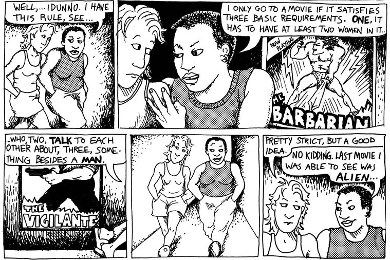
Luka, I can't say much more on this as we will end up in a circular discussion and talking about politics instead of writing, but the world is not saturated in the female gaze (take a look at almost any movie - the Bechdel test is a thing for a reason, though I've noticed more female-gaze movies in recent years)

What's wrong with circular discussions?

Men talking about women in films would probably include most romantic comedies and everything else that's said will be subtextually the same. Seeing relationships develop between a compatible couple is a major part of the lure for most audiences of most films.
Fair enough, homosexual stories will have men talking about men and gay issues or women talking about women and lesbian issues
like Bechdel's Dykes to Watch Out For... which was the primary reason the cartoon character who made the observation, about straight women talking about straight men, made the observation she did. She wanted to see women talking about women or nobody talking about anyone.
Or do you think I'm reading too much into it.
Dykes_to_Watch_Out_For_%28Bechdel_test_origin%29.jpg

It could just be a possibility that most people who read SF are male which leads to most people writing SF being male which leads to most reviewed SF books being done by and about male SF authors.
Which possibly also leads at least tangentially to more men than women taking an interest in the (non-social) sciences. Which would be a shame if there was a direct through-line.

KatG... I didn't know romance books were anymore stigmatized than SF books are... Their audiences certainly aren't stigmatizing them though they are probably equally as unlikely to win the Nobel prize for literature.

AND FANTASY is taking a giant dump on SF. At least in my local book store. It uses three times the amount of shelf space and while SF may be a lure for Fantasy I can't see the favour being returned.

But question, what if we don't want to self-publish or self-promote? Are there any doors that aren't common knowledge writers can use to break into the traditional publishing world?
 
Last edited:
I'm just catching up with this thread, but wanted to thank @KatG - there is some pure gold here. You should be sainted for the time and energy you put into educating us plebs ;).
 
But question, what if we don't want to self-publish or self-promote? Are there any doors that aren't common knowledge writers can use to break into the traditional publishing world?
I suspect that if there are, the people who opened them are keeping them very quiet.
It took me 25 years and half a dozen complete rewrites to find a publisher for my novel (4 years ago). I was convinced it was publishable, but I had (and still have) no interest in self-publishing, so I kept going until I got lucky! I have written two novels since then and I'm looking for an agent and/or a publisher, but there are no guarantees I will secure either.
My conclusion? I don't have one. Writing enjoyment and self-belief will keep me going, even if I don't get published again.
 
I suspect that if there are, the people who opened them are keeping them very quiet.
It took me 25 years and half a dozen complete rewrites to find a publisher for my novel (4 years ago). I was convinced it was publishable, but I had (and still have) no interest in self-publishing, so I kept going until I got lucky! I have written two novels since then and I'm looking for an agent and/or a publisher, but there are no guarantees I will secure either.
My conclusion? I don't have one. Writing enjoyment and self-belief will keep me going, even if I don't get published again.
Yeah, I figure I'll go a similar way as you have.
I know some people disagree and have a greater sense of entitlement than I do... but having read books published by reputable publishers and compared them with others released by hobby houses or self-publishing sites. It seems like the difference is as marked as if it was between classical music and white noise.
 
I mix with a lot of self-published writers on social media and I have read several of their books in the last couple of years, some of which, to my surprise, were indistinguishable in standard to novels traditionally published by the majors. However, while I well understand the frustration trying to find agents and publishers, I want an independent third party to agree with me that my book is good enough and give me money to prove it. Until then I'll write for enjoyment :)
 
JamesM said:
I think the symbiosis thing is what's hard to get my head around, as a writer. As a reader, not at all. In that mode, I head to the bookstore, look in my section and think, "oh, love this book, and here's one that looks a lot like it. I'll give it a try!" Then I merrily go on my way, new book in hand. But as a writer...then I think, "wait, why are they reading that book, rather than mine!" Guess that's something to get over and to try to keep in perspective.

It is counter-intuitive like a lot of things about the fiction market. People expect things to be dog eat dog competitions between products, like sports teams. But as you know from your reading experience, that isn't how fiction readers shop. Which is why fiction writers are happy to team up, because readers from one will often drift to the other and some will become fans. But the process happens whether authors promote together or not. You cannot stop fiction readers from browsing. Every movie adaptation brings in new readers and some of them browse. They'll go from sub-category to sub-category. People freak out when one sub-category becomes popular from some hits and then expands with more titles as publishers use symbiosis to capitalize on the new readers coming in from the hits, because they assume that the popular thing will eat and destroy other things. That is never what happens. Instead, some of the new readers coming in browse outward and a different sub-category gets some hits and expands also, bringing in new readers and so on and so on.

So it's not a matter of wait, why are they reading that guy's book instead of mine. It's a matter of hey, they're reading that guy's book so they might like mine too. They read books! So anything is possible. Symbiosis is one of the fiction authors' best friends. The more bestsellers there are, the more readers there are and the more the industry can expand and fund new writers.

And as far as marketing, I get what you're saying, Kat, about the limited marketplace. However, the vast majority of my sales come from e-books and almost all of them from Amazon. To the point that I bit the bullet and enrolled them in Kindle Select, so I could put them on KU. Since that time, I have someone reading them just about every day. Yes, I am contributing to the take-over of the world by Jeff Bezos, but it's where my sales are.

Kindle Unlimited is their subscription service where you have to go exclusive to Amazon and some authors have done very well with it. There are ways to market/promote that are particular to KU and a lot of its successful authors have given advice and network with each other to help with promotion via KU, so those are things to look into. But recently Amazon has thrown out a bunch of authors from KU for violating their policies on the service, so you do need to be careful about production and marketing strategies and promotional efforts there so as to not upset Amazon or have subscription readers feel cheated.

The other issue with KU is that it mitigates symbiosis by in fact turning authors into direct competitors. Instead of authors getting paid according to the rental usage of their titles on the subscription service like something like Spotify, Amazon just has a set pool of money for everybody and forces authors to fight over who gets it. So that means in the KU service, fiction authors are competing with each other for eyeballs and page reads in a set room and with non-fiction authors who are selling expertise/information as well. Symbiosis still can happen in KU and authors can team up for promotions, plus do other promotions that e-book authors do in general. But you do have some very peculiar circumstances attached to that particular area.

Luka said:
Or do you think I'm reading too much into it.

I think you missed the point of what was being said entirely, but that's not really related to marketing fiction.

It could just be a possibility that most people who read SF are male which leads to most people writing SF being male which leads to most reviewed SF books being done by and about male SF authors.

Men get reviewed more often for fiction in general, not simply SF. And the science fiction audience is near 50-50 men and women. In authorship, it is also about 50-50 gender split. A lot of book reviewers who review SFF are indeed men, but that they are men does not mean that they have to review mostly men authors. It's a bias that discriminates against women authors in the SFF field. As I've been trying to point out, the idea that women only read women authors and men only read men authors is off-base and has led to discrimination in the industry, such as actively keeping women out of writing military SF, that most people are trying to lessen. It's an unnecessary limitation of the audience and of sales, so publishers and booksellers are finally trying to do less of it. As much as you would like to erase some of the problems women authors have had in SFF and elsewhere, Luka, these are things that women authors have been dealing with for a long time.

Also, women are not less interested in the hard sciences. Women have been routinely kept out of the hard sciences and out of jobs thereby and then promptly told that they don't like hard sciences. The same routine was used to try to keep women from being doctors and dentists, as well as out of tech and engineering, etc. And the majority of science fiction published by both men and women does not involve hard science in any case. The biggest sub-category of science fiction is space opera adventure.

If you want to stick to the position that women authors are pushing you out of the market and that women readers won't read your fiction, then you'll have to look at marketing to targeted groups of men. Forums on 4chan and Reddit are possibilities. Conservative Christian websites and networks may be a place to try to connect, even if your work is not particularly conservative Christian in nature.

I didn't know romance books were anymore stigmatized than SF books are... Their audiences certainly aren't stigmatizing them though they are probably equally as unlikely to win the Nobel prize for literature.

Category romance novels are socially stigmatized for men -- they are discouraged from reading them and can face social stigma if they do as the romances are considered inferior women's books (girl cooties.) There is a male audience for category romance but it's smaller than elsewhere. Non-category romance, however, sold in general fiction has less of that problem and bigger male audiences. And all the other types of fiction have male and female audiences.

AND FANTASY is taking a giant dump on SF. At least in my local book store. It uses three times the amount of shelf space and though while SF may be a lure for Fantasy I can't see the favour being returned.

That's again a common misconception in the market -- that one sub-category is eating the other, but that's not what is happening in the whole market. And it particularly doesn't happen with category SF and fantasy because the two are linked at the hip through their specialty publishers who fill most of the category market and have numerous authors who do both SF and fantasy (and horror as well). The success of fantasy titles helps fund SF publishing. Your particular bookstore may have a bigger fantasy set of shelves (they only split the sub-categories twenty years ago,) than SF, but in other stores that won't be the case. As we discussed earlier, the bookstore chains vary stock distribution by what their sales records are for each store/region. And independents will also look at what sells best for them in their location and adjust stock accordingly. But any bookstore is happy to order you a book if you want it and they don't have it on hand and if enough people are ordering sub-fields of books from them, then they'll increase stock in those sub-fields. And there is also the fact that a lot of SFF is published in general fiction by general fiction imprints and not necessarily sold on the category shelves -- but still is selling, including bestsellers. That's all part of the field.

Remember, the YA sections were not the size they are now before Goosebumps and then Harry Potter sent readers streaming into those sections. They expanded and not just the YA fantasy titles. So that meant the YA sections got a lot bigger in just a few years. You could literally watch them adding the shelves. But that didn't meant that adult fiction was declining -- readers sent into YA (which included some adults,) then went browsing into adult market fiction.

In the mid-oughts, I had numerous discussions, one in our fantasy forum here, with folk who were convinced that because fantasy was running through some more expansions that category SF was going to disappear. And one of the reasons that they gave for that was because women supposedly liked fantasy fiction better. (This was pretty funny because in the 1950s-1980s, the claim was that women didn't like fantasy fiction at all, despite loads of women fans and women authors, that it was a man's genre.)

My argument was that SF had been hit harder by the wholesale paperback collapse than fantasy because fantasy had been in the middle of an expansion at the time and so SF had been slower to recover and had not had any large expansions since the cyberpunk expansion except for a bit of one in military SF in the 1990s, that the bringing in of more readers from the various sub-category/YA fantasy expansions was causing some of those readers to browse into SF and that we were having more hits in SF and SF would have/was starting an expansion. And that's exactly what occurred. SF benefited greatly from the fact that Hollywood likes SF way more than they like fantasy as a more reliable genre for them and scooped up a lot of adaptations after having been less interested in that in the 1990s. The hits Hunger Games, Divergent, Maze Runner, The 100, etc. and their film and t.v. adaptations boosted SF at the teen and adult level. The Expanse, The Man in High Castle, Handmaid's Tale, Ready Player One, The Martian, Annihilation, High Rise, Arrival, Edge of Tomorrow, etc. all boost up science fiction attention, as do non-adaptations or graphic novel adaptations such as The Walking Dead, iZombie, the Arrowverse, Star Wars, etc. -- all with tie-in fiction as well that brings in new readers. More adaptations are in the works, including some SF classics, which also bring in new readers. There are oodles of SF novels coming out on the big publishers' lists, current bestsellers like John Scalzi's The Consuming Fire, Andy Weir's Artemis, and prominent fantasy authors doing science fiction novels like Cathrynne Valente, Mary Robinette Kowal and Adrian Tchaikovsky -- all three of them optioned. So SF is doing well right now, in YA and in the adult market, both category and general fiction.

In the 1990's, people dismissed contemporary fantasy as minor, small and unimportant compared to secondary world fantasy, despite a number of hits developing and Harry Potter as well. In the late 1990s-early oughts, contemporary fantasy had a large cluster of bestsellers and was expanding, at the same time that there were expansions in horror (leading to establishing a category horror market,) and paranormal romance from the category romance market. So then suddenly contemporary fantasy was all important, the only thing that was selling was supposedly vampires and other types of fantasy would be wiped out. This did not, needless to say, happen. In the late 1980s and early 1990s, tie-in fiction, first of D&D and other RPG games, then their electronic game adaptations, as well as film/t.v. tie-ins, became very popular, leading into Star Wars and Halo tie-ins. There were lots of media think pieces about how this was going to kill off original SFF fiction in favor of the cheaper and fan-base guaranteed tie-in books. Instead, tie-in bestsellers brought in lots of new readers who then browsed outwards to original fiction and a number of tie-in authors who got their start that way went on to substantial original fiction careers. In 2009, Pride and Prejudice and Zombies -- combining a work of classic literature with a modern SFF update -- was a big hit, followed by Abe Lincoln: Vampire Hunter. So people thought those types of books were going to take over. They did not, they brought in readers. In 2006, World War Z was a big hit and there were several other big hit zombie novels the next several years, leading publishers to flog all their zombie novels for symbiosis, and even more when The Walking Dead t.v. series came out and the novel The Passage was a big hit. Zombies were supposed to kill off other kinds of SFF. They did not; they brought in more readers. Post-apocalyptic SF, first in YA and then in general had an expansion and was supposed to wipe out other types of fiction. It did not, it is a perennially popular sub-field that periodically has an expansion, often starting off an overall SF expansion and was part of the SF expansion going on.

Fiction novels build on each other. Fiction authors are helped out by symbiosis and browsing, but they are also helped out by variety. If you are doing something different than the hits you are noticing, that doesn't mean you're cut out of an audience. You have the potential of readers who are browsing in from those hits, and you also have the potential of readers who don't like the type of stories the hits are and are looking for something different.

But question, what if we don't want to self-publish or self-promote? Are there any doors that aren't common knowledge writers can use to break into the traditional publishing world?

Well first off, there is no such thing as no self-promotion for fiction writers. Whether you are working with a publisher or magazine or anthology or self-publishing, you will be promoting if you are publishing/selling. You get to decide what it is possible for you to do, how much, etc., but some sort of promotional attempts just to attract attention usually occurs. We're not just talking about marketing for self-pub authors.

Second, what you are asking about isn't marketing and promotion but marketing to agents and publishers to invest in. And I haven't forgotten about the literary agent thread request and I will put it up soon. But to answer your question, no, there are no secret back doors, no magic keys, no foolproof formulas for getting an agent or a license publisher. There are sometimes lucky breaks and there are basic things that writers can do to try and get a reading by agents and publishers and hope that they think it's something they want to go with. But they do not have Hollywood money, they do not do options, they know that fiction readers mostly don't care who you the author are, etc., so it comes down to their subjective judgment of the work. It's going out in your little boat and going fishing for someone to like your stuff. But we'll go over some of the things authors can do in the other thread. This one is about understanding and navigating the market promotionally.

Alchemist said:
I'm just catching up with this thread, but wanted to thank @KatG - there is some pure gold here. You should be sainted for the time and energy you put into educating us plebs

I don't consider you all plebs. I just have a knowledge base. As authors, you won't need quite that much of a base. But it can be less frustrating if you understand how the industry works in book-selling, contracts, weird stuff like that.
 
I don't consider you all plebs. I just have a knowledge base. As authors, you won't need quite that much of a base. But it can be less frustrating if you understand how the industry works in book-selling, contracts, weird stuff like that.


I know, I didn't think that you did - just jesting. Anyhow, "plebulousness" is relative, isn't it?
 
I mix with a lot of self-published writers on social media and I have read several of their books in the last couple of years, some of which, to my surprise, were indistinguishable in standard to novels traditionally published by the majors. However, while I well understand the frustration trying to find agents and publishers, I want an independent third party to agree with me that my book is good enough and give me money to prove it. Until then I'll write for enjoyment :)

I've actually read quite a few self-published as well, and have found the same thing. Some are amazing books, that I wouldn't be able to tell weren't professionally done. Others...not so much, and that's where the "problem" is, if there is one. You can put out anything you want, and the ones that are poorly done reflect on all self-published.

However, I will point out that sites like BookBub have proven that the big publishers and agents aren't always right. There have been several examples of a book selling a boatload of copies and gaining a following that has been turned down by everyone else. I don't believe it's common, but it has happened.

I don't feel like I have a sense of entitlement, as Lukas stated, since that would imply that I'm demanding people read my books. Instead, I think I've written a few good books, and the vast majority of those who have read them agree. If someone would like to read them, have at it! I promote to let people know they exist, which as Kat has pointed it, would be no different if a big house did pick them up.

It's been an eye opener, the whole after writing the book thing. It has parts that I enjoy and parts that I hate, but overall...I'll keep on going, and do the same thing. Write for the enjoyment of it.
 
I've not forgotten this thread or doing an agents thread -- just had some family stuff going on. Will get into some more stuff soon. If you all have any other specific questions on publicity, etc., go ahead and put them up.
 
Okay, little bit here. Once you put something out -- whether you are publishing with a publisher or magazine or doing it yourself -- being a writer is part of your bio when you are doing other things (as long as that is not a problem say for your day job to present that information.) Your activities, hobbies, organizations to which you belong, communities and neighborhoods, your work and connections there where it is appropriate to do so, all make up the network that is you and that entire network can offer opportunities to let people know about your written work without it being particularly pushy about it (since we know readers don't like feeling pushed.) If you get interviewed about something or write something -- as long as it won't get you in trouble for doing so -- where there is then a brief bio statement (or question) for you, that bio statement absolutely should include that you are the author of "X" as part of who you are, even though the subject of writing or interview has nothing to do with your fiction writing. If there isn't a bio statement but you get interviewed, try to work it into the subject of the interview somewhere if you can do so without it sounding strange.

This sounds like pretty basic information but it is amazing how many authors don't think about this while Instagramming or doing online garden tips for their gardening club, etc. Authors on average are not put themselves forward people. They tend to hide what they are doing until they reach the imaginary bar they set for themselves, like having 2000 novels sold or 10 short stories published, and so forth, that isn't really necessary and is a side effect of imposter syndrome. Not being a put themselves forward person is not a bad thing, as again, potential readers don't like authors always pushing themselves on them. But the casual mention -- the bio statement as to who the hey you are -- that's not pushing, but it does need to become an automatic part of how you present yourself. You put or are putting stuff out for sale, then you are a writer and that is part of the presentation of you to others when you are offering something else. Obviously if it's going to upset your employers, you don't do it with their stuff, but if you're coaching your kid's soccer team in a league? Then your bio with the league is that you're coaching, you've got two kids, you're an electrical engineer and you're the author of the novel, Good-bye Legolas, or whatever it is. Whenever you are introduced as a bio statement and it won't be a problem -- like you're making a speech, etc. -- your authorship is part of the introduction.

Because, remember the other thread where one of our members was surprised about getting a positive response from co-workers about having written and put out fiction? While people don't necessarily think you're cool for writing fiction (status,) they do often think it's interesting and generally aren't hostile about it. And if just one person on seeing the title of your work checks it out, that person might like it and spread word of mouth. Even if they don't, it still affects the view of you -- part of what you are is a fiction author -- that people associate with you, in talking about you, etc., which again can lead to at least a few people checking stuff out and that can spread. In any case, it usually can't hurt.

And from doing that, from letting it be casually known that you wrote X work of fiction instead of hiding it like a guilty secret, that can sometimes lead to building other networks and interesting conversations. It isn't unusual for someone you know or meet, upon hearing that you produce novels or had stories in magazines, to mention someone they know who is a book or magazine editor or an agent or maybe another, more known author who wouldn't necessarily be against talking to a friend of a friend, or a media person who might in some capacity be of use to you as a connection. And while publishing is not dependent on who you know -- because again, the stories are what interest readers, not who authors are -- casual connections can lead to someone in the business learning of your existence and being willing to take a look at work of yours -- which may lead to something if they like it, if you are seeking that sort of further assistance. Or in the case of other authors, simply some useful information and someone to hang out with, maybe team up with on promotion, build a network, etc. And for media people, maybe getting an interview, not even necessarily for fiction (maybe it's for coaching local youth soccer,) but the fiction mentioned as part of your bio. Nobody knows what is going to happen, so at least putting it out there that you are in fact a fiction writer with stories available for reading/possibly for sale as you interact with other people, is not going to hurt either. As long as you aren't screaming in their face about it or waxing poetic about it. It's just something about you, like the fact that you know how to make pad thai or once got lost in a swamp, and that may create connections with others that can eventually bear fruit.
 
getting a positive response from co-workers about having written and put out fiction
It all depends on what you write about. I wrote an impersonal speculative narrative fairly neutral in terms of why who was responsible about the near future being about how it got that way. I used current events from all fields. It is like a fictional speculative textbook about near future history that doesn't exist yet. Its not popular because the structure of the writing doesn't have the usual forms of entertainment in it. People resolve problems by not solving them, etc. Now I need to advertise it to people who might appreciate it. Possibilities include some sort of crowd funding or publication as an audio book. Can you send a published story to audiobook publishers for publishing the same way an unpublished story is sent to traditional publishers? Can crowd funding be used to run an advertising campaign where only the author profits. When an audio book is produced, does the music in the background have its own set of rights by the musicians for original work they do. If I self publish all formats I never have to worry about rights but when entering into arrangements for having some one else publish books are all the different rights always up for negotiations? Are there more places like Amazon and Smashwords that don't ask for any parts of the rights. Are there any companies that "help" you create audio books without strings attached the way amazon helps you publish paperbacks?
 
It all depends on what you write about. I wrote an impersonal speculative narrative fairly neutral in terms of why who was responsible about the near future being about how it got that way. I used current events from all fields. It is like a fictional speculative textbook about near future history that doesn't exist yet. Its not popular because the structure of the writing doesn't have the usual forms of entertainment in it. People resolve problems by not solving them, etc. Now I need to advertise it to people who might appreciate it.

Have you read World War Z by Max Brooks? Not the movie, the actual novel, which is written as a pretend oral history of the zombie apocalypse (that's its subtitle.) The novel was a follow-up to Brooks' hit humor satire book, The Zombie Survival Guide. So you could take a look at those and how Zombie Survival Guide was initially marketed. Some other books to take a look at:

The Thackery T. Lambshead Pocket Guide to Eccentric and Discredited Diseases, edited by Jeff Vandermeer and Mark Roberts, which was a surprise hit.

The Tough Guide to Fantasyland: The Essential Guide to Fantasy Travel by Dianne Wynne-Jones, which has become an iconic book in the field.

I.e. there is stuff out there like what you are doing, both more fictional and presenting as non-fictional but humorous SFF, so see what is going on there.

Can you send a published story to audiobook publishers for publishing the same way an unpublished story is sent to traditional publishers?

Yes, you can also send a previously published book to print publishers too. But the key issue is what the specific publisher is doing/wants. Specifically you want to know if the audio publisher takes unagented work if you don't have an agent, and if they do their own projects rather than just license sub-rights from and/or make audio editions for major publishers. Every business decides what their scope is going to be. So you have to look and your best bet is probably a smaller audio publisher that is publishing original work in audio and also reprints and has worked with self-pub authors and small presses. Take a look specifically at what some of the bigger self-pub authors have done in getting their books in audio. They may have gone through Amazon, they may have paid an audio publisher to produce an audio version for them just like POD, or they may have licensed the rights to the audio publisher for production. If you don't have a sales track record, an audio publisher that does original work might, like a print publisher, not be interested or they might be, so you have to see what's available and what their requirements are.

Can crowd funding be used to run an advertising campaign where only the author profits.

Yes, it's done all the time. A lot of the crowd-funding is an author launching a product and the donors are essentially people willing to buy the product without first having it necessarily ready to go if the project isn't completed but then there is a deadline by which the author is supposed to release the product, first exclusively to the donors usually as an e-copy or some special edition, and then to wider sale. Or sometimes an author holds a crowd-funder simply to cover publicity and promotional costs, with again donors getting a copy of the work for their donation. I'm not an expert in crowd-funding, so you'll have to research what other authors have done on Kickstarter, Patreon, GoFundMe, etc., and what the rules are for the various sites that host crowd-funding.

When an audio book is produced, does the music in the background have its own set of rights by the musicians for original work they do.

Yes, just like your rights in your book, musicians have the rights to their music (or sometimes the studios that bought those rights and produced the music do.) You have to pay them to use their music for your product. It is called a permissions license, and you will need a contract that spells out credit in the product, payment, rights of production or use allowed, etc. Music permissions can be very expensive, so you're going to have to pick carefully if you want to include music that isn't your own.

If I self publish all formats I never have to worry about rights but when entering into arrangements for having some one else publish books are all the different rights always up for negotiations? Are there more places like Amazon and Smashwords that don't ask for any parts of the rights. Are there any companies that "help" you create audio books without strings attached the way amazon helps you publish paperbacks?

It depends on whether you are doing licensing publishing or self-publishing. If you are license publishing, you are asking a publisher to invest in your work in return for an exclusive license to a specified set of production rights. The publisher chooses to acquire the license or not, there are contractual terms for how you are paid for the license through the sale of the product and the publisher takes on all the costs of production, distribution, marketing to most vendors as their product from your license. You are asking them for money and taking on the risk that the product might not sell as partners. They are gambling that they can produce it at reasonable cost and make a profit from it in sales.

In contrast, when you are self-publishing an e-book with Amazon, it is not a license contract, you are not granting any license to Amazon for production rights in your product. Instead, you are entering into a vendor's agreement with Amazon to sell your e-book on their platform. They require you to have a certain production format to do that with an e-book, and you then pay Amazon to do that production format and for various marketing services on their platform, both directly in up-front fees and also in fees deducted from the sales of your e-books. Amazon thus offers a combo of vendor services and required production services as a vendor, not a rights holder. They can set rules about how you can sell -- Kindle Unlimited requires that you not sell your e-book on any other vendor's platform, for instance. But they own no stake in your book and they don't spend any of their money on it.

If you are hiring an audio publisher to produce an audio book for you, that's a non-license for-hire production contract, same as you would have with a printer or a free-lance copy-editor. You are hiring them for a service -- audio production -- and you pay them fees for that service. They have no rights in your work, but also no obligations to you besides producing the audio version contracted for. If the audio publisher also has a sales platform from which to sell audio books, you might also enter into a vendor's contract with them similar to Amazon's, and you might also sell the audio book on other vendors' platforms. It's your choice as publisher.
 

Sponsors


We try to keep the forum as free of ads as possible, please consider supporting SFFWorld on Patreon


Your ad here.
Back
Top