

You are using an out of date browser. It may not display this or other websites correctly.
You should upgrade or use an alternative browser.
You should upgrade or use an alternative browser.
A Sci Fi Reading Odyssey - 50 Novels
- Thread starter Matt H.
- Start date

Now that's cool. The one I got , also Penguin, is just very un sci-fi looking.. being a scowling woman in a beach chair with her arms folded. It's unexpected, but maybe it's original in that way, and captures some subtler aspect of the book.

- Joined
- Jul 16, 2001
- Messages
- 18,434
I'll help you out here, Matt: this one?
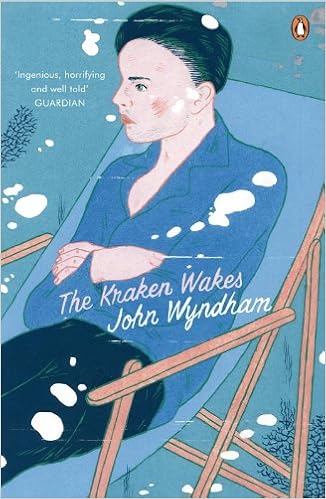
Not really sure what Penguin are trying to do with these latest covers, to be honest. I really don't like them - the Day of the Triffids one and The Chrysalids are awful too. Suspect that it's an attempt to persuade readers who don't read that sort've thing.
Side note: Just realised (or re-remembered!) that the Wyndham novel titled Out of the Deeps is actually the same as The Kraken Wakes. Apart from the title, I don't think that there's any major changes. Might be an easier edition for our US readers to get.
Not really sure what Penguin are trying to do with these latest covers, to be honest. I really don't like them - the Day of the Triffids one and The Chrysalids are awful too. Suspect that it's an attempt to persuade readers who don't read that sort've thing.
Side note: Just realised (or re-remembered!) that the Wyndham novel titled Out of the Deeps is actually the same as The Kraken Wakes. Apart from the title, I don't think that there's any major changes. Might be an easier edition for our US readers to get.
Yep that's it. Rather disliked it too to be honest, but giving Penguin the benefit of the doubt because I respect the publisher. (I probably respect it too much, since Penguin books really dominated my reading life, especially when younger... Though dumb, have to say I almost revere them!).I'll help you out here, Matt: this one?...
Appreciate your speculation as to why this art was used. I would guess the artist realized that she/he was not creating either an exciting or particularly conventionally pleasant image. Though off-putting, it also creates curiosity as to how this image might relate to the story. Already got that edition. Thanks for tidbit on title change.
Last edited:

Ringworld by Larry Niven (1970)
Ballantine / Del Rey
342 pages
Reader Response by Matt H. [v 2.4] from Reading Odyssey
Rating: Has good points but not entirely recommended
Story Summary
Four explorers visit a vast artificial world on an undisclosed mission. There are two humans – Louis Wu and Teela Brown, and two aliens – Nessus, a two-headed “puppeteer”, and Speaker-to-Animals, a large, fierce, carnivorous Kzin. The artificial planet, Ringworld is a ribbon of terraformed matter a million miles wide and about 93 million miles in circumference. As they approach, their ship is attacked and it crashes on the surface. The four are thrown into various adventures as they explore the vastness of Ringworld and learn its mysteries and attempt to get back home. At the time of the story, the core of the galaxy has exploded releasing deadly cosmic rays. The radiation will reach Earth and other civilizations in 20,000 years and requires some plan of action, most likely interplanetary relocation.
Critical Reader Response
Ringworld is an often engaging work with some memorable characters, interesting plot twists and good humor. It also contains some admirable explorations of interstellar “culture clash”, the history of technology (especially space travel), courage and cowardice, luck and innocence, war and peace, sex and pleasure and the results of overweening, meddling arrogance. Unfortunately, with all these positive attributes comes substantial negatives, which on balance make it hard to recommend this book.
Though Niven succeeds in making you care about the characters, as characters, and treats of interesting ideas, he is perhaps less successful in making you understand the overall why and wherefore of the story, its technology as well as its physical setting. This is a result of occasionally unclear writing, a somewhat jumbled-seeming plot as well as some rather colorless descriptive passages. Perhaps worst of all is that the ending and "resolution" is abrupt and unsatisfying.
With the wonderful humorous incident at the end of the first chapter I was happy and very eager to read on. But the story began to slow down when the characters left the Puppeteer planet about one quarter into the book.
The physical and astronomical details of the fairly complicated Ringworld, its foundations, walls, wires, panels, satellites, elevators, abandoned space ports, skies, weather, geologic features, etc. were often difficult to visualize. Also less than clear were the details of how the companions rigged solutions to various critical engineering problems. The main characters are full, dimensional and have color, however the world created, its abandoned cities, landscapes and inhabitants have less concreteness and interest to them. In a way, the book leaves the mysteries of the vast Ringworld under-exploited. I felt I wanted more adventures and more creatures with a little less ill-fitting description injected into the narrative.
Ringworld’s most appealing qualities are its main characters, their respective cultures and their interpersonal dynamics. Both the Puppeteers and Kzin are physically and intellectually intriguing. In the Kzin, with their blunt militarism and real politic, it is difficult not to see some shade of the Soviets. The Puppeteers -- borderline evil, infuriatingly arrogant are nevertheless adorable, with weird and wonderful abilities. There is some very funny banter between the characters and an ongoing competition to out-think each other. This it could be argued is the best aspect of the book.
Sex is among the themes treated in the novel. In my estimation it is handled acceptably and fits in with the story. However - there is almost inevitably something to criticize in male depictions of female characters, and male-female relations of this period, especially in an entertainment genre like Sci Fi. This book is no exception in that respect.
There are a few other avenues of criticism too. For example, Louis is said to be a great explorer, but he’s never felt pain? He has a young physique, but seems to tire easily and complains about lack of transport booths. In fairness, later he does show some heroics. Late-introduced is a truly cartoonish male “hunk” character. Teela is hopelessly in love with him - a point central to the whole story - though all agree he is not very intelligent. Also introduced later in the story is the alien female, Prill. In the final chapter her behavior seems far out of character. It would seem the galaxy core explosion would be a major plot element. But somehow it is never satisfyingly integrated into the story. The last part of the book perhaps has a hint of disorganization to it.
Last edited:
Posted a draft of my Ringworld review. As always would love to hear from any and all what you think of the analysis and if you agree or disagree! Who has read it?
Last edited:
Legit as a point. As a binary choice, I'd say I guess I don't recommend it. Will look at review to see if there's reason to make it clearer.Nice review, Matt. The only thing I'm not sure of is - overall, did you enjoy it?
I felt cheated a bit by the ending and loose ends. Also quite possible I missed something in the plot too. This is a reader response, so that must remain a given, for better or worse.
(added)
Made some changes to review - re-org and minor edits. I think it's a little clearer now. Paragraph 2-
"...With all these positive attributes unfortunately comes some negatives, which on balance make it hard to unequivocally recommend this book..."
But let me know if you have any further comments at all. Again want a polished final product to extent possible.
(added)
Made some more, fairly substantial changes to wording and org... Trying to improve its structure and clarity.
Last edited:
(edited)
Mark, made quite a few changes and additions to review. I have now succeeded in conveying my feeling about the book, much more accurately and fairly! Sorry about all the editing rounds... I know might be hard to respond to a moving target. Going to stop fiddling with it now.
About 1/3 into Kraken ... Looking forward already to writing review/response!
Mark, made quite a few changes and additions to review. I have now succeeded in conveying my feeling about the book, much more accurately and fairly! Sorry about all the editing rounds... I know might be hard to respond to a moving target.
Going to stop fiddling with it now.About 1/3 into Kraken ... Looking forward already to writing review/response!
Last edited:
- Joined
- Jul 16, 2001
- Messages
- 18,434
Sorry about all the editing rounds... I know might be hard to respond to a moving target.
No need to apologise... you should see what goes on behind the scenes at SFFWorld when we're writing reviews! Most of my reviews have two drafts at least. (Thanks to Rob, MarkC & Nila for comments and suggestions, btw.)
I am constantly editing and refining.
If it helps, I often write a review, leave it for a while (ie: go and do another!) and then come back to it. Amazing what you notice on a reread! It also allows me to distill what I want to say or lets me explain more if I think it needs it.
Pleased you're enjoying Kraken so far... I really want to reread it myself, but is just not happening at the moment.
Hi Everyone,
About reading list...
Looking back now, I wonder if Ringworld perhaps belonged on this list, intended to be of "major classics". Not that it's that awful or anything. I know it has its fans.
(added)
On second thought, I added it because it was on a lot of external lists. It is well regarded by many. Thus arguably it certainly could belong on the list.
1. Legion of Space - Also wondering if (as per some of Mark's comments, others...) I should replace Legion of Space with something else perhaps of higher overall seriousness? Is there anything from the early "space opera" vein, not written by Heinlein or any other author already on the list anyone might recommend? Or is Legion of Space a good choice? Just worried it might be too simplistic. Historically it might be important, but the review will be a "reader response" not a historical/critical analysis...
2. Childhood's End - Is there perhaps a better/more influential Clarke book (other than Rama or 2001) that could be subbed? The City and the Stars? Mark, do you know it?
Any thoughts appreciated.
Reading The Kraken Wakes now... about 1/2 through.
About reading list...
Looking back now, I wonder if Ringworld perhaps belonged on this list, intended to be of "major classics". Not that it's that awful or anything. I know it has its fans.
(added)
On second thought, I added it because it was on a lot of external lists. It is well regarded by many. Thus arguably it certainly could belong on the list.
1. Legion of Space - Also wondering if (as per some of Mark's comments, others...) I should replace Legion of Space with something else perhaps of higher overall seriousness? Is there anything from the early "space opera" vein, not written by Heinlein or any other author already on the list anyone might recommend? Or is Legion of Space a good choice? Just worried it might be too simplistic. Historically it might be important, but the review will be a "reader response" not a historical/critical analysis...
2. Childhood's End - Is there perhaps a better/more influential Clarke book (other than Rama or 2001) that could be subbed? The City and the Stars? Mark, do you know it?
Any thoughts appreciated.
Reading The Kraken Wakes now... about 1/2 through.
Last edited:

krisbslick
Prime Executor
- Joined
- Dec 30, 2010
- Messages
- 670
Looking back now, I wonder if Ringworld perhaps belonged on this list, intended to be of "major classics". Not that it's that awful or anything. I know it has its fans.
Ringworld seems to be on pretty much every major SF classic list I've looked at. Here's a couple:
https://www.abebooks.com/books/features/50-essential-science-fiction-books.shtml
https://io9.gizmodo.com/21-books-that-changed-science-fiction-and-fantasy-forev-1610590701
Also, here's an interesting list (not a classic list, per say, but best SF books of all time - ranked):
http://scifilists.sffjazz.com/lists_books_rank1.html
Was curious how you came up with your list... can't speak to switching out Childhood's End or Legion. However, when I did my cursory run through of some of the classics, I thought some were just bad as well. Just because they're considered a classic doesn't mean they're going to be to everyone's liking and won't be dated.
Are you trying to get a broad smattering of the genre or just want to read the best of the genre - they might be two very different things to different people.
Last edited:
Ringworld to be on pretty much every major SF classic list I've looked at.../
Was curious how you came up with your list... /...Are you trying to get a broad smattering of the genre or just want to read the best of the genre....
Kris, thanks very much for the thoughtful response and details!
1. Now that I think of it, yes, I guess I included Ringworld because it was on a lot of lists. (I looked at quite a few in compiling my final 16) I know you were fond of it. My review represents a particularly subjective "reader response" format. Would be great to hear any specific comments on my review.
2. The list was hammered out in previous discussion threads with help from user experts based on several things you could not have known easily. Firstly, we limited it to the post Wells/Verne era. Next we eliminated various classics that were by authors who were mostly of the non-sci-fi genre (Vonnegut, Huxley, Orwell, etc.), Then we nixed a couple because mostly they were too long or already read (Dune mostly). Non officially, I kind of limited it to pre-1990's. So from the 30's probably through the 1980's.
3. Yes, the goal was to get the widest spread of styles, themes, subjects, possible within 16 "classics" (like a lit. survey class). Another goal was to include books that originated ideas, tropes, etc. and that influenced many succeeding works.
That's probably more than you wanted to know. lol...
Thanks again for your comments.
Last edited:
- Joined
- Jul 16, 2001
- Messages
- 18,434
Yes to both. Bit of a Clarke fan.2. Childhood's End - Is there perhaps a better/more influential Clarke book (other than Rama or 2001) that could be subbed? The City and the Stars? Mark, do you know it?
Childhood's End review for SFFWorld HERE.
City and the Stars is on my reread list. It is an old favourite, but is an early Clarke work and shows it. It is in my 50 because it was an early reading favourite, but it is of its time, i think.
Thanks for info as always. Began to read your review but decided to hold off. (If I end up reading it wanted to go into the work totally clean slated... will be interesting how our takes match or differ!)Yes to both. Bit of a Clarke fan...Childhood's End review for SFFWorld HERE..
Looking at the first few sentences of your review can see it's a little more readable than mine, which are a bit dry, hehe... Sure I can learn a thing or two from them. My "responses" are supposedly devoid of reference to any external info or opinions (both a strength and weakness).
Still considering whether to keep Childhood's...
Last edited:
I fancied-up this thread a bit... improved links\nav, formatting, consistency... added a bit on first post about my aims, methods, blah, blah.
Two down, 14 to go! (gulp)
Got Shockwave Rider today... erm, looks... fun, lol. I'll be pure pulsing cerebrum by the time I finish all this if I ever do. We'll see what level of quality I can reach\maintain with the reviews. It will be a good workout.
Two down, 14 to go! (gulp)
Got Shockwave Rider today... erm, looks... fun, lol. I'll be pure pulsing cerebrum by the time I finish all this if I ever do. We'll see what level of quality I can reach\maintain with the reviews. It will be a good workout.
Last edited:

psikeyhackr
Live Long & Suffer
- Joined
- Feb 12, 2008
- Messages
- 3,408
- The Martian Chronicles, Ray Bradbury (re-read) [1945]
- Foundation, Isaac Asimov (Book 1) (re-read) [1951]
- Childhood’s End, Arthur C. Clarke (re-read) [1953]
- Citizen of the Galaxy, Robert A. Heinlein [1957]
- The Left Hand of Darkness, Ursula K. Le Guin [1969]
- Ringworld, Larry Niven [1970] Review/Response
- Tau Zero, Poul Anderson [1970]
- The Shockwave Rider, John Brunner [1975]
- Gateway (Heechee Saga), Frederik Pohl [1976]
- Ender's Game, Orson Scott Card [1977]
- Neuromancer, William Gibson [1984]
Foundation is a collection from 1942-1950.

Vince W
Towel Champion
- Joined
- Nov 8, 2013
- Messages
- 685
Nice review @Matt H. I'm rather biased towards Ringworld as it's one of my favourites. I've read it several times. Your assessment is not wrong in any technical respect, however, Niven was pretty well established when he wrote Ringworld and is part of his larger Known Universe. I think when he wrote it he was anticipating that his readers would have at least a passing familiarity with his previous works.
That is part of the problem with Ringworld, it can't be really taken as a stand-alone book. There's already an implied history that the casual reader would not know about.
That is part of the problem with Ringworld, it can't be really taken as a stand-alone book. There's already an implied history that the casual reader would not know about.

Sea Serpent
Frantic Scribbler
- Joined
- Mar 19, 2019
- Messages
- 427
So I've managed 5 of your list. Looking forward to your reviews so I can fill in some gaps. I'm particularly looking forward to seeing what you think of Kraken. I first read it as a teenager and it was a major factor in my choice of oceanography as a career. 
- The Martian Chronicles, Ray Bradbury (re-read) [1945]
- Foundation, Isaac Asimov (Book 1) (re-read) [1951]
- Childhood’s End, Arthur C. Clarke (re-read) [1953]
- The Kraken Wakes, John Wyndham [1953]
- Neuromancer, William Gibson [1984]
Vince W
Towel Champion
- Joined
- Nov 8, 2013
- Messages
- 685
I've read twelve off your list:
Several of these I've read more than once.
- The Martian Chronicles, Ray Bradbury (re-read) [1945]
- Foundation, Isaac Asimov (Book 1) (re-read) [1951]
- Childhood’s End, Arthur C. Clarke (re-read) [1953]
- Citizen of the Galaxy, Robert A. Heinlein [1957]
- Solaris, Stanislaw Lem [1961] Review/Response
- The Left Hand of Darkness, Ursula K. Le Guin [1969]
- Ringworld, Larry Niven [1970] Review/Response
- Tau Zero, Poul Anderson [1970]
- The Shockwave Rider, John Brunner [1975]
- Gateway (Heechee Saga), Frederik Pohl [1976]
- Ender's Game, Orson Scott Card [1977]
- Neuromancer, William Gibson [1984]
Several of these I've read more than once.
Sponsors

We try to keep the forum as free of ads as possible, please consider supporting SFFWorld on Patreon

Your ad here.