A Sci Fi Reading Odyssey - 50 Novels

img087.jpg

The Voyage of the Space Beagle by A.E. Van Vogt [1950]
Orb Books
215 pages
Reader Response by Matt H. [v 1.21] from Reading Odyssey
Rating: Highly recommended

Story and Setting

The “Space Beagle” is a huge, spherical intergalactic spaceship. Like its ancient namesake of Charles Darwin fame, its mission involves gathering information on new, undiscovered life forms. The ship is immensely well provisioned with scientific laboratories, equipment and weapons, and has a crew of over a thousand carefully selected men. The crew is organized in two roughly equal parts - scientists and military men. The scientists range from every conceivable discipline -- physics and metallurgy to psychology and history. These two groups, military and scientific are of roughly equal influence and authority. The leaders of the scientists is Dr. Hal Morton. Later his rival, a more passionate man, Kent, the head of the chemistry department, comes to power.

Soon after beginning the exploration of a strange planet, the crew encounters an extremely dangerous alien presence. The situation quickly devolves and becomes a life or death struggle involving the fate of the entire ship and its crew. This is the first in a series or perilous encounters with increasingly horrible and powerful alien adversaries. In these battles, the aliens will prove their deadly guile and intelligence as well as display unreal defenses and weapons, both physical and mental.

Aboard the ship a mid level functionary of the new, and little understood science of Nexialism is Elliot Grosvenor. He will become central to the crew’s battles with the aliens. But Grosvenor must not only fight the aliens, he must deal with political instability and maneuvering among the crew. In the final struggle, he must use all his scientific brilliance, reasoning power and understanding of human psychology as well as the revolutionary methods of Nexialism. He must also resort to extreme but necessary measures. The Space Beagle faces a foe that could devour all life in the universe!

Critical Reader Appraisal

This book starts with a bang. We are dropped straight into the POV of a terrifying alien -- prowling, desperately seeking to feed. It instantly and irresistibly draws you into the world of the Space Beagle, its crew and its mission. The narrative technique is slick, the writing vivid, clear and easy. And you soon realize some substantial ideas are being served up along with the fun and excitement. They don’t seem like philosophical asides, but they fit with the plot and are part of it. The pretty gripping action continues to the end with only very minor flagging points. It wraps up grandly with the most consequential outcome imaginable and with the virtual apotheosis of the once measly underling, Elliot Grosvenor.

The shifting POV is what gives this book its pace and special reading fun. You see that both the men and the monsters have numerous tricks up their sleeve as well as some weaknesses and propensity to error. Knowing the motivation of the beasts is key to their horror. They don’t just feed on flesh, they feed on death itself -- the process of death or cessation of id. The “Coeurl” is a fearsome, powerful, elegant cat-like beast. But the Ixyl is truly a hideous devil, with horribly grisly reproductive needs. It floats in the inconceivable emptiness of intergalactic space, waiting… You really want to scream “Hey, don’t do that!” when the crew foolishly starts messing with it.

For me and within this text, the overall idea of Nexialism is appealing. Its best parts are its combination of disciplines -- scientific sleuthing and deduction, and most of all its willingness to shatter paradigms and face unlikely and unlikable conclusions. The association with direct mind control and an assertion of the benignity of this is not so great though, nor is the ends-justify-means flavor. Of course the dictum – “for the good of the greatest number” has problems. Since the Enlightenment we have realized that pure majoritarianism can easily become oppressive. Nevertheless, Nexialism saves the day handily and niftily in this story and I felt inclined to admire it. Also wonderful is the way abstract science is applied to solve no-time, life-or-death emergency situations. But as the story shows, not only brain power is required – physical courage, sacrifice and coolness under pressure are also essential.

At the start, quite a few characters are introduced as well as a somewhat complex political situation shipboard. It requires a bit of effort. It helps a little that they are referred to as “the chemist”, “the geologist”, etc. Among the human characters only Grosvenor and Kent are significantly developed, but some others are partially.

Grosvenor fights many separate but simultaneous wars in each of the four stories – the attacking aliens, the ship’s bureaucracy, his crew-mates psychologically, politically and even physically. But he is just quietly and unassumingly far too good. He has everything wired in every sense of the word. There is a theme of scientific territoriality in the book, as other departments try to muscle-out the protagonist and take over his lab space. There’s a little bit again of the disguised god motif. For, though only slyly apparent, Grosvenor’s progress is basically from untouchable to a kind of god. He has out-thought and outfought a succession of ever more powerful super-beings. He has completely dominated the crew and seized their minds directly. He has calmly saved the ship and universe four times!

Kent is a nasty antagonist and he plays dirty. He is jealous, impulsive, emotional and violent. In fact, he could lead to the ruin of the Space Beagle or even of the entire cosmos. But, observes one of the characters -- groups usually favor the passionate and irrational leaders over the better ones. This rang true, among several other observations and iconoclastic nougats of wisdom. His potential redemption in the final scene shows a merciful bent. He certainly seemed to deserve a harsher fate.

Delivered as individual episodes, the four, similar conflict stories of the book have no plot-twist connection. I was hoping there might be one. They are of course connected in that Grosvenor and Nexialism saves the day in each case. But a link between the episodes is perhaps something left unfulfilled on the wish list. The second episode featuring the effects of remote hypnosis was perhaps the least comprehensible. Even so, the mental journeys Grosvenor took to the Bird people’s home world were weird and wonderful. Occasionally the narrative had me confused, such as the exact reason for the crew infighting during the second attack. There is also a stiffness and sterility to the environment aboard the Space Beagle, a certain clinical creepiness that includes Grosvenor himself. One could add that the crew members who are killed are perhaps a bit prop-ish. The writer does a moderately good job at fudging when scientific backing is needed – when technology becomes central to the plot. Some of it still almost strayed occasionally into fake-science-as-plot-device territory.

For me, even with the somewhat repeating, though ultimately unrelated four invasion stories, overall the unity of the book is maintained. Of rather, the virtues of the book so outshine those faults, that they bestow on it a unity regardless. The impression left is of a thrilling story, with fitting and unobtrusive philosophical themes interwoven. The only thing even more important than the sum effect of that, is the sheer greatness of the monsters!
 
Last edited:
arting shot, lol... surprised Mark un-hesitatingly said King was a better writer than RAH! Would have to read King to judge, but Heinlein is impressively skillful, well-crafted and fun to read, and always gives you something to chew on, and he goes outside conventions, even in a book like Puppet Masters.
Just to qualify, I meant that King is a better writer for today's modern tastes. Techniques, style and vocabulary have all changed since RAH's day. Today King is much much more widely read and using styles and techniques that are modern. As groundbreaking as RAH was at the time (1940's-50s) he was a big fish in a relatively small pool. (Think this was something Windy said, and I meant.) King has been nominated for many awards outside the genre, (Heinlein's were mainly in-house) and has more influence on today's writing/writers than RAH ever did. King's on 50+ books at the moment, RAH less. Despite a number of notable failures, King's success in film and television far surpasses RAH's Tom Corbett & Destination Moon, although they are undoubtedly influential.

As much as I enjoy RAH, King's broad readership and influence is beyond that of the genre, IMO.

Hope that makes my seemingly-surprising choice easier to understand!
 
img087.jpg

The Voyage of the Space Beagle by A.E. Van Vogt [1950]
Orb Books
215 pages
Reader Response by Matt H. [v 1.11] from Reading Odyssey
Rating: Highly recommended

Story and Setting

The “Space Beagle” is a huge, spherical intergalactic spaceship. Like its ancient namesake of Charles Darwin fame, its mission involves gathering information on new, undiscovered life forms. The ship is immensely well provisioned with scientific laboratories, equipment and weapons, and has a crew of over a thousand carefully selected men. The crew is organized in two roughly equal parts - scientists and military men. The scientists range from every conceivable discipline, from physics and metallurgy to psychology and history. These two groups, military and scientific are of roughly equal influence and authority. The leaders of the scientists is Dr. Hal Morton. Later his rival, a more passionate man, Kent, the head of the chemistry department, comes to power.

Soon after beginning the exploration of a strange planet, the crew encounters an extremely dangerous alien presence. The situation quickly devolves and becomes a life or death struggle involving the fate of the entire ship and its crew. This is the first in a series or perilous encounters with increasingly horrible and powerful alien adversaries. In these battles, the aliens will prove their immensely deadly guile and intelligence as well as display unreal defenses and weapons, both physical and mental.

Aboard the ship a mid level functionary of the new, and little understood science of Nexialism is Elliot Grosvenor. He will become central to the crew’s battles with the aliens. But Grosvenor must not only fight the aliens, he must deal with political instability and maneuvering among the crew. In the final struggle, he must use all his scientific brilliance, reasoning power and understanding of human psychology as well as the revolutionary methods of Nexialism. He must also resort to extreme but necessary measures. The Space Beagle faces a foe that could devour all life in the universe!

Critical Reader Appraisal

This book starts with a bang. We are dropped straight into the POV of a terrifying alien -- prowling, desperately seeking to feed. It instantly and irresistibly draws you into the world of the Space Beagle, its crew and its mission. The narrative technique is slick, the writing vivid, clear and easy. And you soon realize some substantial ideas are being served up along with the fun and excitement. They don’t seem like philosophical asides, but they fit with the plot and are part of it. The pretty gripping action continues to the end with only very minor flagging points. It wraps up grandly with the most consequential outcome imaginable and with the virtual apotheosis of the once measly underling, Elliot Grosvenor.

The shifting POV is what gives this book its pace and sheer reading fun. You see that both the men and the monsters have numerous tricks up their sleeve as well as some weaknesses and propensity to error. Knowing the motivation of the beasts is key to their horror. They don’t just feed on flesh, they feed on death itself -- the process of death or cessation of id. The “Coeurl” is a fearsome, powerful, elegant cat-like beast. But the Ixyl is truly a hideous devil, with horribly grisly reproductive needs. It floats in the inconceivable emptiness of intergalactic space, waiting… You really want to scream “Hey, don’t do that!” when the crew foolishly starts messing with it.

For me and within this text, the overall idea of Nexialism is appealing. Its best parts are its combination of disciplines -- scientific sleuthing and deduction, and most of all its willingness to shatter paradigms and face unlikely and unlikable conclusions. The association with direct mind control and an assertion of the benignity of this is not so great though, nor is the ends-justify-means flavor. Of course the dictum – “for the good of the greatest number” has problems. Since the Enlightenment we have realized that pure majoritarianism can easily become oppressive. Nevertheless, Nexialism saves the day handily and niftily in this story and I felt inclined to admire it. Also wonderful is the way abstract science is applied to solve no-time, life-or-death emergency situations. But as the story shows, not only brain power is required – physical courage, sacrifice and coolness under pressure are also essential.

At the start, quite a few characters are introduced as well as a somewhat complex political situation shipboard. It requires a bit of effort. It helps a little that they are referred to as “the chemist”, “the geologist”, etc. Among the human characters only Grosvenor and Kent are significantly developed, but some others are partially.

Grosvenor fights many separate but simultaneous wars in each of the four stories – the attacking aliens, the ship’s bureaucracy, his crew-mates’ psychologically, his crew-mates politically and even physically. But he is just quietly and unassumingly far too good. He has everything wired in every sense of the word. There is a theme of scientific territoriality in the book, as other departments try to muscle-out the protagonist and take over his lab space. There’s a little bit again of the disguised god motif. For, though only slyly apparent, Grosvenor’s progress is basically from underling to a God. He has out thought and outfought a succession of ever more powerful super-beings. He has completely dominated the crew and seized their minds directly. He has calmly saved the ship and universe four times!

Kent is a nasty antagonist and he plays dirty. He is jealous, impulsive, emotional and violent. In fact, he could lead to the ruin of the Space Beagle or even of the entire cosmos. But, observes one of the characters -- groups usually favor the passionate and irrational leaders over the better ones. This rang true, among several other observations and iconoclastic nougats of wisdom. His potential redemption in the final scene shows a merciful bent. He certainly seemed to deserve a harsher fate.

Delivered as individual episodes, the four, similar conflict stories of the book have no plot-twist connection. I was hoping there might be one. They are of course connected in that Grosvenor and Nexialism saves the day in each case. But a link between the episodes is perhaps something left unfulfilled on the wish list. The second episode featuring the effects of remote hypnosis was perhaps the least comprehensible. Even so, the mental journeys Grosvenor took to the Bird people’s home world were weird and wonderful. Occasionally the narrative had me confused, such as the exact reason for the crew infighting during the second attack. There is also a stiffness and sterility to the environment aboard the Space Beagle, a certain clinical creepiness that includes Grosvenor himself. The writer does a moderately good job at fudging when scientific backing is needed – when technology becomes central to the plot. Some of it still almost strayed occasionally into fake-science-as-plot-device territory.

For me, even with the somewhat repeating, though ultimately unrelated four invasion stories, overall the unity of the book is maintained. Of rather, the virtues of the book so outshine those faults, that they bestow on it a unity regardless. The impression left is of a thrilling story, with fitting and unobtrusive philosophical themes interwoven. The only thing even more important than the sum effect of that, is the sheer greatness of the monsters!
Two comments. vanVogt called his reworking of stories "fix-ups", a term that entered the general SF lexicon.
As Matt comments, the unity of the book is maintained.
Quoting from his Wikipedia entry, "The son-of-a-gun gets hold of you in the first paragraph, ties a knot around you, and keeps it tied in every paragraph thereafter—including the ultimate last one" - John Campbell. This is more true here than, to the best of my memory, any other of his books.
 
...King's success in film and television far surpasses RAH's Tom Corbett & Destination Moon,
Go back to 1951. My grandfather purchased a tv set for my family which introduced a whole new family dynamic. Mom was a stickler on everyone being at the dinner table when she had it prepared the way she wanted it. Unfortunately, Tom Corbett, Space Cadet, dismantled her scheduled. The 15 minute show aired at 5:45PM and no one, not even my elder sister who developed a crush on Tom Corbett, could be moved from the living room. Mom yielded and dinner began at 6:00PM.
Now, that's influence.
 
So you liked this Van Vogt book... I commented a few months ago that I hadn't been impressed by Slan. Maybe I should give this author another try.
 
So you liked this Van Vogt book... I commented a few months ago that I hadn't been impressed by Slan. Maybe I should give this author another try.
Well, can never be sure what your exact taste will be, but I can pretty much guarantee you a lot of action, and some neat monsters at a minimum. But remember, this is from someone who has only read 25 Sci Fi novels (see list) in the last 30 years. If Slan is similar and comparable, then maybe you should pass. For me it was a breeze to read, memorable and fun.
 
If you ever read some of the S.F. Hall of Fame volumes or Adventures in Time and Space or some other early sf anthologies, you've probably come across "Black Destroyer" which I believe is one of the stories incorporated in ...Space Beagle.

Randy M.
 
Thanks for chiming-in Randy. Had a vague idea this was a fix-up book, but I need to judge all the books by the same yardstick. Fix-up doesn't mean bad by any stretch, but as I did with City I might in a way, ding a book to some extent for issues of unity and wholeness. Fix-up is not an excuse, and fortunately doesn't need to be, in this case.

Speaking of City, and as different as it is in tone, that Simak book has marked parallels and resemblances to Earth Abides. which I am reading now. Save any comments, gallery for post-review talk. :)
 
If you ever read some of the S.F. Hall of Fame volumes or Adventures in Time and Space or some other early sf anthologies, you've probably come across "Black Destroyer" which I believe is one of the stories incorporated in ...Space Beagle.

Randy M.
This a very important hardcover book published at the end of world war 2
and the foundation of "modern" Science fiction was in these short stories that were first seen in the publishing ghetto That was the pulp genre magazines of the Period
You will find used copies of the later editions priced from $12 to 20 at the usual suspects but the original 1945 edition is now an expensive collectors item due to it’s importance to the history of Science Fiction.
I know your project ifs focused on novels and you are exposed to many of these stories as they appear in the fixup novels of the authors in question but I think a reading of this seminal hardcover book should be done even if it is only for background.
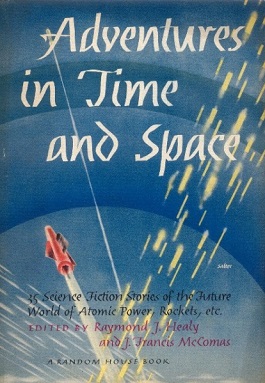
for some odd reaso my attempt to include the dust jacket illustration is failing
Adventures in Time and Space
Dust-jacket from the first edition
EditorsRaymond J. Healy and J. Francis McComas
CountryUnited States
LanguageEnglish
GenreScience fiction
PublisherRandom House
Publication date1946
Media typePrint (hardback)
Pages997 pp
Adventures in Time and Space is an American anthology of science fiction stories edited by Raymond J. Healy and J. Francis McComas and published in 1946 by Random House. A second edition was also published in 1946 that eliminated the last five stories.[1] A Modern Library edition was issued in 1957.[2] When it was re-released in 1975 by Ballantine Books, Analog book reviewer Lester del Rey referred to it as a book he often gave to people in order to turn them onto the genre. It is now once again out of print.

The book and A Treasury of Science Fiction were among the only science fiction hardcover books from large, mainstream publishers before about 1950.[3] The large (997 page) anthology collected numerous stories from the Golden Age of Science Fiction, which had originally appeared in pulp magazines (mostly Astounding Science Fiction) and are now regarded as classics of science fiction. According to Frederik Pohl, it was "A colossal achievement...the book that started the science-fiction publishing industry!"[4] In 1954, Anthony Boucher described it as "the one anthology unarguably essential to every reader."[5] In Astounding readers' surveys in both 1952 and 1956, it was rated the best science fiction book ever published

Contents[edit]
 
Last edited:
Thanks Windshadow for your particularization of the contents of Adventures---. I've mentioned it perhaps a dozen times, including that it was the stor(ies) that most influenced me to read Science Fiction.
I mentioned the Boucher and Pohl comments, mostly as incitements to others here to pick it up.
It wasn't just that it came out from Random House and then Modern Library, but that this was a unique recognition that the field was more than pulp trash but was creative literature worthy of notice.
The only two comparable recognitions that I can think of are that SFF is now mentioned, often with it's own review column, in the NYT. The other being that The Library of America has republished many SFF authors, including six volumes of LeGuin alone, three of Phil Dick, three of Vonnegut plus even more of classic authors and compilations such as The Future Is Female. They have volumes of novels from specific periods that include a huge number of the most remarked on workls mentioned here or elsewhere. See LINK and click on a few of them.
Back to Matt.
 
Last edited:
Thanks Pogo,
More than a few authors I know only from their short story in this book not all of them achieved the fame that so many there found.

As an out-of-print book, originally published in 1945, clearing the rights from the estates or current rights holders of so many Authors who have died must not be a simple problem or there would be a Kindle version.

I had a quick look in the Gutenberg project but did not see it there; but of course, I would not be surprised if there was not a rather roughly scanned and OCRed version lurking on the grubby grey web.
 
We
As an out-of-print book, originally published in 1945, clearing the rights from the estates or current rights holders of so many Authors who have died must not be a simple problem or there would be a Kindle version.

As an excellent alternative, the Science Fiction Hall of Fame anthologies are available as ebooks.
 
I apologize for mentioning Earth Abides in post 424, although I believe that it was already on your list. Hadn't read it. Just mentioned it based on rep.
Feeling obligated to read/finish something really bites the big one doesn't it? It's the reason that the one course I flunked in college was Sociology - and hate it to this day.
 
I apologize for mentioning Earth Abides in post 424, although I believe that it was already on your list. Hadn't read it. Just mentioned it based on rep.
Feeling obligated to read/finish something really bites the big one doesn't it? It's the reason that the one course I flunked in college was Sociology - and hate it to this day.
Haha! was wondering after I posted that if anyone would say "hey, that's my favorite book!" Yes, it was already on the list, based on rep and fame, etc. It's not poorly written prose wise, but it's a reader abuser from my perspective, especially after a fun read like Space Beagle. Glad you mentioned school because what I'm doing is really putting myself (with help of gallery) through a long, rigorous Sci Fi novel survey class. I can't drop a book no matter how excruciating, because there *will be a quiz* (review). But like you said, it can also inspire hate! :)

(added)

Arguably, it does have a place on the list, and it fills a time-gap (40's). That's the main point, not wether I personally enjoy it. What a noble scholar, eh? Btw, again - I am always grateful for ideas about the list from you all, regardless of my subjective responses.
 
Last edited:
Matt, I covered in detail my thoughts about
and why you should read it for background on the 30s and 40s even though it is short stories and novella-length writing and your project is novels only but do give it a thought to reading it for a background of the early days of the genre.

Having it to hand would also help when you must plow through books like Earth Abides which I also kicked to the curb after about 40 pages as best I recall... it was a very long time ago and I may have just stood in the book shop and read enough to decide I did not want it, in the 60s when I was frequently short of cash,
 
Earth Abides is sooooooo f-in' boring...

My feeling about that was that it was that way largely because it is also realistic. No Nuclear power stations tinkered together with coconuts and bamboo à la Gilligan's Island - just non-specialist ordinary people making do with what is at hand.
 
Earth Abides is sooooooo f-in' boring...

That's because you are only looking for lowbrow entertainment and don't appreciate literary quality... nah, just kidding! I haven't read this one because somehow I had the suspicion that it's one of those books that's easier to admire than to like.
 
My feeling about that was that it was that way largely because it is also realistic. No Nuclear power stations tinkered together with coconuts and bamboo à la Gilligan's Island - just non-specialist ordinary people making do with what is at hand.
Atrem, read it recently? I often like naturalistic and realistic tales, and "quiet stories" with largely inner action, (e.g. Kraken Wakes, Long Tomorrow) but this book is just way out of balance, IMO. It's painfully trivial, not realistically trivial and protag is just not all that! I will give it a fair chance - I got 145 pages left (to grind through). Will keep an open mind, but I have my doubts it will in any way substantially satisfy *as a story*. :-) Review coming as soon as I can bore through to the end! lolol
 
Matt, I covered in detail my thoughts about
and why you should read it for background on the 30s and 40s even though it is short stories and novella-length writing and your project is novels only but do give it a thought to reading it for a background of the early days of the genre.
Thanks, Windy, you and the gang have emphasized the importance of this collection, and the gallery's wish is my command! Will try to read it first when I get to stories.

Having it to hand would also help when you must plow through books like Earth Abides...
Ugh, Windy, I resolved not to do any side-reading during the novels, so I'm doomed! Who ever knew fun could be such a drag, hahaha... jk. Reading this is like running up hill with weights strapped to your ankles... makes for a beefy readership. Getting the reading-equivalent of tremendous calf muscles. :)

Only hope for a pallet cleanse will be the next book I select.
 

Sponsors


We try to keep the forum as free of ads as possible, please consider supporting SFFWorld on Patreon


Your ad here.
Back
Top