Heinlein Rereads: Citizen of the Galaxy by Robert A Heinlein

Joined
Apr 18, 2015
Messages
1,249
It begins with a slave auction… and ends up as a revolution. Here’s the latest reread of Heinlein’s works, as Mark continues his intermittent re-read of Robert Heinlein’s novels through the Virginia Edition series. With the latest juvenile in the series (after Time for the Stars) we’re back to that now-common Heinlein bildungsroman. Citizen is a tale […]

Continue reading...
 
It begins with a slave auction… and ends up as a revolution. Here’s the latest reread of Heinlein’s works, as Mark continues his intermittent re-read of Robert Heinlein’s novels through the Virginia Edition series. With the latest juvenile in the series (after Time for the Stars) we’re back to that now-common Heinlein bildungsroman. Citizen is a tale […]

Continue reading...

I enjoyed reading that.
 
I have probably read it at least 4 times. I think it is his best juvenile, as they call it.

I think this is the best cover:
96b58867cf17644354a9cbca9db6748c.jpg


but this is the one I first bought:
45ede9e802bf24679f65b3e010fbda4e.jpg

psik
 
My original cover, I think. From 1972, so it sounds about right:

citizen.png

I think it is his best juvenile, as they call it.
Yeah, I mentioned that a lot of people think that in the review, I believe, though as I've started the prep on the 'last juvenile', "Have Spacesuit, Will Travel" there's a lot of people who think that that is the best. Mind you, there's a few people trying to claim that Podkayne of Mars was the last juvenile, so I'll mention that as well. And of course Starship Troopers was originally envisaged for the juvenile market, as well.
 
I had that same Penguin cover, Hobbit. Re-read it so many many times it was held together with sellotape until I replaced it with that first one that psikeyhackr linked. Still have that original somewhere though. Not only my favourite of the juveniles but for many years through my teens and beyond one of my favourite novels by any author.

The thing that continues to impress me to this day is its brevity and concise nature. In this age where we're bombarded with books the size of the Yellow Pages which are little more than the prologue for a multi-novel epic here we have an entire story, a journey complete with beginning, middle and end all contained in less than 300 pages and yet after reading it seems like it was much longer. That, I think, is a testament to Heinlein's craft. One which sadly seems to be a dying art.
 
The thing that continues to impress me to this day is its brevity and concise nature.
Hi Jim. You've made a good point, and as you may know it is something typical of the time. Most of the novels were about 200 pages and brevity, due to printing costs and paper shortages and the like, was the norm. Part of it may be the 'sell by wordage' that some of the pulp magazines were still using, though sales to novels (which Heinlein was doing very very well at) would phase a lot of that out. I'm sure that there is an inverse correlation between the loss of the pay per-cent and the growth in the number of pages. :)

You are right, though, in my opinion. Heinlein by this stage was the master of the sentence, each word, sentence paragraph honed and edited for maximum effect. It is something that I've noticed more as I've read them chronologically, which I have never done before. And as this is towards the end of the so-called juvenile period, with Double Star and The Door into Summer under his belt, that he really was on a roll.

I'm still not sure why Citizen doesn't rank higher on my list of good-'uns. It is skillfully written, has all those elements that I've liked in the past, and although the ending's a bit weak, its not a disaster by any means - in fact, it shows the reader that big complex problems cannot be solved so easily.

I've mentioned it in my review: I totally admire what he was doing, but for me its not a favourite. Still surprises me.
 
Hobbit said:
Heinlein himself said to Miss Dalgleish that “The message [my work] carries – the message I try to put into my stories – is that all customs change, but that a free man with a free mind, a mind willing to study hard to learn the immutable truths, is at home anywhere, on any planet, in any culture.”
I love that note thanks of including it in the review.
for me it is not my favorite of his juvenal novels (as you note the weak ending lets it down a bit) it is still a favorite and gets reread every decade or so.
sorry i have not been posting but i broke my neck 6 weeks ago, C2 no neurological impairment thank the stars, beyond extremely high levels of right occipital nerve pain controlled by Gabropentin but i have another 6 weeks or aspen cervical collar 24/7 before i can drive a car again so i am effectively under house arrest as i live alone in a semi rural area. meds are now cut back to a point where i can type with some semblance of coherence if not yet sensible punctuation! so expect more of my rambling posts to return to the fora here.
 
Last edited by a moderator:
It does seem to be one that people re-read.

And thanks for the thanks, Windshadow. One of the reasons I'm reading the Virginia Editions is because there is an Introduction that includes background details like that. I would recommend the William H. Patterson biographies if you can get them. They are not perfect, by any means, but they do give us more of an idea of this complex writer.

Get well soon, Btw. It sounds horrendous, but we hope you're more mobile soon. :)

M.
 
I did a complete read of Heinlein's juveniles and it was a very enjoyable experience. The lack of computers was strange for a modern reader, of course, but the storytelling was very good. It's no wonder so many kids were inspired by those books in their time.
 
Any author setting out to write YA books will greatly benefit from a study of the series of YA book by Robert Anson Heinlein. Yes it shows that he wrote in the 1950s.... No personal computers etc but I for one have no problem putting that to one side

RAH made a point of not dumbing down the vocabulary to meet any set of standards for a given age range. He did make it a bit easier to discern the meaning of fifty cent words from their context but he was on record that he expected his young readers to have a dictionary at hand when they read his YA books. In this sense his books were educational. Though I recall being told by my town librarian when I was six or 7 years old that the book I had selected (I think it might have been Double Star) was too hard for one of my age... and would I not prefer an Uncle Remus book with lots of colorful Disney pictures? Thank goodness my Father was also in the library and told her that if i wanted to check out Ulysses she should keep her council to herself unless specifically requested to provide it by either of his children.... that I still read 5 or 6 books a week at age 68 I ascribe in part to his attitude... that and his teaching me to use a dictionary at a very early age.
 
Though I recall being told by my town librarian when I was six or 7 years old that the book I had selected (I think it might have been Double Star) was too hard for one of my age... and would I not prefer an Uncle Remus book with lots of colorful Disney pictures?

Don't you know all 7 year olds are identical? How dare you not conform?

What do you mean, what you read made you different? No wonder SF should be banned!

This is about the best review I have see:

What’s interesting is that Heinlein, ever the ideologue, uses this framework to impart some very, dare I say, edifying ideas. Don’t get me wrong, this is still a rollicking adventure story that pulls the reader along for the ride, but this turns out to be a candy coating. The first hint is that as the protagonist’s life progresses through stages from grim existence to ever more elevated positions (beggar, trader crewman, soldier, magnate) he becomes less and less happy. Toward the end, after shocking a long lost relative with a brief account of his early life, he laments that his days as a beggar were the happiest of his life.
https://matthilliard.wordpress.com/2009/07/07/citizen-of-the-galaxy-by-robert-heinlein/

The ending isn't what one would expect from most similar SF but everntually I have come to conclude it is better than the Pablum I expected. Like the song says, "I never promised you a rose garden...".

psik
 
Thanks for your re-read review, Mark.

I've found my original version (starting in Astounding, January 1958) and I'm going to read it again as well,
musty old paper and all ..

erbz2a.jpg
 
And thank you for your kind words, Darkflow! You know, I've got the UK edition of the Astounding issue, too
20160917_113656(0).jpg :
 
An extra shilling for the one from OZ (well 11 pence if we are being picky)

That'll be the postage & packing.... :)

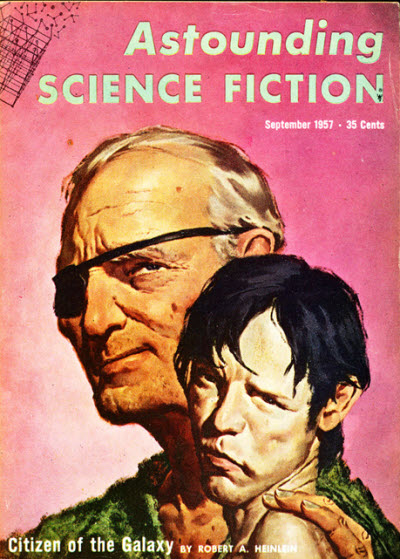
Generally though, these international editions of the magazine, due to paper rationing in the UK, had fewer pages than the US editions, and were usually often a couple of months behind the US edition. So the UK/Aus edition was January 1958, whilst the US edition was September 1957:

astounding_science_fiction_195709.jpg


I've been told that the UK covers were never the same as the US editions at this stage but (presumably for copyright reasons) were redrawn, even if they look pretty much the same!
 

Sponsors


We try to keep the forum as free of ads as possible, please consider supporting SFFWorld on Patreon


Your ad here.
Back
Top