It begins with a slave auction… and ends up as a revolution.
Here’s the latest reread of Heinlein’s works, as Mark continues his intermittent re-read of Robert Heinlein’s novels through the Virginia Edition series.
With the latest juvenile in the series (after Time for the Stars) we’re back to that now-common Heinlein bildungsroman. Citizen is a tale that begins with a relatively uneducated young man and shows that with a suitable education, administered through an appropriate mentor, good can make a difference.
The plot of the book is in three main parts. In the first, a boy we later know as Thorby is bought and brought up by a crippled beggar, Baslim. Despite Baslim’s disabilities, Thorby is given an education in life that enables him to make progress.
This leads to the second part of the plot, where Thorby is smuggled onto a spaceship as a favour to Baslim and is accepted as part of the Free Traders. This is, at first glance, typical old-school Heinlein. Whilst with the Free Traders in space Thorby is given a broader education. Much of this is adapting to new cultures and lifestyles as well as being trained as a fire controlman, until Baslim’s debt is repaid and Thorby is handed over to the military.
The final section of the story is when Thorby, now a young adult, makes good on his promises to his mentor. His identity is revealed and Thorby takes on the mighty legal departments of Earth.
My first thought at the end of this one is that it is much better than I remembered. It is a book where each part plays to Heinlein’s strengths. We have the first section, which shows Thorby developing his ideas of freedom and managing against the odds. In the second section, the plot, like in Space Cadet, shows that once Thorby can accept his new-found ideas of freedom, he can integrate into a bigger group, either in the military or with his space ‘family’. The final part of the book has Thorby knowing his original identity but, like in The Star Beast, is back in court using lawyers to help fight for a cause.
This may be why I remember it less fondly than some of RAH’s other juvenile novels read so far. The book is good, but there are parts where I feel I’ve read them or been there before. This made me feel that the novel is not entirely new, though it is perhaps the most effectively crafted of the books so far, albeit with a weak ending.
As usual by now Heinlein mentions a diverse range of races and cultures throughout, something RAH traditionally revels in. There are brief but telling mentions throughout of class systems, alien races, unusual languages and strange customs, reflecting that in RAH’s universe diversity is to be admired and appreciated.
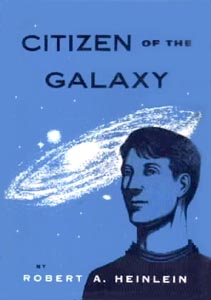
And yet on rereading I can’t help that my overriding emotion was that, on the whole, I’d been here before. Was Heinlein treading water? There have been comments made on the similarities between Rudyard Kipling’s adventure novel, Kim (1900-1901) and Citizen. Even our two biographers say here that the framework for Kim was an incentive for Heinlein, but then so was Mark Twain’s The Prince and the Pauper. Whilst there are general similarities – both Kim and Citizen have scenes set in a market bazaar, and both act as couriers for older mentors, for example – I felt that these were mere inspiration rather than deliberate homages.
Nevertheless I am starting to feel that the pressure on Heinlein ‘to produce’ is starting to make an impact. It is clear from the introduction of the book (written as usual by Robert James and William H. Patterson) that the stress for Heinlein was getting to be a problem, almost a “make or break” situation. Heinlein wrote in correspondence that:
“The kid’s books worry me too much. Each one means four months of chronic insomnia and physical debilitation simply because I am so acutely conscious that so many censors stand between me and my readers.”
This was in part due to the ongoing, increasingly fractious relationship with Heinlein’s editor of the juvenile novels, Miss Alice Dalgleish which I have mentioned of in previous rereads. By this book, the penultimate juvenile novel, Heinlein still continues to push the boundaries about what is acceptable for teens. One of the amusing highlights of the middle part of the novel is when there is the discovery that comic strips and pin-up magazines become worth valuable commodities for trade on the planet of Finster. The mention of girlie magazines is something that Miss Dalgleish was unhappy about, although James and Patterson claim that there were no problems with the manuscript at first.
Having said that, as in previous books, Heinlein generally champions the cause of women throughout the book by having them as key characters integral to the plot. When on board the spaceship, Thorby finds himself being beaten in training by a girl, which does not initially go down well. Leda Weemsby takes part in one of the most important events of the book in the last part of the novel, as well as becoming a girlfriend to Thorby, and to me was rather reminiscent of The Star Beast’s competent Betty Sorenson. The book is a richer experience for such plot points.
Despite this, I am also sure that the ending of the novel, with Thorby in a bar watching pretty girls, is not only there to make the point that Thorby is ‘grown-up’, but possibly also an attempt to test Miss Dalgleish. The end of the juvenile novels, especially as the adult books were becoming internationally profitable, is now in sight.
So: what are the aims of the novel? Clearly one of its’ purposes is to write an adventure tale, in space, that will entertain but also present key beliefs of Heinlein’s in an acceptable form, something we will see more and more of in later writing. As I’ve suggested already, it is an attack on racism, gender roles and restrictions to freedom.
Perhaps most of all though, Citizen is Heinlein’s own take on the journey of a boy who makes that rite of passage into a man. Heinlein himself said to Miss Dalgleish that “The message [my work] carries – the message I try to put into my stories – is that all customs change, but that a free man with a free mind, a mind willing to study hard to learn the immutable truths, is at home anywhere, on any planet, in any culture.”
This concept of ‘freedom’ is confirmed further in Heinlein’s other letters. In Volume 2 of his biography, Patterson quotes part of a correspondence from RAH to John W. Campbell of Astounding when Campbell was considering changing the novel title to “The Slave” in the magazine serialisation. Heinlein replied, to explain why the title should not be altered, saying “… my basic theme is that all creatures everywhere are constrained by their circumstances but that a mature creature (that is to say a “citizen”) faces up to the constraints in a mature fashion, not evading, not ducking, not taking the easy way. This certainly does not make him a slave even though it may require of him a self-discipline more stringent than the externally – imposed discipline of a slave…” (page 141)
And this is what Thorby does, from being a slave on the planet of Jubbulpore to being in the jungle of the legal system on Earth. Whilst I take RAH’s point, and after all, he is the author, I do think that Campbell’s point has a lot of merit. Though Thorby is often in different circumstances, he is still often a slave to external forces, be they social, economic or political. Whilst there is closure at the end of the novel, it is not a book with all problems solved, something I don’t think I appreciated on first reading.
Of the characters, many of the now-classic Heinlein templates appear. I have mentioned Leda already. Thorby himself is a typical protégé, willing to learn and improve his lot in life, like Rod Walker of Tunnel in the Sky or Matt Dodson of Space Cadet. Baslim is, despite the loss of one eye and part of one leg, the now often used father-figure-mentor, determined to do his best to help Thorby achieve his potential.
To add to this we also have Jim Garsch, a lawyer who is a proto- Jubal Harshaw but who is also similar to those met already in The Star Beast. Lastly we have military men and women who are similar in tone and style to those already met in Space Cadet.
Throughout the novel one moral message is clear – don’t waste your time when growing up, make the most of the education that is offered to you, wherever it comes from and however you get it. In the hands of a modern author Citizen could so easily turn into a revenge tale, with Thorby taking bloody vengeance on the slavers and masters who had dealt with him so badly in the past. However Heinlein cleverly looks forward rather than back – an early case of ‘Pay it Forward’, perhaps? – and ensures that Thorby uses his newly-acquired abilities for positive change for others rather than for bad. Ah, positive message….
One interesting side point I noticed here. In Citizen RAH refers again to tachistoscopic training based on the ideas of Doctor Samuel Renshaw, where light hypnosis helps people remember by rote long messages. This idea was already mentioned in Gulf (1948) but here they help Thorby absorb messages he does not understand. The idea will appear again in Stranger in a Strange Land.
In summary, Citizen of the Galaxy is surprisingly good. It effectively refines what has gone before, taking now- traditional Heinlein themes and ideas and distilled them into something surprisingly complex. It shows a confident author, clearly enthused by his recent writing, at the height of his considerable powers.
Whilst there are minor glimpses of the troubles in Heinlein’s writing to come, at this stage most of his own views and his lecturing are kept in check, allowing a thoroughly entertaining tale to emerge. If I remember rightly, I originally read this as my third Heinlein (Tunnel & Red Planet going before it) and I’m surprised I didn’t rate it higher than I remember, though I think my re-read and comments above have in part explained that.
Don’t let me put you off though. This is about as effective a one-book summary of Heinlein’s work to this point as you can get. It is still a shock to realise that this was all written and published before Sputnik’s launch in October 1957.
Next (probably about 2020!): Have Space Suit Will Travel.
Citizen of the Galaxy was originally serialized in Astounding Stories (September, October, November, December 1957) and published in hardcover in July 1957 by Scribners.
Virginia Edition published December 2008, with minor corrections. Volume 20. Introduction by Robert James and William H Patterson.
ISBN: 978-1-897350-25-6
220 pages
Review by Mark Yon, August 2016