Science fact thread

This implies that life can exist in all types of environments, not just those that contain oxygen and h20. Many more then we've even thought of before now.


It only implies that life can exist in places once thought impossible... on a planet already teeming with life. If Earth is the ideal situation for life than those creatures that have found a niche, no matter how inhospitable, have done so under the perfect conditions.
 
Because I'm using science and just plain playing the odds... using the Drake Equation.

Verschuur presented his take on the Drake equation, formulated by astronomer Frank Drake in 1960, that provides a means for calculating the number of intelligent civilizations that it is possible for humans to make contact with.

The equation relates those chances to the rate of star and habitable planet formation. It includes the rate at which life arises on such planets and develops intelligence, technology, and interplanetary communication skills. Finally, it factors in the lifetime of such a civilization.

Using Drake’s equation, Verschuur calculated there may be just one other technological civilization capable of communicating with humans in the whole group of galaxies that include our Milky Way — a vanishingly small number that may explain why 30 years of scanning the skies for signs of intelligent life has come up empty.

“I’m not very optimistic,” Verschuur said.

That's because you are using the Drake equation for estimating intelligent civilizations, not for extraterrestrial life.

Drake himself was involved with the SETI project that is doing the searching for radio signals. Drake was far more optimistic then this Verschuur fellow. (There are also many reasons why ET may not be suing radio, including quantum level communication, or more likely that they've long gone on to singularity status. We've discussed this already.)
Drake himself is inclined to a more modest estimate for N, namely that there are approximately 10 thousand technological civilizations sprinkled through the Milky Way. If he’s right, then our nearest neighbors will be 500 to 1,000 light-years distant. That’s a fair piece, although it’s only one percent of the distance across the Galaxy.

The plain and simple fact is that we won’t know the mileage to ET’s home turf until we find a signal. But unless you’re of the opinion that the Galaxy fizzes with more than a million inhabited worlds, the distance will be at least 100 light-years. Conversation – should we ever attempt it – will be mighty slow. Two centuries for a query and a reply, minimum.

My understanding is that SETI has investigated something like 1000 star systems. I believe they are all well within 100 light years of Earth. The vast, vast majority of the galaxy remains to be investigated by SETI.
 
Why would we expect that? When you have only one data point, that being the Earth, extraoplations from it is fantasy not true science. As of this minute we have no way of knowing if life is rare, common or utterly unique. No matter what we believe what is needed is more data.

there's an interesting 'proof' of probability maths I saw years ago which takes the chances of the 4 bit system of the 'rungs' of DNA and the 21 bit system (freestyling without wiki) of the helix chains combining means (probabilistically) that either life is everywhere because this is an imperative or else statistically we're alone...

it got published and stuff but it's one of those.. no idea....

my wife and I are discussing it at the moment. It's weird man. We SHOULD be able to see radio looking back through time and distance.

it weirds me out. We simply CAN'T be that important...?

i want answers frankly...
 
Because I'm using science and just plain playing the odds... using the Drake Equation.


I think once you realize that humanity will someday be extinct, as all life on this planet will become no more, then you can better appreciate the mounting odds against life in the universe. Leastwise life that is capable of communicating with us through the dead of space.


THAT'S what I currently choose not to accept personally. I choose to continue on the assumption that my actions are not dead ended. My moral vector counts for something.

not sure how... not really my problem. Current solution is reading a lot of sci-fi...
 
That's because you are using the Drake equation for estimating intelligent civilizations, not for extraterrestrial life.

Drake himself was involved with the SETI project that is doing the searching for radio signals. Drake was far more optimistic then this Verschuur fellow. (There are also many reasons why ET may not be suing radio, including quantum level communication, or more likely that they've long gone on to singularity status. We've discussed this already.)


My understanding is that SETI has investigated something like 1000 star systems. I believe they are all well within 100 light years of Earth. The vast, vast majority of the galaxy remains to be investigated by SETI.

if I were super advanced first thing I'd do would be set up a strobing beacon with maths in it. It's feasible to imagine getting to the stage where you can build a mirror in space ffs. Oldschool bounce your sunlight off a very slightly convex switchable mirror and point it to a new ish galaxy just for a laugh. If there was a lot of life someone would be flashing! surely!

I just don't know anymore!!! guh.
 
THAT'S what I currently choose not to accept personally. I choose to continue on the assumption that my actions are not dead ended. My moral vector counts for something.

not sure how... not really my problem. Current solution is reading a lot of sci-fi...


We all still wake up in the morning and live our lives; though they have no meaning or intrinsic value beyond our brief existence on Earth.
 
not for me though, personal choice!

"do the best you can" from my point of view has lasting consequences...
 
My understanding is that SETI has investigated something like 1000 star systems. I believe they are all well within 100 light years of Earth. The vast, vast majority of the galaxy remains to be investigated by SETI.

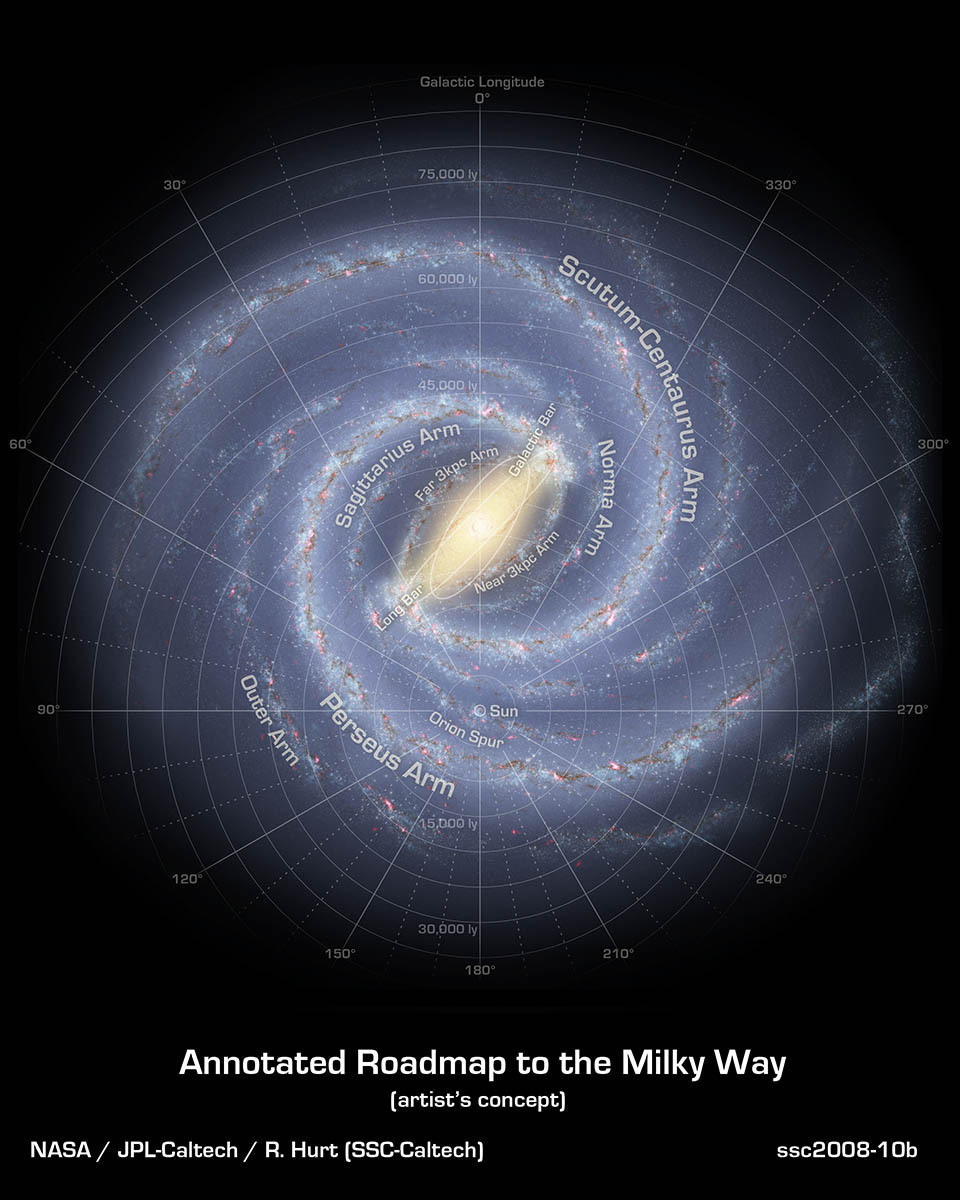
I wanted to add some perspective about SETI. This is my favorite representation of the Milky Way, as seen from above:

ssc2008-10b_Sm.jpg


http://www.spitzer.caltech.edu/images/1925-ssc2008-10b-A-Roadmap-to-the-Milky-Way-Annotated-

(The Spitzer Telescope Site is one of my favorites.)

The small circle around our sun is approximately 100 light years. The SETI project clearly has a long way to go. My recollection from the December 2009 National Geographic article is that the project has investigated 100 light years towards the 60 degree longitude of our Orion Spur location in the galaxy. Keep in mind this includes a search area above and below the galactic plane.

The new Allen Array Telescope will help immensely in the search, but there is a new idea emerging. A name familiar to most of us around here, Gregory Benford, thinks we need to look along the 0 longitude, towards the galactic "bars" of the very center of the Milky Way Galaxy:

But where to look? The Benfords' frugal-alien model points to our own Milky Way galaxy, especially the center, where 90 percent of its stars are clustered.

"The stars there are a billion years older than our sun, which suggests a greater possibility of contact with an advanced civilization than does pointing SETI receivers outward to the newer and less crowded edge of our galaxy," Gregory Benford says.

http://www.sciencedaily.com/releases/2010/07/100721094231.htm
 
The new Allen Array Telescope will help immensely in the search, but there is a new idea emerging. A name familiar to most of us around here, Gregory Benford, thinks we need to look along the 0 longitude, towards the galactic "bars" of the very center of the Milky Way Galaxy:

There are other problems with what SETI is searching for; if for example an alien species sent out radio bursts, or put on a light show, or some other type of energetic signal, that it would be washed out by other cosmic events such as gamma bursts.

What happens if we find out that it is us who are the superbeings?
 
Then we shall RULE this universe and plough their puny civilisations into the mud of their conquered worlds......most likely.:eek:

What amazes me most about our universe is that it's only some 14 billion years since the Big Bang. That really isn't very old. What if we're first generation life and our species is the only hope for spreading life amongst the stars?
 
There are other problems with what SETI is searching for; if for example an alien species sent out radio bursts, or put on a light show, or some other type of energetic signal, that it would be washed out by other cosmic events such as gamma bursts.

For sure that is an issue, but IMO, cosmic events would be much more likely to wash out the types of radio-like signals they are looking for now.

What happens if we find out that it is us who are the superbeings?

Anything is possible, but given the relative age of Earth and the Universe, much more likely that the opposite will be the case. More on this later...
 
What amazes me most about our universe is that it's only some 14 billion years since the Big Bang. That really isn't very old.

But the Earth is only around 5 billion years old. That's 10 billion years for life to evolve elsewhere. You probably realize our sun and everything in our solar system, were once part of first generation stars...

"Recognize that the very molecules that make up your body, the atoms that construct the molecules, are traceable to the crucibles that were once the centers of high mass stars that exploded their chemically rich guts into the galaxy, enriching pristine gas clouds with the chemistry of life. So that we are all connected to each other biologically, to the earth chemically and to the rest of the universe atomically."-- Neal deGrasse Tyson

http://www.goodreads.com/author/quotes/12855.Neil_deGrasse_Tyson

Back to the SETI project, I do have some reservations about this whole "contact" thing. Probably the same ones that Stephen Hawking had recently mentioned.

It seems very likely that if ET is out there, that their civilization has achieved something like singularity status. What if they've moved on, but they've left behind something like Fred Saberhagen's "Bezerkers" or even something like "The Borg"? (Not a big fan of "Star Trek", but I think machine intelligence is very likely.)

I think Banks may have also had some ideas in this area, "The Sentinels"? Do we really want to make "contact" with the Bezerkers? :D

Come to think of it, if there are all-life-must-be-destroyed AI's out there, it may be why wiser species than our own will not be advertising their presence.

What if we're first generation life and our species is the only hope for spreading life amongst the stars?

While I think it is unlikely we are first-generation life, it is certainly possible that the "Bezerkers" have managed to already wipe everybody else out.

I do sense that you seem to be opening up a bit to the idea of humans exploring space, Sparrow. Good. :)

Even if there are hostile AI's out to destroy all living entities, it is just as likely in my view that meanwhile something else has evolved to deal with it. Lets all hope humanity gets a chance to find out if that is the case, eventually...
 
Back to the SETI project, I do have some reservations about this whole "contact" thing. Probably the same ones that Stephen Hawking had recently mentioned.

It seems very likely that if ET is out there, that their civilization has achieved something like singularity status. What if they've moved on, but they've left behind something like Fred Saberhagen's "Bezerkers" or even something like "The Borg"?

I think Banks may have also had some ideas in this area, "The Sentinels"? Do we really want to make "contact" with the Bezerkers? :D

Come to think of it, if there are all-life-must-be-destroyed AI's out there, it may be why wiser species than our own will not be advertising their presence...

You sound apprehensive about contact with other beings. It sounds like reading too much sci-fi has left you paranoid. Would you like to talk about it?

The problem with the idea of invading aliens is that, realistically, the times and distances involved in space travel make the idea completely impractical. The other big assumption is that aliens would be aggressive to begin with. It's largely the invention of writers projecting human mores onto alien-analogues, and I've never bought into it at all.
 
But the Earth is only around 5 billion years old. That's 10 billion years for life to evolve elsewhere. You probably realize our sun and everything in our solar system, were once part of first generation stars...

How many billion years before the first galaxy clusters formed?
Some scientists suspect that supernovae are necessary for life, at least creating some of the building blocks for life... sometimes called the Left Hand of God...
http://www.astrobio.net/exclusive/3582/supernova’s-spin-on-life

... which means you would have to wait for first generation stars, the really large ones, to go supernova and seed parts of the universe with these exotic materials.

Back to the SETI project, I do have some reservations about this whole "contact" thing. Probably the same ones that Stephen Hawking had recently mentioned.

It seems very likely that if ET is out there, that their civilization has achieved something like singularity status. What if they've moved on, but they've left behind something like Fred Saberhagen's "Bezerkers" or even something like "The Borg"? (Not a big fan of "Star Trek", but I think machine intelligence is very likely.)

Why would they do that?
Remember, the science fiction we've all read for so many years may have nothing to do with reality. Aliens that advanced would have nothing to fear from us, so why on earth would they go to such extravagant measures to destroy creatures that have barely learned to walk upright?

And why stray so far from what scientific observation tells us?

We have searched three decades for something, anything, and so far as we know we are alone.


I think Banks may have also had some ideas in this area, "The Sentinels"? Do we really want to make "contact" with the Bezerkers? :D

Come to think of it, if there are all-life-must-be-destroyed AI's out there, it may be why wiser species than our own will not be advertising their presence.

Again, why do aliens always have to be out for blood?
The entire notion seems preposterous.


While I think it is unlikely we are first-generation life, it is certainly possible that the "Bezerkers" have managed to already wipe everybody else out.

For what purpose would it serve, self preservation?

I do sense that you seem to be opening up a bit to the idea of humans exploring space, Sparrow. Good. :)

I'm not open to the idea of manned missions to the Moon, Mars, the Moons of Jupiter, or any place for that matter. Our priorities are here on Earth.

Even if there are hostile AI's out to destroy all living entities, it is just as likely in my view that meanwhile something else has evolved to deal with it. Lets all hope humanity gets a chance to find out if that is the case, eventually...


There's no finding out anything if what I suspect is true, we are alone in the galaxy and whatever other intelligent life may exist are simply too far away to worry about... or are intelligent in the way other creatures on Earth are.

You seem to believe the universe is awash in life?
Yet there is nothing, leastwise that we can observe, that would support such a belief.
 
Last edited:
Great thread!

I've been doing a bit of research for a new novel.

Since it appears there are quite a few scientists on this thread, I wanted to ask: I've read a few studies on the quark and I have two questions;

1. Has anyone ever come close to actually seeing it?
2. Is it considered the smallest particle?

Excuse my ignorance, but I'm finding a hard time finding 'reputable studies' online. It's hard to filter out the fact from fiction.
 
Great thread!

I've been doing a bit of research for a new novel.

Since it appears there are quite a few scientists on this thread, I wanted to ask: I've read a few studies on the quark and I have two questions;

1. Has anyone ever come close to actually seeing it?
2. Is it considered the smallest particle?

Excuse my ignorance, but I'm finding a hard time finding 'reputable studies' online. It's hard to filter out the fact from fiction.


That fact that you are questioning what's out there and what the research shows, and doesn't show, means you're already brighter than most.
Most folks who are into SF assume String Theory to be beyond doubt.

String Theory has been the darling of the cosmic community ever since it was proposed... and it goes unproved to this day.
 
Come to think of it, if there are all-life-must-be-destroyed AI's out there, it may be why wiser species than our own will not be advertising their presence.

it's so tempting to speculate that that's why it's so quiet out there.... Keeping one's emission profile to a minimum might well be sensible decision until we know a little more. I have to concede that to Hawking.

@sparrow, this is all a cost benefit analysis thing. I think we should be pursuing everything we're capable of. You can't 'retask' space scientists to sort out more beds in hospitals, and we might have one chance to get into space and start bringing back important minerals from the solar system. We're nearly out of metals.

metals.jpg


In what way can we afford NOT to invest in this? Even speculatively.
 
Last edited:
You sound apprehensive about contact with other beings. It sounds like reading too much sci-fi has left you paranoid. Would you like to talk about it?

;) Yeah put me on the couch, you jackwagon...


The problem with the idea of invading aliens is that, realistically, the times and distances involved in space travel make the idea completely impractical. The other big assumption is that aliens would be aggressive to begin with. It's largely the invention of writers projecting human mores onto alien-analogues, and I've never bought into it at all.

OK, you've never bought into it. Would you please send Mr. Hawking to the same therapist?

Stephen's been reading way too much Banks and Saberhagen lately, right?

Maybe I can put things in another way, in just two words:

Cosmic Dice

To me, that was the point of the anti-climatic NASA announcement last week.

Its all about possible combination's of the basic building blocks. Life's cosmic dice now has at least one more possibility of coming up positive. (Titan Squidworm maybe?) :D

The Universe got another spin at the Cosmic Dice last week:

According to Yale's Professor Pieter van Dokkum, who led the research, the discovery also increases the estimate for the number of planets in the Universe and therefore greatly increases the likelihood of life existing elsewhere in the cosmos.

"There are possibly trillions of Earths orbiting these stars," he said. "Red dwarfs are typically more than 10 billion years old and so have been around long enough for complex life to evolve on planets around them. It's one reason why people are interested in this type of star."

http://www.bbc.co.uk/news/science-environment-11888362

When I throw an idea like "hostile AI" out here, I do it for two reasons:

1) It is just one of millions of possible ET equations that we can speculate about. I happen to think the odds of AI being hostile are certainly worth a wager. Probably something like 10 to 1 against, hopefully higher.

2) It is fun and good for a few laughs. :D

Steven, I was hoping you would respond to that WMAP link I speculated about a few replies back? :)
 

Sponsors


We try to keep the forum as free of ads as possible, please consider supporting SFFWorld on Patreon


Your ad here.
Back
Top