Trouble with reading older sf works?

.....I remember reading somewhere (or maybe I dreamt it) that for years the clay tablets written in Linear B, some of the earliest written records we have, were indecipherable mysteries. When Linear B was was finally cracked one of the first things translated was a letter from someone complaining that the youth of the day had no respect for their elders and the world was going to pot*.

*I've no idea if this is true and don't want to spoil a good story by trying to find out. Print the ****ing legend!

I think that the quote is rather later and may be attributed by Plato to Socrates. Google suggests that it comes from the Republic Book 4. A slightly older view on modern days comes from Homer's Iliad which has in Alexander Pope's translation of Book XX, line 337: "A mass enormous! which in modern days / No two of earth's degenerate sons could raise".
 
Lately I have had a harder time enjoying older works as much as I used to. Am I being spoiled by spending too much time with the new folks? Anyone else have similar problems?

As JunkMonkey said (albeit in a few more words): the times, they are a-changin'. Panta rei and all that. These days you know a lot less about a lot more things than you - and SF writers- did a couple of decades ago. This is bound to influence your appreciation of an older text. It's not only technologically outdated, but also socially. Which only becomes more glaringly apparent when you also read contemporary authors.

And you yourself have grown (or so I am assuming). As JM also experienced: when i was a kid, I adored Asimov, and his Foundation series. I reread it a couple of years ago and was shocked by the poor writing. I'd venture that 9 out of any 10 given books I really liked, say, a dozen years ago, I wouldn't enjoy reading now. And that fraction decreases exponentially when you go further back.

Going back to your original question: mixed results. I still enjoy some 'oldies' (Verne, Pohl, Niven, Vance), but others have lost all their charm (as mentioned, Asimov, but also Bear, Clarke...and I never did get the enthusiasm for Wells...).

Cheers,

Sfinx.
 
I still thoroughly enjoy Heinlein at least. I started reading him around 12 maybe 13 years old and have never stopped. I frequently go back and grab a random Heinlein book and still enjoy it utterly and completely (I'm 35 now).
 
It's funny: Although I can generally overlook outdated science in older stories, I'm becoming more and more distracted by the outdated cadence of the English language in some books. I recently re-read Brave New World, for example, and at times I found myself thoroughly distracted by the old-timey phrases and idiosyncrasies of Huxley's dialogue!

Fortunately, this doesn't happen to me all the time, but it seems to distract me more and more as I get older.
 
I'm becoming more and more distracted by the outdated cadence of the English language in some books.
I read Les Océans du Ciel, by Kurt Steiner (nom de plume of André Ruellan), and the French sounded adequate, albeit perhaps 60s-70s in style. Basically no French-speaking person would address others in that way, nowadays.

And it's not actually old, it dates from 1992...
 
It's funny: Although I can generally overlook outdated science in older stories, I'm becoming more and more distracted by the outdated cadence of the English language in some books. I recently re-read Brave New World, for example, and at times I found myself thoroughly distracted by the old-timey phrases and idiosyncrasies of Huxley's dialogue!

Fortunately, this doesn't happen to me all the time, but it seems to distract me more and more as I get older.
Actually I frequently enjoy seeing differences in language.
 
I still thoroughly enjoy Heinlein at least. I started reading him around 12 maybe 13 years old and have never stopped. I frequently go back and grab a random Heinlein book and still enjoy it utterly and completely (I'm 35 now).

I agree! Have Space Suit, Will Travel was my first Heinlein (I think) and I can still read it and enjoy it. I go through my stages, and once a year or so, I hit the oldies but goodies. Heinlein, Zelazny, etcetera. Some books though, I try to read something that blew me away as a kid, and most of the time I can hardly make it a couple pages in. I think it maybe has more to do with age than the times, though. I have to believe that, given a chance, all 12 year old kids could enjoy Spacial Delivery, most Heinlein books, the list just goes on.
Maybe we are doomed to a future generation of oddly mutated humans with over developed thumbs (from video games), thin and wobbly necks, wide and soft buttocks, and really poor vision. They will laugh at the idea of books, or any story that is longer than a few pages.
I can still read some of the older stuff, but less and less of it each year.
 
Some books though, I try to read something that blew me away as a kid, and most of the time I can hardly make it a couple pages in. I think it maybe has more to do with age than the times, though. I have to believe that, given a chance, all 12 year old kids could enjoy Spacial Delivery, most Heinlein books, the list just goes on.
Maybe we are doomed to a future generation of oddly mutated humans with over developed thumbs (from video games), thin and wobbly necks, wide and soft buttocks, and really poor vision.

I think this is an important point and I don't hear our educational psychologists discussing it.

What ideas do we want in kids heads and at what ages is it appropriate for them to assimilate what ideas? Why don't we have a National Recommended Reading List classified by age and subject?

What good is Harry Potter at any age?

psik
 
[...]

What good is Harry Potter at any age?

psik

It's as good as any book that emphasizes the benefits of friendship, loyalty, cooperation, thinking for yourself, learning as much as possible about the situation you are in before acting, and snogging.


Randy M.
 
I read Les Océans du Ciel, by Kurt Steiner (nom de plume of André Ruellan), and the French sounded adequate, albeit perhaps 60s-70s in style. Basically no French-speaking person would address others in that way, nowadays.

And it's not actually old, it dates from 1992...

Yep, when I picked up Mathieu Gaborit's Les Chroniques des Crépusculaires a couple years ago, I was thrust into passé simple verb conjugation which was very off putting, and that dates to 1995.

However, it's cute in its way...that sort of antiquated, hautaine style. (And, I got so used to it, I don't even remember if Pierre Pevel uses it in his Wieldstat or Lames Du Cardinal books. (Feeling lazy...the books are just upstairs in the study, lol.)
 
It's as good as any book that emphasizes the benefits of friendship, loyalty, cooperation, thinking for yourself, learning as much as possible about the situation you are in before acting, and snogging.

Randy M.

There are plenty of books with more complicated themes that cover all of those.

snogging?

Oh yeah, learning nonsense words like muggles. :D

psik
 
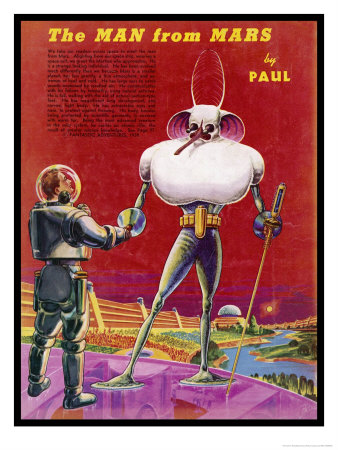
Maybe we are doomed to a future generation of oddly mutated humans with over developed thumbs (from video games), thin and wobbly necks, wide and soft buttocks, and really poor vision.

Been there, done that: Frank R Paul -

frank-r-paul-mars-martians-enjoy-less-gravity-but-must-withstand-a-thinner-atmosphere-with-extreme-temperatures.jpg


(Hee hee!)

Mark
 
There are plenty of books with more complicated themes that cover all of those.

snogging?

Oh yeah, learning nonsense words like muggles. :D

psik

For kids?

The Potter books do one other thing: They become a bit more complex as the reader ages. Rowling did a nice job of keeping the advancing age of her first audience in mind as she wrote.

And the non-sense words are no worse than Jabberwock. And snogging is current slang in England. (Or was when the books were written -- current slang is sometimes discarded when too many of us old folks start recognizing it.)

I'm not willing to call the Potter books classics. That takes time and the enjoyment of generations. But they aren't all that bad, and the lessons about dealing with others, not trusting first impressions and not taking people at face value in-between the parts of the adventure story is well worth having repeated over multiple books by many authors.

Randy M.
 
Perhaps the thread has moved on somewhat, but so far as older sci-fi is concerned, I feel the best is well worth reading even if the science is outdated. Thus Leigh Brackett's Mars series is splendid and powerful despite the fact that her "Mars" does not actually exist {in our solar system}. Perhaps in a parallel universe or another part of our cosmos there is such a planet. Does that make any difference?

In fact, I believe her image of Mars {being the seat of an ancient civilization--having a canal system, etc} really does exist as an imaginative concept which has historical roots in the scientific thought of the past. It doesn't bother me at all that Wells, Heinlein, Brackett, and Burroughs make use of this concept to create wonderful, atmospheric worlds.
 
Last edited:
In fact, I believe her image of Mars {being the seat of an ancient civilization--having a canal system, etc} really does exist as an imaginative concept which has historical roots in the scientific thought of the past. It doesn't bother me at all that Wells, Heinlein, Brackett, and Burroughs make use of this concept to create wonderful, atmospheric worlds.

This story does the same thing.

Omnilingual by Henry Beam Piper
http://www.feedbooks.com/book/308/omnilingual

But it is a question of what is the story really about. The title of Piper's book says more about the subject of the story than the setting. The point that it gets across to a YOUNG reader is the reason to read it. If a 35 year old doesn't know it already then he has a problem.

psik
 
More likely than not correct:

When Linear B was was finally cracked one of the first things translated was a letter from someone complaining that the youth of the day had no respect for their elders and the world was going to pot.

Well, if we simplify and assume that civilizations rise and fall on a symmetrical arc, then at any given moment in history, even randomly selected, one has a 50% chance of being right by saying things are going downhill. Even if we allow that the arc of a civilization's progress is not smooth, with local ups and downs, we only make it fractal, and the 50% estimate still holds. If we next note that in civilizations on the rise there is usually a widespread sense of euphoria and positivity, and that in civilizations on the decline there is often a prevailing sense, at least among the more percipient, of what is happening, the odds become fairly high that any declamation of declining standards or the like that has managed to last through history was probably a valid assessment.

On another track, closer to the original post: I don't know how I have missed it out so long, but there is a rather good, eclectic, and only somewhat idiosyncratic listing of "interesting" sf works (not all books) from M. John Harrison's blog, extensively added to by posters; it begins with Frankenstein in 1818, and progresses through a 2006 work. As Harrison says of it, "there’s no attempt to provide 'balance' between old & new, to weight each decade evenly, or to make the list exhaustive." I don't quite agree with everything on it, and could supply (as posters did) not a few other titles, but it's a good starting point for those interested in finding good sf from earlier times.
 
Oh yeah, learning nonsense words like muggles
That's an interesting topic - is there a real word that covers the definition of 'muggle', even in the general sense? If you define muggle as a person lacking in a certain skill, is there a real word that can replace it? Maybe layperson or layman?

The OED added muggle with the general definition a couple of years ago, and I don't think they provide a synonym. When there is no word to define a certain situation or topic, it is called a lexical gap. I think Rowling may have discovered a lexical gap when searching for a word to mean a person with no magical powers. You could use 'layperson' but muggle is much more specific, and also slightly derogatory since it is based on 'mug', an easily fooled person, so it carries more meaning.

I think in this case you could argue Rowling really did her work proud by creating a well thought out word where there was none before.
 
That's an interesting topic - is there a real word that covers the definition of 'muggle', even in the general sense? If you define muggle as a person lacking in a certain skill, is there a real word that can replace it? Maybe layperson or layman?

I think in this case you could argue Rowling really did her work proud by creating a well thought out word where there was none before.

But is a layperson someone who is SUPPOSED TO BE KEPT IGNORANT?

I worked for IBM.

I remember trying to get more experienced employees to explain what MICROCODE was. THEY DIDN'T REALLY KNOW. But in order to understand microcode you must understand how a von Neumann machine works. I never saw that term on any IBM documentation even though I learned years later that IBM hired John von Neumann as a consultant in 1952.

http://www.youtube.com/watch?v=7dg96tefnEU

Microcode has to do with the design of CPUs, RISC versus CISC processors. CISC processors have a CPU inside of a CPU and the inner CPU runs a program that analyzes the machine code of the outer CPU and executes it. That inner program is the MICROCODE. But IBM was not explaining that to its own employees.

A "muggle" or "layman" could be someone who is supposed to be kept ignorant. But in Rowling's universe there is an inherent TALENT. Intelligence and knowledge are two different things and maybe it is more difficult for some people to learn certain things. But there is a hell of a lot of information hiding going on and pseudo-intellectual morons are pretending to be intelligent.

That is why I promote certain science fiction as being EDUCATIONAL. To better inform the muggles. But some so called science fiction is shallow crap containing BAD SCIENCE which no one can learn anything from. Just like Harry Potter.

Heinlein's Citizen of the Galaxy and Door into Summer totally blow away Harry Potter. I have only read 2 HP books and seen 6 movies but the movies correspond quite well to the books in my opinion. The books just had more boring details. Even Andre Norton is better than J. K. Rowling.

psik
 
But is a layperson someone who is SUPPOSED TO BE KEPT IGNORANT?

Maybe phil_geo's point would be better made if it we substituted the word 'ability' for 'skill'. Skills can be learned, abilities are, to a greater or lesser degree, innate. You've got them - or you haven't. Like the ability to smell (or not) asparagus in your own urine. (And as superpowers go it's a pretty rubbish one.) If you can't smell that smell, no amount of trying is going to make your nose work so that you can.
 

Sponsors


We try to keep the forum as free of ads as possible, please consider supporting SFFWorld on Patreon


Your ad here.

Latest posts

Back
Top