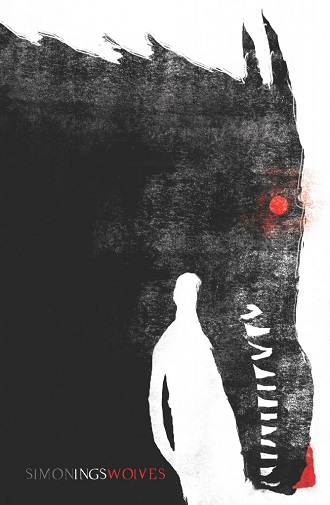
 Wolves is a novel set in the near future that deftly explores the disjunct between perception and reality. Failures in perception pierce the Simon Ings’ narrative like shards of glass. It is through the prism of these shards that we glimpse a near future world start to wash away under the waves. The science fiction landscape is flooded (an apt metaphor when talking about this book) with media that uses the concept of virtuality to navigate similar themes. Likewise, there is a rich tradition of British fiction examining the concept of a cosy catastrophe. Few do so with Ings’ level of literary craftsmanship, speculative acumen, and sophistication in thinking about the relationship between technology and society.
Initially, the book’s science fiction adornments are muted as we are introduced to Conrad, working in near-future London for an augmented reality company specialising in web-enabled glasses; a technology very much part of our present capabilities. Conrad and Mandy are living under the shadow of a recent car accident caused by Conrad’s failure to see oncoming traffic at an intersection – one the books many incidents of a kind of failure in perception. Conrad’s injuries are relatively minor; Mandy’s more severe – her face is scarred and, even worse, she has lost her hands and is adjusting to life with artificial replacements. Conrad, on the other hand (no pun intended), is unable to adjust; he is repulsed by Mandy’s artificial hands, sees them as things of “sheen” and “industry” (p.13). He comes to the realisation that “[f]alling in love with a person is hard. Falling in love with a world is easy. Confusing the two loves is easier still.” (p.20)
After a couple of phone calls from Michel, a close childhood friend, Conrad decides to abandon Mandy. He travels to stay with Michel and partner, Hanna, on a remote part of the coast where the couple are restoring a 30-foot boat. Since childhood Michel has been obsessed with a great flood coming to end the world and believes this boat will serve as an ark for Hanna and him as the oceans rise.
Conrad and Hanna have a brief affair while Michel is occupied for the night taking photographs at an apocalyptic party in a house to be demolished (research for his novel). Conrad returns home and after a few years he founds a start-up called Loophole with a coder named Ralf. Ralf is at the forefront of developments in augmented reality, and in one scene, Ralf impresses Conrad by rendering him unable to see a chair sitting in the middle of an otherwise empty room. From here, the augmented reality technology in the book advances, not only giving the novel its strong flavor of science fiction, but also amplifying the book’s themes about perception and reality.
In the intervening years Michel has become a bestselling author of a book about a flooded post-apocalyptic future and has scored a movie deal, bringing him to London. Michel and Hanna eventually re-enter Conrad’s life with a daughter, Agnes. Looking at Agnes, Conrad quickly establishes that she is actually his daughter, and wonders why this is not obvious to everybody else – another one of those quirks in perception that stud the book.
At this point the book introduces the producer of Michel’s film, a mysterious figure named Vaux. Vaux has a unique artistic vision:
“Vaux’s production company is buying up immersive technologies. With them, he plans to smear movies across the real. This is where his current ambitions lie: in characters who’ll share your breakfast coffee. In plot beats played out on your journey to work, and confrontations staged in streets you already know. He imagines dreams woven through the real, and all the dreamers dreaming (p.203).’’
Vaux partners with Conrad and Ralf’s company Loophole to realise this vision.
The chapters I’ve just described alternate with the narrative of Conrad and Michel’s childhood friendship, which is far more complex than first meets the eye. Conrad’s parents once ran a failing hotel, purchased with his mother’s family money. Conrad’s father supplements their income by treating blinded veterans from a nearby veterans’ hospital; he has designed a jacket studded with sensors that restore some level of sight. As a child Condrad delights in taking control of the remote that operates the jacket, causing the blind veterans to tumble over on hotel’s garden lawn. Conrad’s mother is battling mental illness and dabbles in small entrepreneurial endeavors, such as making and selling her own make-up, which she tests on Conrad, making him look like a younger version of herself in her mirror.
We also find out that Michel’s father was a soldier whose beheading while on operations in the Middle East was filmed and uploaded on the internet. Even from an early age, a disturbed Michel is obsessing about the end of the world. Towards the novel’s climax, his vision of flooded cityscapes and rural coastlands begins to bleed out of augmented reality into the real world.
There are many obvious reference points that other reviews of Wolves have pointed to. The imagery of flooded countryside and cityscapes is reminiscent of J.G. Ballard, but unlike other books written in the British tradition of the cosy catastrophe this book is concerned with the beginning of the end, rather than life in the final aftermath. The Fall, it posits, will start to happen at the edge of our vision – not unlike like the car that crashes into Conrad and Mandy at the beginning of the book.
Ings’ estranging literary prose certainly recalls M. John Harrison (a point, again, made by reviewers other than myself, though not surprising given past collaborations between the two), but the book lacks the more gonzo science fictional conceits of that Harrison’s recent work; it is a more restrained affair. If it were not for the fact Gollancz published it, the book could quite easily be marketed as a mainstream novel, with a plot that combines thriller and mystery elements with a coming-of-age narrative. And if it were not the for the fact this book has failed to be picked up by an US publisher it would surely have received much wider praise, as, in my opinion, it is undeniably one of the best science fiction books published last calendar year – a worthy consideration during this current award nomination season.
Wolves is an example of the very best of modern science fiction literature, set in a vision of the near future which is both disturbingly plausible and surreal. At the end, if you are like me, you will be left wondering about the space where the material meets the real.
Wolves by Simon Ings
Published by Gollancz, November 2014
304 pages
ISBN: 978-0575119871
Review by Luke Brown, January 2015