
Let’s put Harry Dresden and Frodo Baggins next to each other. (No, seriously. Let’s.) At the beginning of their respective series, they don’t have a lot in common: They’re male. They’re good people. They both have an extraordinary ability to persevere in the face of terrible adversity.
The rest is contrast. One is personally powerful while one is not. One is human, one is not. One had an abusive upbringing, one has not.
To go further, Dresden is a Peter Parker-type hero. He’s powerful within his world, but not the most powerful. He’s beset by personal difficulties and indignities of all kinds. He’s treated with disrespect by the establishment. Despite all this, he always tries to do the right thing, no matter how much he has to sacrifice. Finally (and most importantly for the purpose of this post) he’s an expert in the setting of his story.
As for Frodo, he’s a… actually, I haven’t been able to think of a character who is a more recognizable example of this sort of hero than Frodo himself, so I’m going to be a little ridiculous and call him a Frodo Baggins-type. Which is to say: he’s not particularly powerful, although he is clever and determined (some Frodo types gain power at the end of the story). Any personal issues in his life have little to no bearing on the main plot. He’s treated fairly by most figures of authority, often protected and encouraged by them. However, unlike Dresden, he’s largely ignorant of the world around him.
It’s that ignorance/expertise dichotomy that I want to talk about today. Does the main point of view character have a great deal of first hand knowledge of the world of the story? In other words: are they an expert, or are they a bumpkin?
When fantasy authors create a setting, one of the biggest decisions they have to make is how best to present all that information to the reader. (Well, it’s possible most authors don’t think much about it, but I sure do.) Maybe there are elves, or three flavors of vampire, or spells to be cast, but for the story to have context, and for the plot to have a foundation, the setting has to be established. How that’s done has a profound effect on the story.
The first thing to understand is that I’m not talking absolutes here. Asserting that Harry Dresden is an expert-type protagonist doesn’t mean he knows everything. There are parts of his world that surprise him, such as [spoiler] and [spoiler]; if there were no secrets to reveal his books would be less fun. However, he does act as the reader’s entry point into the world. Dresden doesn’t stand over a corpse thinking “Two puncture wounds on the neck, and the body’s been drained of blood? What could that possibly mean?” Not only does he know they’re real, he knows where to find them, what they’re powers are, and so on. He’s an expert, and when it’s time for the reader to know these things, he straight up tells us.
Similarly, Frodo’s ignorance is not as complete as, say, the protagonists in the “You wake up with amnesia” point-and-click games my son used to play. He knows about elves and hopes to see them for himself. He’s wary of big people, and has heard stories of kings and armies in the wider world.
But he’s never seen them for himself, and so the reader experiences much of Middle Earth through him.
Admittedly, Frodo is not the Aristotelian ideal of the “reader’s mirror,” the naive protagonist who needs everything explained in a clear way so the readers can eavesdrop. The book opens with an omniscient narrator who explains what hobbits are, and later in the books, while Frodo is an essential character, he’s not the only one.
Frankly, a purer example of exposition through a Frodo-style character would be Harry Potter or Neo from The Matrix. They fit the criteria for a Frodo-type protagonist, but I’m using Frodo anyway because I like the character more and he can fit very well without fitting perfectly.
The thing about Harry Dresden, though, is that when there’s something the reader needs to know, he tells us. He’s very much in the urban fantasy tradition of the “tour guide protagonist”—there’s a fun, interesting world of magic and danger, and it’s the protagonist who shows it to us. Occasionally, a supporting character will explain something new, the way a guide will ask a guest speaker to briefly take over for a special exhibit, then the audience move on.
Deploying an expert-type protagonist is an extremely common technique, used in police procedurals, James Bond-style spy thrillers, super hero comics, and more. They lead the reader into the story.
For the bumpkin-type, I see two options: to lean heavily on Someone Offers An Explanation, or Unexplained Events Make The Situation Clear.
Usually, a story contains some of both. Yes, Kyle Reese tells Sarah Connor what the Terminator is and why it’s after her, but only after inexplicable action scenes pique interest appetites. Unexplained Events capture the reader’s interest, the Explanation satisfies their curiosity and solidifies their understanding of the setting.
Frankly, the bumpkin style seems straight forward, but it’s harder to pull off. Explain things too much or too early, and you end up with The Dragonbone Chair and its tedious lectures on the history of William’s made up world. Explain things too late or too little, you end up with my own Twenty Palaces series, which a small number of readers really really liked but most bounce off of.
Still, the Unexplained Events… method is my absolute favorite. You guys have seen Tremors, right?
Also, I’ve begun to look at book covers to suggest which kind of story I’m about to get. Compare the covers of The Dresden Files with these covers of The Fellowship of The Ring. All of the Dresden novels portray a figure with an air of confidence or command. Of the Tolkien covers, only one does, and it’s a supporting character.
Contrast that with the cover for The Dragonbone Chair. It also show a figure, but he’s a bumpkin and there’s no sense of confidence about him. If you click through to the final book in that trilogy, you’ll see the cover art suggests expertise in a way the first didn’t, because the character has changed so much.
Then again, look at the cover for City of Stairs. It’s an expert novel with a commanding figure on the cover, but the figure is clearly some kind of god, not the protagonist.
There are plenty of exceptions, of course, like The Eye of the World cover art. It’s a bumpkin novel with commanding figures, but they’re supporting characters—I imagine that’s because the publishers (rightly) believed the female spell caster would be a fan favorite. It’s the exception that tests the rule.
Which goes to show that this isn’t a one-to-one correlation. Not every expert protagonist gets figurative art with a certain posture, and not every bumpkin novel eschews it. But when I glance at covers, those are the expectations I bring, and I don’t think I’m alone.
By the way, my new trilogy? Expert characters (see the art below) dealing with inexplicable events. I can’t help it. As soon as I think I recognize some trend or category, I want to mess with it.
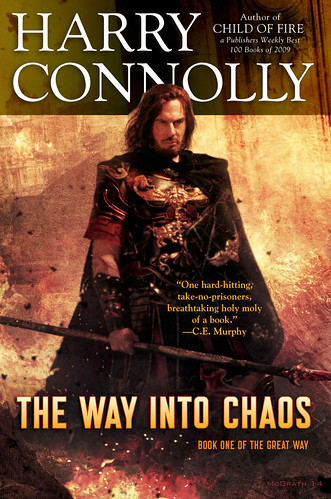
Publishers Weekly gave it a starred review. Quote: “This twisty, subversive novel will win Connolly a whole new set of fans.”
You can find out more about that first book here, or you can read the sample chapters I’ve posted on my blog.
Thanks.
BIO: Harry Connolly’s debut novel, Child Of Fire, was named to Publishers Weekly’s Best 100 Novels of 2009. For his epic fantasy series The Great Way, he turned to Kickstarter; at the time this was written, it’s the ninth-most-funded Fiction campaign ever. Book one of The Great Way, The Way Into Chaos was published in December, 2014. Book two, The Way Into Magic, was published in January, 2015. The third and final book, The Way Into Darkness, was released on February 3rd, 2015. Harry lives in Seattle with his beloved wife, beloved son, and beloved library system.




Great article. I’ve learned something new!