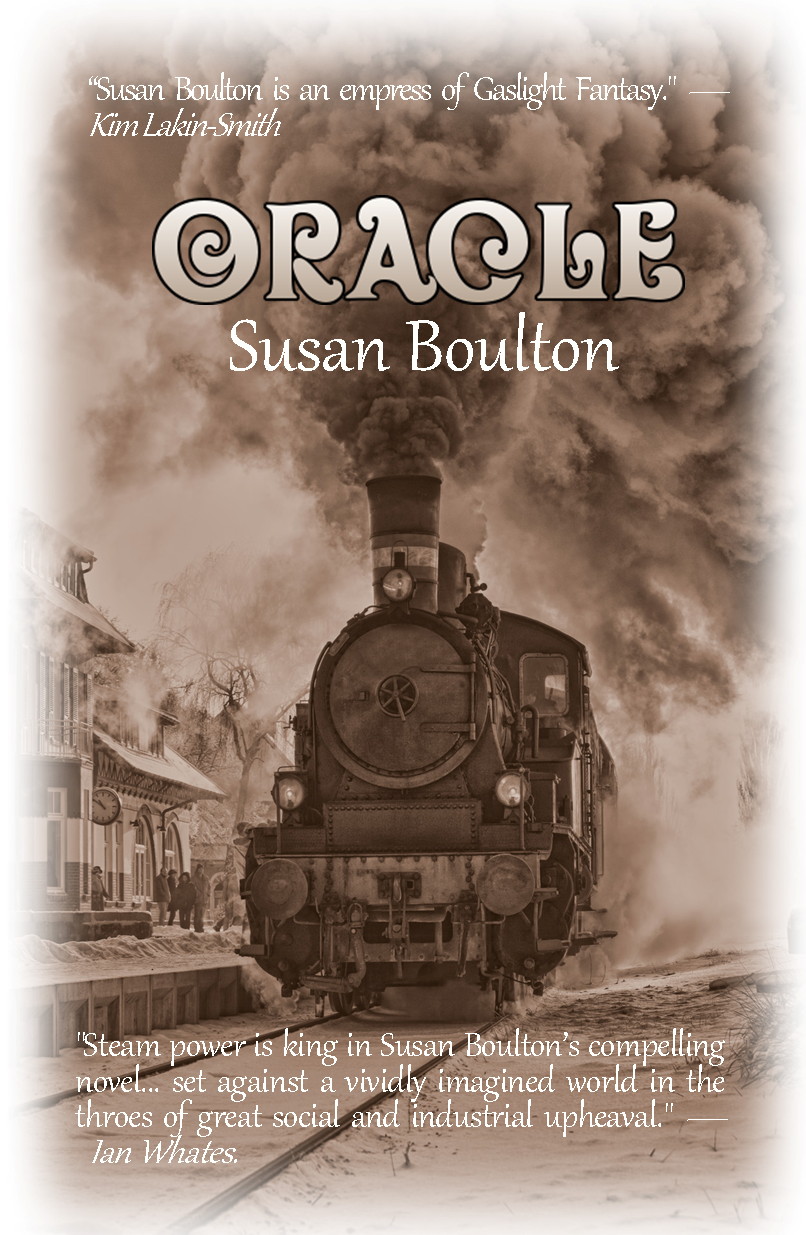
 We’re very excited to be talking with Susan Boulton in the U.K., a long-time member of the SFFWorld community, about her debut fantasy novel, Oracle, out now from Tickety Boo Press. Oracle tells the story of an empty, mad prophet trying to deliver critical warnings in a world caught in a time of change and revolution.
How did you come to create this novel, with such an unusual, complex character as Oracle?
How did I create this novel? Slowly. I am not, what is termed, an outliner. I tend to get an idea, a glimpse of a character or a situation, and write about a thousand words and then stop. With Oracle, the first rambling pages sat on my computer for a long time while I thought about the character and the world in which it existed.
In many fantasy novels, there are prophecies, given by seers and wise men or women who can see the future. And they seemed to follow a standard pattern. The prophecies are detailed, and the seers are wise, all knowing, even tormenting the main protagonist with their foreknowledge.
I wondered, what if the prophecies made no sense, that they were just jumbled phrases, even odd words. The seer was not all knowing and wise, but a mere husk of a person, driven to a kind of madness by the hundreds of voices in their head, as each voice vied for control. Add to that the idea that the seer, or Glimpser, as I have called my Cassandra, had no memory of what they had said and were just driven by the tide of voices to roam the world in which they lived, seeking out the person for who the prophecy was meant. And it did not have to be linked to world-shattering events. It could be a choice of which garment to wear, whether to have carrots or peas for lunch. Then again, when one considers the butterfly effect, a choice of vegetable could have dire consequences.
This left me with a problem: was Oracle just going to be a cypher, a mere reference point for my other characters to fall back on, or did Oracle have a past, and more importantly was Oracle going to develop and grow as all characters should? Also, there was Oracle’s relationship to the other characters – how did Oracle affect their journey, their world, etc.
And as to developing their world, that opened up a whole new can of worms.
The world that developed is an industrialized one, with steam trains, pit mines and rapid expansion going on that is causing political conflict and violent protest. What appealed to you about doing the story in that sort of setting?
This is a hard question. When I began writing Oracle, I knew more of what I didn’t want as a setting, than what I did want. I didn’t want a sword and sorcery medieval land, with kings and all the trimmings. I didn’t want a modern setting, though that did cross my mind at one point and I toyed with the idea of a 1920’s or ‘30’s setting for awhile, but there was too much technology accepted by that point in history as every-day. Then I began thinking of the period in English history between 1800 and 1850. In the lifetime of one person, the country had gone from semi-rural to dark satanic mills. It was a massive upheaval, on an industrial and social level, that plunged the working class into the darkest of pits with regards to their rights, living and working conditions, and which took nearly a 100 years to climb out of to any degree.
It also made some people very, very rich. The structure of society shifted, reinforcing some aspects, breaking down others. In many ways society was like an out of control train at that time more so than any other. People had no frame of reference within which to place the technology that was evolving. Even though we have been in the throes of our own digital revolution for the last 30 years, we as a society have adapted, because we learned nearly two hundred years ago that our society is not set, but fluid, and we have to learn to swim or die.
It slowly began to dawn on me that a society in the early throes of an industrial revolution, with a very rigid class system and a parliament torn between those who want to push through reforms to the social order and those who believe that any change would destroy the status quo, would be ideal. It meant I had a lot of toys to play with, both steam-powered and social. I did not want to weave magic into my steam-power as many steampunk novels do, but I did want a supernatural element that would allow me to use Oracle as a catalyst. So Oracle became what they now call a gaslight fantasy, with my characters facing upheavals that would reshape their country and their lives. It also allowed me to crash a stream train, have devious politicians, political riots and a mysterious religious order.
In the middle of all that change and chaos is Pugh Avinguard, a military officer trying to protect a reform-minded politician and discovering a singular horror – that the Glimpser he encounters with perhaps a critical prophecy used to be his late wife. That’s a wild twist that creates a fascinating relationship. How does Pugh deal with this resurrection and everything that is going on?
I wanted a connection to already exist between the Glimpser and one of the main characters. I tried various ones, but then it struck me that it had to be to Pugh. The fact that she was, and still is in his mind, his wife allowed me to develop a strong dramatic thread in the story which was in direct contrast to the political shenanigans going on. It allowed me to show how the other characters reacted to this knowledge as they came to know about it. Pugh deals with the matter in a way I hope is believable, as a man trying to continue, to do the things he has to, what is expected of him, yet torn beneath the surface. However, at a pivotal point in the story the relationship becomes the catalyst for Pugh’s eventual actions and the climax of the story. It was a little hard to get the balance between Pugh’s inner turmoil and the fact that he has to continue to “do his duty”. My editor, Teresa Edgerton, helped me find the right approach, and I think in the end it works very well.
Many of the other main characters in the novel also seem to be dealing with painful obstacles and something of a crisis of faith. Without giving too much away, how does that play out for them?
This is difficult to put into just a few words. Each character in Oracle does suffer to some extent with regards to the consequences brought about by their actions and choices. The industrial revolution that is engulfing the country of Timeholm is sending ripples not just through the political arena, but is causing a reshaping of what part religion plays in this changing world.
Take the character of Mathew, a young idealist whose intentions are honourable, but as the story progresses, his personal experiences makes it impossible for him to even entertain the idea of any sort of compromise. People become blinkered by the noble ideal and forget that all actions have consequences. His very idealism turns him into a tool for other, less noble players in the game of politics.
And though the government’s High Forum is a male-only preserve, with characters like Lord Calvinward and Sir Henry speaking on the floor of the Forum, the female characters also have a big impact. Strong women, such as Lady Elizabeth Hotspur and Lady Constance Manling, are very skilled in the game, because they are forced by the patriarchal society to play it in the shadows, and this makes them far more ruthless.
I know you do a lot of historical research for your books, whether they are historical fantasies or alternate world ones, including some family history. What draws you to history and British history, particularly the modern eras of industrialized development and war?
I have always had a passion for history and historical novels, and over the years I found I was drawn more to the early industrial period and most especially to the period of 1900 to 1945. When I had decided on Oracle’s setting, I knew I had to research the early 1800’s, and living in a part of the UK that has a wealth of early industrial heritage, it was not easy, but not as hard as it could have been. I could go and see a working cotton mill, steam beam engine and stream trains in action. I could get the feel of what they look like, the smell, even the taste of the air. It is a personal thing. I find if I understand something, I can talk about it in a way that gives the reader an understanding of what my characters are experiencing, feeling, seeing. I am not just listing things I have found on the Internet.
British history of the last 100 years is in a way my family history. I come from a working class background. Each generation has stood on the shoulders of the previous one. Each has fought battles, so that their children do not have to. My great grandmother could not write, my daughters have gone to university. I love to show how world-shattering events affect normal people, often by using supernatural or fantastical elements I can slip into aspects of that battle that reflect it symbolically.
What else and who else do you feel have influenced you as a fiction writer? Do you have any favorite works?
As a child, I loved books like Swallows and Amazons, the two Jungle Books and Enid Blyton’s works. I moved on to Tolkien, Michael Moorcock, Edgar Rice Burroughs, George Orwell and John Wyndham in the SF and Fantasy field. I liked Norah Lofts (historical supernatural) and Georgette Heyer (mystery and Regency romance,) and of course Agatha Christie and Ellis Peters when it comes to crime. These books have a very British feel; they reflect the tone and texture of the country I grew up in. These writers captured the British attitude, the layered, complex, funny, dark, and at times harsh take on the world in which we and they live.
I also loved the Powell and Pressburger films of the 1940’s and ‘50s, as well as the Ealing comedies of the same period. In fact, if I see any British film of that period on TV then I either watch or record them. These too show a side of the British psyche that is still there buried under the veneer of the modern. The Powell and Pressburger films, especially, have a dark supernatural undertone that makes you unsure of the world around you.
You grew up in Tolkien country, didn’t you?
Yes, I was born about 200 yards away from where many years before Tolkien spent his time thinking and writing about hobbits. I’ve lived all my life in rural Staffordshire and never lost that passion for its history and legends. My day job is with my local county council, dealing with recycling and the environment. It’s not quite as exciting as making up my own worlds or versions of history, but it gives you an interesting view of human civilization.
What’s the next project for you?
I have a number of projects on the boil at the moment. It’s possible that Oracle will be getting a sequel, although the story itself is a standalone story.
There’s also my historical supernatural thriller series. The first title, Hand of Glory, is a tale of ghosts, thieves and the occult, and takes place from the horrors of the battlefields at the end of the first World War through the survivors trying to piece themselves back together in the early 1920’s. The sequel, Catnip, which is in the planning stages still, has the two Inspector characters from the first story dealing with murder and raising the dead Ancient Egyptian style in rural England, tapping into the national frenzy for all things Egyptian caused by the discovery of a certain young Pharaoh’s tomb in 1923.
I’m also in the middle of another historical fantasy thriller set during World War II, my own sort of fictionalized version of the story of Colditz Castle’s prisoner-of-war camp mixed with a particularly nasty, fae type of gremlins.
As someone who has gotten to read Hand of Glory, I’m eager to see it out, but the gremlin novel sounds great too. In a vein not that dissimilar from Oracle, Hand of Glory is kind of a cross between Dorothy Sayer’s Peter Wimsey and a Gothic horror story. Would you say that you have a pessimistic outlook or an optimistic one in tackling such dark subject matter?
I suppose you could say a bit of both. I love exploring how a character feels and has to adapt, to not only a changing world, but to the unknown. How they face the darkness that is often the result of either their own actions, or that of others. The pessimist in me believes that they haven’t got a cat in hell’s chance.
Then, as often happens, a single act of courage or kindness can bring the optimist to the fore. The darkness can be banished, and the hero can win, maybe. 😉
How can folks get their hands on Oracle?
The book is out in e-book form and just out in print form. You can order the e-book for the Kindle and from some other vendors. The print edition is available in bookstores in Great Britain, or you can order directly from Tickety Boo Press, my publisher, including international orders. (Some links below).
http://www.ticketyboopress.co.uk/