We’re happy to be able to reveal the UK cover of Matt Hill’s new novel Graft, due to be released in February by Angry Robot Books. We’ve also had the pleasure of talking to Matt about the release and the cover designed by John Coulthart.
“A nightmarish trans-dimensional human trafficking conspiracy”. Can you tell us a bit about your new novel, Graft?
Graft is a near-future SF crime-thriller set in a barely functional Britain about ten years from now. It follows a Manchester mechanic, Sol, who finds a three-armed woman called Y in a car he steals. The pair of them end up in the sights of Y’s traffickers, and things go from bad to worse.
Can you give us some insight into your main characters Sol and Y?
Y’s the central focus of the book. She wakes in a strange cot to find she’s had her voice taken from her, her body augmented beyond recognition, and her previous identity all but erased. She’s been marked out for something, and isn’t sure what. And then her training begins.
After the collapse, Sol has turned into a petty criminal, doing what needs to be done to keep food on the table. He’s estranged from his partner, living in a bedsit and stealing cars to prop up his ailing workshop. When he meets Y, he’s basically forced to confront himself. They’re an unlikely duo, really, which is why it was satisfying to write them.
“Many people are only worth what’s on their price tag”. It’s a rather grim future you portray. What is it about writing about the future you find fascinating?
To paraphrase Ballard, civilisation is an illusion in which we all collaborate. While I’m conscious that dystopia can be simply a look, an aesthetic, the pieces are all around us. Graft takes those pieces and smashes them together, so I guess its future is an extrapolation of all the stuff that could go wrong from here (and hopefully won’t). For me, the future means more conflict, more people getting a rough deal. I don’t enjoy being so cynical, and I cling to every kindness, but despite our best intentions we seem very good at messing up. Maybe it’s that I get something out of writing about what scares me.
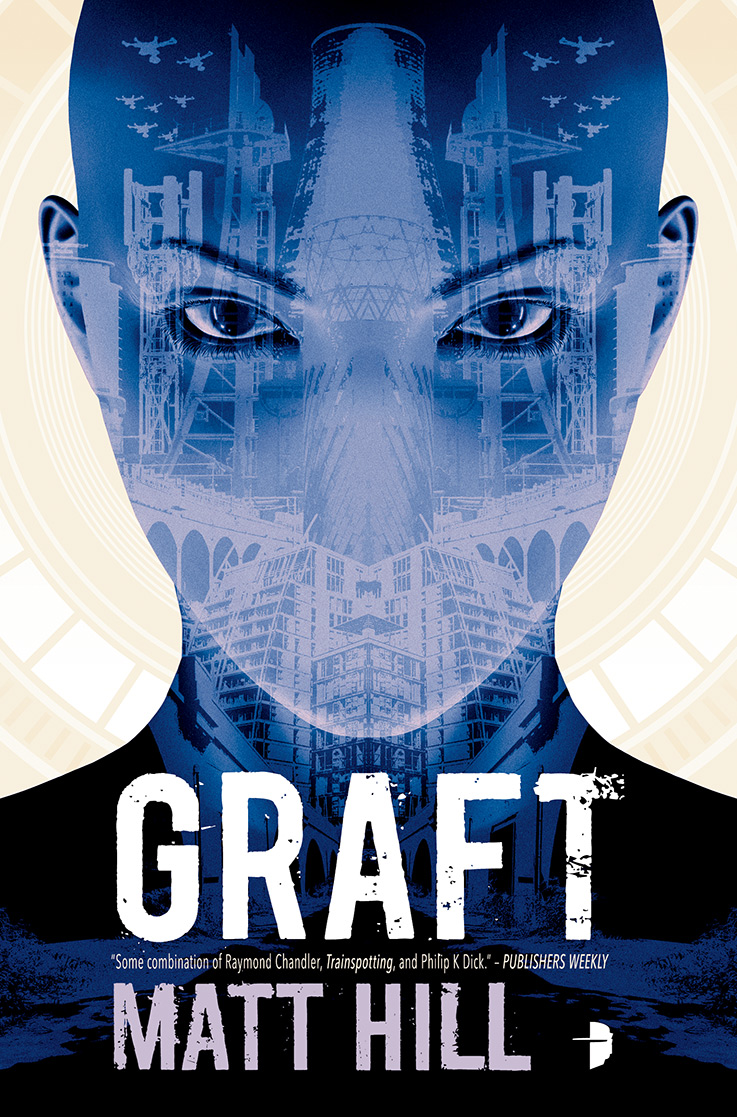
The cover is designed by World Fantasy Award winning artist John Coulthart. Can you tell us a bit about the cover and how it came about?
The cover’s a genius composite of Manchester buildings and Y’s face, using John’s own photography from in and around the city. I was beaming the moment I saw it – it perfectly conveys the texture of the novel, and is unsettling and elegant by turns.
In terms of briefs, I chatted to the Angry Robot team about ideas, key imagery and symbols – things like the cooling tower you see on Y’s forehead – and they’ve each made their way on there. I feel ridiculously proud and lucky that John worked on it, and I’m grateful to Marc Gascoigne for overseeing the process.
The cover image is the same both for US and UK as well as the e-book, but the colouring is different. Care to explain why this distinction was chosen?
John’s first concepts came in a range of colours, three of which Marc and the rest of the Angry Robot team loved equally. In the end we thought it’d be fun to use different colours for each edition – UK, US and ebook. The ebook’s colour actually stands out a lot better in thumbnail size on a digital carousel, too. I can’t wait to see the different versions together. (Though I don’t know if I’d have them overlooking my bed – they’re quite intense!)
How involved have you been in the process?
It’s felt like a really collaborative effort. Obviously it’s always going to be Angry Robot’s decision in the end – they’re publishing the novel, and they know what works on the shelves. That said, the team appreciates that a book cover is one of the Treasured Things for an author, so it’s lovely that they’ve let me stick my oar in.
What new challenges did you set for yourself with Graft?
Definitely writing a more complicated structure, with a tighter narrative.The Folded Man was written from a single character’s viewpoint, told linearly. Graft has four points of view and two different tenses, and occasionally moves back and forth in time. It’s also twice as long, so you’re always trying to keep up the momentum (and hopefully maintaining the reader’s interest).
Both Graft and your previous novel, The Folded Man, are set in a future Manchester. The Folded Man in 2018 and Graft in 2025. Is it the familiarity with Manchester that made you go for this setting?
I think Manchester is where my imagination has always lived. I grew up around it and then lived in the centre for a good few years, so those experiences and the city’s terrain were inevitably going to leak out in my fiction. Sounds a bit daft, but I wrote a lot of Graft after I’d moved to London, and the distance has probably contributed to some weird personal mythology. It’s a wonderful city, full of structures, interesting characters and stories, layered-up architecture. So yes, it’s the familiarity and my love for the place that have driven those choices. It’ll always be home to me.
Do we see a pattern here, will your next novel be Manchester 2032?
It’s tempting! While the novel I’m working on is set in the future, it isn’t explicitly linked to the first two at all, and goes well beyond the UK to an island in the South Pacific. So I’m expanding my horizons a bit. If I ever return to Graft-world it might be interesting to see what’s happening down in London by then. Utter carnage, I reckon.
Thinking back, how did you start writing? Was there a particular book or moment in your life that spurred you on?
I’m not sure, is my honest answer. The first thing I distinctly remember writing in school was about a family trapped by an avalanche. God knows what I’d been watching. Then came screeds of Warhammer 40K-inspired nonsense. I think most of all, my grandparents nurtured in me a love for words and reading, and have always told me their own marvellous stories and anecdotes. If there’s one book that opened my brain during my teens, it was Michael Marshall Smith’s Only Forward. It was a revelation.
What has been most surprising to you in your writing and publishing career?
I’m still luminous green, career-wise, and had never really engaged with the literary world before the first book came out. For that reason, the most surprising, brilliant thing has been the generosity of readers, and the encouragement of other writers. I still can’t get my head around the fact that people pick up your stuff and let you know if they’ve liked it.
What kind of books do you read, any favourite authors?
My formative SF influences are probably Philip K Dick and Iain Banks, though I grew up on Roald Dahl, Gerry Anderson and my gran’s true crime books, so that’s all in the pot. I tend to read non-fiction or non-SF titles when I’m actively writing, then try to catch up on newer releases when I’m not. This last couple of months I’ve started making my way through Sarah Hall’s backlist, which is brimming with astonishing writing.
What’s next? What other projects are you working on at the moment?
I’ve just finished working with an amazing Taiwanese artist called Yu-Chen Wang on a Turing-inspired art installation being shown at Manchester’s Museum of Science and Industry and Manchester Art Gallery next year. I’m also about halfway through my third novel, which takes in urban exploration, steeplejacking, gutter journalism and tiny beings that may or may not be fairies. I’ve promised myself no one will die in this one.
Thanks for having me!
* * * * * * *
Interview by Dag Rambraut – SFFWorld.com © 2015