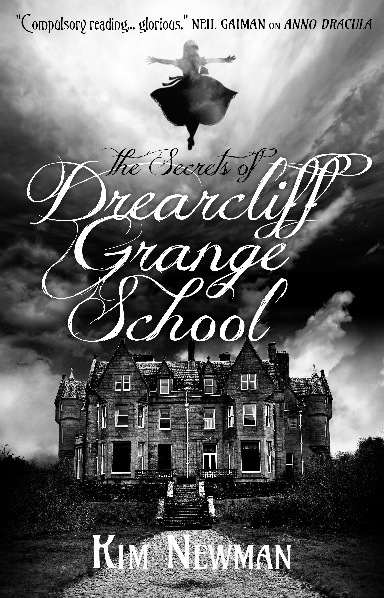
 Ah, school. If your memories of the educational system are of a life at a boarding school like that at Hogwarts, or indeed of books such as Enid Blyton’s Malory Towers series which told of life like that at Hogwarts, then this may be the book for you. In The Secrets of Drearcliff Grange School (expanded from the Diogenes Club short story, “Kentish Glory: The Secrets of Drearcliff Grange School” ) Kim has produced a novel that is deliberately designed to echo that of a rural English Girls Boarding School of the 1930’s – all jolly hockey sticks, picnic sandwiches and phrases like “Calamity and crumpets!”.
Of course, as this is a Kim Newman novel, it also has its own genre twist. For whilst all of the pupils at Drearcliff are spiffing good eggs or rascally rotters (not to mention those dastardly foreign types), there’s also the twist that many of them have ‘special’ if not rather supernatural, gifts.
Told from the perspective of ‘new girl’ Amy Thomsett, much of the start of the book is recognisable to anyone who has been to school. There’s that sick, empty feeling caused by being new to the environment and not knowing what to expect. Then there’s the chance to meet new people and make new friends as well as realising who to avoid and what the school culture’s pecking order is. And of course, away from the social side of things there’s the curriculum, the rather odd teachers and the just-as-weird support staff to put up with.
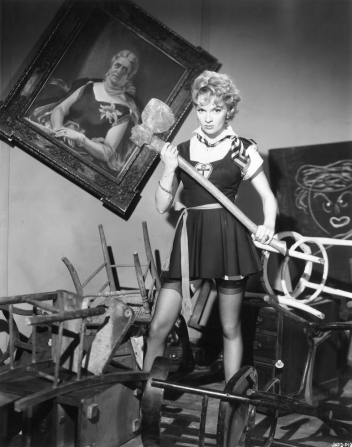
Part St. Trinians, part Nancy Drew, the first part of the book (‘The First Term’) reads like an extract from a happy yet sadistic story of ancient academia. Admittedly much of this is also like settling in to any new school – about the chance to learn new things, take on new opportunities and deal with the new experiences that such an academic life can bring. In Amy’s case it is also about dealing with the fact that the week before she arrived at Drearcliff Grange she was found by her mother sleeping on her bedroom ceiling. When her new friends realise her powers Amy discovers that she is an ‘Unusual’, and also not the only person with such talents at the school. Amy soon realises that Drearcliff Grange is actually less like St Trinians and more like Professor X’s School Xavier’s School for Gifted Youngsters than it first appears to be, filled with the daughters of ‘criminal masterminds, outlaw scientists, master magicians, (and) clubland heroes.’
Once Amy has settled into the school routines with the Forus of ‘Frecks’, ‘Light Fingers’ and Kali Chattopadhyay, it is not long before Amy and her select group of chums have to solve a mystery – something with a fine tradition and history in such novels – see Nancy Drew. And so it is that when a ‘Hooded Conspiracy’ of black hooded men are seen around the school and one of Amy’s new compadres disappears, it is clear that there’s something strange afoot. And as ‘The Moth Club’, it is up to Amy and her friends to find out what! Fights with the school prefects (the ‘Witches of Drearcliff’) and other enemies ensue until the situation is resolved.
After this initial set up and first outing for the Moth Club girls, things do become a little darker and more adult in nature and tone with the arrival of Rayne in the Second Term, though it must be stressed that this is most definitely not some sort of erotic bonkfest, but more for older teens perhaps. Rayne is deceptively quiet, and yet soon becomes someone who, rather in the manner of Hitler in the 1930’s, creates a new cult following – one that involves ants. It begins with an adaptation of the school uniform – Hitler’s ‘brownshirts’ become Rayne’s black skirts – and along with a nursery rhyme chant and the use of skipping soon removes the previous school order. Any Unusual is soon ostracised.
There are other subtler effects – Amy’s beloved books about moths are soon removed and replaced with books about ants. Classes become ‘blackskirt only’. Secret cabals are formed and before long Amy is banished to ‘The Remove’ along with any of the other students who cannot conform. The cumulative effect of these subtle changes mean that not all is immediately seen as a threat, but over the stretch of the middle section of the novel the end result is catastrophic. The downside of all these things happening realistically is that they can seem to take a while, albeit understandably so. Consequently, whilst the events therein are readable I did find myself losing interest a little as this section became a little repetitive.
However, the latter part of the book (‘The Remove’) is about Amy and her friend’s attempt to return the school to its previous state and it picks things up nicely. There’s a big fight, lots of ‘Oh, wow!’ moments and an ending which ties in with the Diogenes Club and brings things to a satisfactory conclusion.
My initial thought when I finished this one was that this one was a bit of a strange one to read, in that I’m not quite sure what it is trying to do. Is it trying to affectionately parody those old school detective stories, to bring back a whiff of nostalgia for those immersed in such tales in their formative years? Or is it trying to create a chiller tale for those readers who have read X Men and Harry Potter and are now looking for something else similar yet different? Or both? Alternatively, is it just an entertaining tale, designed to – you know, entertain?
Whatever the reason for the book, as ever, Kim’s skilful writing gets the tone of the old style stories just right, but I can’t quite decide whether it is a not so subtle attempt at deriding the class-based education system of yesteryear (seemingly the 1910’s or 20’s) or a story celebrating the indolent sadism, the joyous enthusiasm and the amusing naivety of such plots. The dialogue’s impressively appropriate for the situations created (“Buttered crumpets!” cried the reader!), and there’s a certain degree of empowerment for the girls which many readers will enjoy. There are some rather odd, even psychedelic aspects to certain parts of the plot that readers may find a tad bewildering, but generally it also means that despite the deliberate ridiculousness of the plot, our heroines win the reader over enough to be able to go with the narrative flow.
To add to the fun, there’s also a good sprinkling of Kim’s rather expected cultural references – as befitting a story set in the 1920’s, there are references to both old silent films and film actors (Charlie Chaplin, Lon Chaney, Douglas Fairbanks and so on) and old pulp magazines (I got H P Lovecraft, and Kim’s own Dr Shade, for example) – though, as ever, part of the entertainment in such narratives is in spotting them yourself. The book is not as heavily laden with such homages as much of his other work, though admittedly that might just be that I spotted less of them!
In summary, The Secrets of Drearcliff Grange School is rapidly paced, atmospherically placed and all good fun. It’s the sort of book that you can settle down with on an autumnal evening and while away a few hours being thoroughly entertained, or for younger YA readers can amuse you no end in an otherwise dull school holiday. It’s also a nice read if you’re not looking for something too scary. After all, school’s scary enough already, isn’t it?
The Secrets of Drearcliff Grange School by Kim Newman
Published by Titan Books, October 2015
ISBN: 978 178 1165 720
410 pages
Review by Mark Yon