
 We have talked to Hugo and Nebula Award-winning author Robert J. Sawyer about his new book Quantum Night where he explores the thin line between good and evil that every human being is capable of crossing…
First of all can you tell us a bit about Quantum Night?
I’m often characterized as an optimistic writer, and certainly my Neanderthal Parallax and WWW trilogies shade toward the utopian. I like to think that’s not simple naïveté, but rather a reasonable approach. Still, no one can be blind to the negative forces and outright evil in the world today. I wanted to address head on the dark side of human nature. We spent an awful lot of time trying to come up with a title for this book that would encapsulate that journey, but ultimately I’m pleased with Quantum Night as a title — because it’s always darkest before the dawn.
Your main character, Jim Marchuk, is quite complex and with a strong belief in utilitarianism. Can you tell us a bit about your main characters and what is important for you when you create your characters?
I really strived to give equal weight to the two halves of my genre’s name: science and fiction. Hard science fiction, which is what I write, often is rightly criticized for having either negligible or unbelievable characterization, but the science I’ve actually studied most post-secondarily is psychology, and characterization is the art of dramatizing psychological principles. Real people are complex, contradictory, and have their own motivations — they can’t just be mouthpieces for the writers’ point of view.
I’m a small-u utilitarian, but Jim Marchuk takes it way beyond what I would; I’m an atheist, but the other male lead in the book is a Mennonite. Like that character, I’m a pacifist, but that doesn’t come from a religious place for me. I’m proud that the novel features not one but two strong female scientists — Kayla Huron and Victoria Chen — and, of course, as in all my work, the novel handily passes the Bechdel Test: they talk about ideas, and often talk over the head of the character of Jim Marchuk.
In the end, what’s important for me is not whether the characters are likable, but whether they are nuanced and believable; that’s something I learned early on as a writer reading Frederik Pohl’s Gateway, which I think is the finest science-fiction novel ever written.
What came first – the story or the characters?
Neither. I’m a thematically driven writer; I figure out what I want to say first and then devise a storyline and a cast of characters that will let me most effectively say it. For Quantum Night, the high-level concept is this: most human beings have no inner life, and the majority of those who do have no conscience. And the theme is: the most pernicious lie humanity has ever told itself is that you can’t change human nature. Once I had those tent poles in place, the rest was easy.
After I finished the book I’ve several times found myself in situations where I’m suddenly drawing parallels to some of the philosopher’s zombie theories in your book and I must admit it’s a bit disturbing at times. What kind of reaction do you hope to get from your readers?
Precisely the reaction you describe: I wanted to open people’s eyes and have them look critically at the social forces sweeping around them. It’s fashionable on the Internet to invoke Godwin’s Law and suggest that no comparison to Nazi Germany is ever apt. But all over the world we are seeing people mindlessly following charismatic leaders. Enormous amounts of been written about what must be wrong with the Donald Trumps of the world, including the Daesh leaders, but precious little new has been said about the cogs in the machines since Hannah Arendt wrote Eichmann in Jerusalem in 1963, in which she coined the phrase “the banality of evil” to refer to the blindly obedient without whom evil would have no power.
George Orwell warned us against letting propaganda be forced into our homes. He would’ve been astonished to find millions tuning into it voluntarily in the form of Fox News and conservative talk radio. If my book makes people wonder about and challenge those who seem impervious to reason, oblivious to facts, and unquestioning in their obedience to authority, I’ll be pleased.
Do you feel that at least at some level there is some truth to the theories you base your book on?
Of course; absolutely. I’m a science-fiction writer, not a fantasy writer. Science fiction is the literature of plausible extrapolation from what we now know into what reasonably might be.
At the end of the novel, there is a Further Reading section, listing fifty-one of the nonfiction books I consulted in creating the novel, and all you have to do is glance of the Acknowledgements, listing the people I consulted with while writing the book to know how grounded the research I present is. That list includes all of the following, who at the very least read the entire book in manuscript and provided comments, and in many cases had lengthy conversations with me while I was crafting the narrative. Among them: Stuart Hameroff, the co-devisor of the microtubule model of consciousness; David Chalmers, who more or less invented the notion of philosophical zombies; Oxford psychologist Kevin Dutton, who is one of the world’s leading authorities on psychopathy; two scientists from the Canadian Light Source synchrotron where much of the novel is set; four clinical psychologists; a clinical psychiatrist; a neurologist; and more.
This is not just a book about philosopher’s zombies and quantum physics, but you also touch upon the increasingly destabilized world we see today. I get the impression that it’s important for you to use your voice to make a difference, is that correct?
Yes, absolutely. H.G. Wells invented science fiction as social comment — The Time Machine is about the failings of the British class system; The War of the Worlds is about the evils of British colonialism — and I do my best to follow in his footsteps. I know the whole world is ga-ga right now over the new Star Wars film, but I only have a passing interest in it. To me, science fiction should be a laboratory for thought experiments that would be impossible, impractical, or unethical to conduct in real life; it’s an exploration of the deepest questions there are, and a way of getting past people’s prejudices and preconceptions so that they will engage with issues they otherwise might have been resistant to. And, yes, absolutely, out of that engagement I hope my readers will make a difference.
I must say the level of detail is staggering. Is it all based on previous research you’ve done for other projects or did you do a lot of new research for this novel?
Well, I’ve written a lot about the nature of consciousness. In 2010, I gave a keynote address at the famed Toward a science of Consciousness conference in Tucson, and, in fact, I’m speaking there again in 2016. The nature of consciousness is central to my Nebula Award winner The Terminal Experiment, my Hugo Award nominees Factoring Humanity and Wake (plus its sequels), my Hugo Award winner Hominids (and its sequels), and my John W. Campbell Memorial Award-winner Mindscan, and it figures prominently in my recent novels Triggers and Red Planet Blues; it’s fair to say it’s the central area of exploration in my fiction.
But I spent an entire year doing nothing but additional specific research for Quantum Night. If I may digress for a moment, I despair for the future of science-fiction publishing. Traditional print publishers are cutting back on their advances — the money paid upfront to a writer to fund the time it takes to research and craft a book — and they’re now paying three quarters of the advance after the manuscript is finished. In the freewheeling world of self-published ebooks, authors are expected to be enormously prolific, producing three, four, five, or more books a year. Mindless action adventure might be producible on that schedule, but not the kind of complex, sophisticated, elaborate books that I myself either want to read or wish to write.
Do you enjoy doing such research?
Oh, my goodness, yes! It’s my favorite part of the process. I sometimes quip that I only write books to support my research habit; if someone would pay me just to learn things I’d be content doing nothing but that. I enjoy all kinds of research: reading books and articles, attending scientific conferences, digging online. And I’ve been enormously grateful for the special access I’ve been given as an author. For instance, much of Quantum Night is set at the Canadian Light Source, Canada’s national synchrotron research facility, in Saskatoon. Well, I got to spend the entire summer of 2009 as Writer-in-Residence there, a position specifically created for me so that I could hang out with the scientists, observe them at work, and just soak up the atmosphere. For a science geek like me, that was heaven.
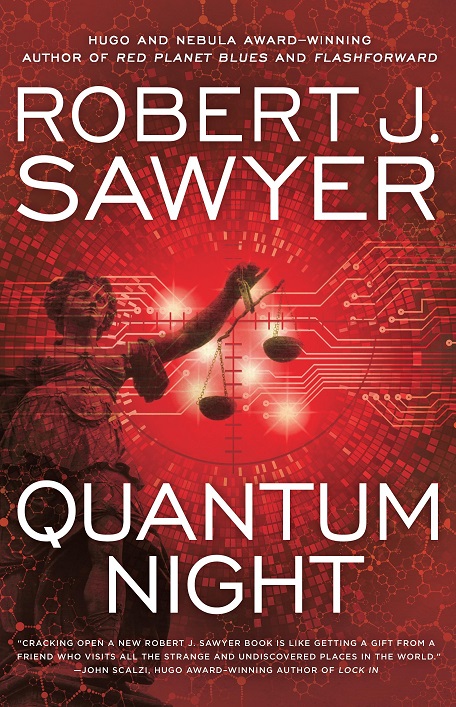 I can’t quite put my finger on it, but I really like the cover. Can you tell us a bit about it?
We had quite a go-around on the cover, and, in fact a completely different one was prepared, by a famous artist, that we ultimately chose not to use. Quantum Night is a very difficult novel to encapsulate in a single image; I give full credit to Rita Frangie, the art director at Ace Science Fiction in New York; she’s given me an astonishingly good series of covers — the best I’ve ever had.
We have to walk a delicate balance with my books. I’m published separately by Ace Science Fiction in New York and Penguin Canada’s mainstream Viking imprint in Toronto. We need a cover for each of my books that will work well with the genre science-fiction fans and also appeal to mainstream readers. There’s a lot of back-and-forth between me and my editors; we wrangle over every quotation and even the kerning of the typesetting, but in the end, yes, I think Quantum Night ended up with a spectacular cover that does justice to the contents.
Many Science Fiction novels are just pure entertainment while others have the potential to inspire and even predict the future. What is your goal?
Well, despite much of what I said earlier, I am first and foremost an entertainer; I have to be. Before I can accomplish any higher purpose, I have to get people to keep turning the pages, and they won’t do that if they’re not having fun — and Quantum Night is, among other things, a humorous book, fully of puns and geeky jokes.
We tried a bunch of different quotes to put on the front cover, but ultimately settled on one from my colleague John Scalzi, who said, “Cracking open a new Robert J. Sawyer book is like getting a gift from a friend who visits all the strange and undiscovered places in the world.” And that’s what reading any good novel should feel like — a gift from a friend. Yes, I hope my work is thought-provoking, but thinking is entertaining for a great many people, thank goodness.
Which other Science Fiction authors do you admire?
I mentioned H.G. Wells and Frederik Pohl earlier. I often think of myself as being akin to Kim Stanley Robinson: Stan are I are both liberal, we both love doing copious research and aren’t afraid to share it with our readers, and I think it’s fair to say we’re both ambitious writers.
One of my best friends is Robert Charles Wilson, who won the Hugo award for his novel Spin. Bob and I often have a similar approach to creating books. I’ve often said that one good story generating engine for science fiction is to take something that’s only ever meant metaphorically and treat it as literal. I did that for the notion of a collective unconscious in my Factoring Humanity, and Bob did that with social networking in his latest, The Affinities. He and I often talk science and philosophy when we get together, and I always admire his books.
For me, the most interesting Science Fiction juxtaposes a things that would normally not go together — in Quantum Night, it’s quantum physics and experimental psychology. I admire other writers who similarly throw disparate things together and let us watch the sparks fly. David Brin can do that masterfully; his latest, Existence, is a perfect example.
What’s next? Do you have any new and exciting projects you’re working on?
I’ve just finished the final draft of a commissioned feature-film screenplay adaptation of my novel Triggers. There are still a million steps before it goes in front of the cameras, if it ever does, but it’s on track to be the most expensive independent Canadian feature film in history, and I’m having a blast.
I also recently created a TV series — again, there are a lot of things that need to come together for it to actually get made. Unlike FlashForward, the ABC TV series adapting my novel of the same name for which I was one of the scriptwriters, this was a wholly new project designed specifically for television. I’m working with some great people on that, including Fred Fuchs, who was an executive producer on The Godfather Part III.
And I’m deep into research for what might become my next novel — meaning, of course, I’m having the time of my life.
* * * * * * *
Interview by Dag Rambraut – SFFWorld.com © 2016





One of the few, if not the only writer I’ve seen say that ‘theme’ comes first over character and story.
I’ve read almost all of Robert’s books and although they all have their strengths my favorite is Starplex. This was an early work and he packed a lot of new ideas into one book. Now he tends play a few (good) ideas out into one book at time, I won’t say milking them but using them as efficiently as possibly. I like his ideas but he needs to take more risk with his characters (imho).4 stars out of 5.