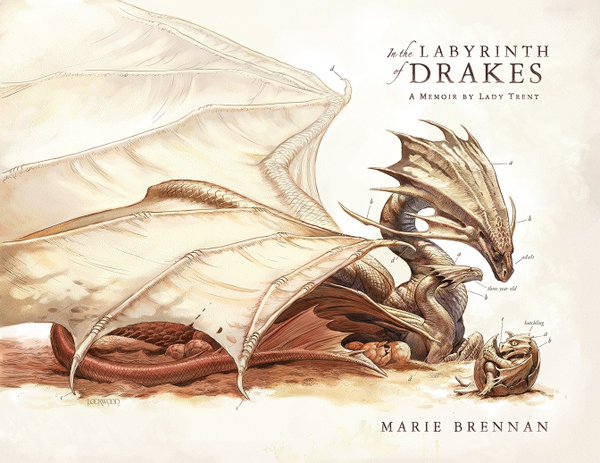
 We’re very pleased to welcome Marie Brennan to SFFWorld. As her latest book, In the Labyrinth of Drakes, the fourth in The Memoirs of Lady Trent, hits the shelves in both the U.S. and the U.K. we asked her to tell us why Dragons are such a staple of Fantasy. Here’s what she said:
At FOGcon last month, I was on a panel whose topic amounted to “Dragons: discuss.” Although my usual preference is for panels whose descriptions pose more complex questions (my other program item this year was “The Ethics of Magic,” tackling questions such as when, if ever, it would be ethical to use mind control on someone), it wound up being an excellent experience, with a remarkably large audience for the last timeblock on a Sunday afternoon.
In large part I credit my fellow panelists for this success, but it also owed more than a little to dragons. They’re cool. And even better, they’re complicated enough that you can actually fill an entire hour talking about them, without devolving into arguments over who would win in a fight, Smaug or Ramoth. (My money’s on Ramoth. She can teleport.)
Why is this? I think some of it is due to their variety. There are legends of large, serpentine creatures in many parts of the world; for all the differences between them, the basic similarity is close enough for us group them together as a type. This makes them different from, say, centaurs, which are pretty much just a Greek idea with a narrowly-defined canon. That built-in variation means that right out of the gate, writers have freedom to propose a huge number of different takes on the idea. As long as it’s shaped like a giant serpentine thing, you’re still telling a story about a dragon.
Plus, they have just the faintest veneer of possibility about them. Okay, sure, dragons aren’t real . . . but dinosaurs are. They were big, and we used to think they were scaly, and some of ’em could fly. (Before anybody can correct me: I know, I know; pterosaurs are not actually a type of dinosaur. I had a six-year-old girl set me straight on that fact several years ago.) Maybe with hollow bones, or internal sacs of lifting gas, or some other handwavy scientific justification, they could work! It’s a pretty flimsy hook, but it’s enough to tempt our subconscious into buying into the dream. What if . . .
That “what if” is pretty shiny. Giant! Flying! Beasts! Even if they don’t let you climb aboard, the way Anne McCaffrey’s or Naomi Novik’s dragons would, the notion of seeing one soar through the sky is a major sensawunda moment. We landbound monkeys are endlessly awed by the sky and the things that call it home. Centaurs aren’t a lot different from humans on horseback — which is probably where the folklore came from. But a dragon . . . that’s different. It’s a thing of fear and amazement. The day we invent truly immersive, full-sensory virtual reality, you just know somebody will write a module where you get to fly on the back of a dragon — or be a dragon yourself.
I noted during the panel that “dragon” often gets used as a marker for awesomeness in contexts completely separated from the beasts themselves. Ender Wiggin commands the Dragon Army; Rand al’Thor is the Dragon Reborn. In both Europe and East Asia, dragons are symbols of power and rulership. Although fiction sometimes treats them as mundane animals — I’ve done that myself, obviously — more commonly they are intelligent, whether they bend that intelligence to cruel and cunning ends (European dragons) or wiser and more admirable ones (Asian dragons). They are majestic in appearance, dangerous in their wrath, and often associated with wealth: gold, pearls, and more. That’s a far cry from something like the hairy, ugly lubberkin of English folklore, who does housework in exchange for milk. Small wonder we more often choose to write about the dragons!
But of course their role in our stories has changed over the years. I already noted the trend of attempting to come up with plausible-sounding “scientific” explanations for dragons. They’ve also gone from being monstrous villains like Smaug, raining fiery death on the world below, to more ambiguous depictions. Sometimes they can be bargained with. Sometimes they’re even our loyal companions. And sometimes they’ve been hunted nearly to extinction — which makes me wonder how much of the change is driven by a change in our relationship to the natural world. With a few exceptions (hi, sharks!), we mostly don’t fear big predators eating us anymore. Instead, the wilderness has become a thing we have to deal with cautiously . . . or even something that has to fear us. Dragons aren’t a threat to humanity: humanity is a threat to dragons.
Unlike many of the real animals around us, dragons aren’t in in danger of going extinct any time soon. They’ll just continue to evolve: we’ll have science fictional dragons and fantastical ones and pseudo-naturalistic ones, playing all kinds of roles in our stories. But one thing they’ll have in common — they’ll still be awesome.
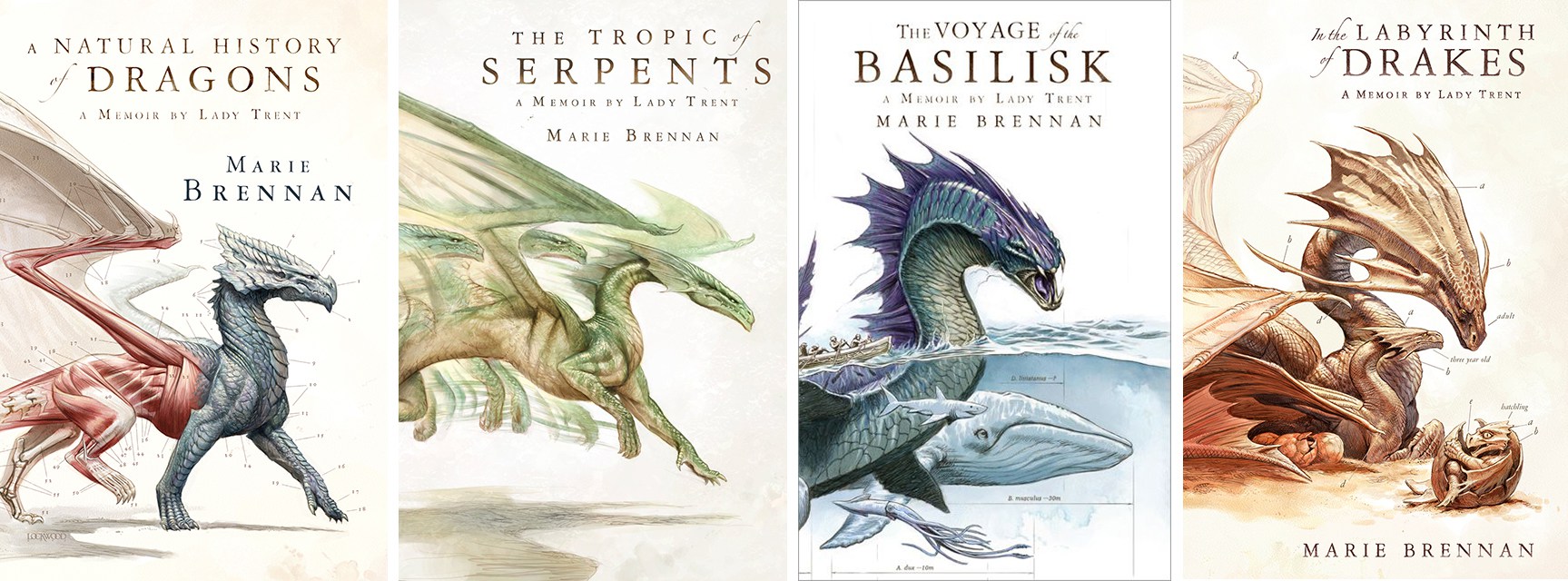
Marie’s latest book on dragons, In the Labyrinth of Drakes is out in the U.S (at Tor). and the U.K. (at Titan Books) now. Many thanks to Philippa Ward and all at Titan UK for helping us with this.