
 Tim C. Taylor is the author behind the Human Legion series. We’ve talked to him about the series and his collaboration with other British Military Science Fiction authors.
Welcome to SFFWorld Tim, many thanks for giving us some time here. In your own words, who is Tim C. Taylor?
I’m a lifelong fan of science fiction who began writing in his 30s due to the influence of beer! I love my ale, and I had deepened my appreciation of the world of brewing by having a go myself. I devised my own recipes, mashed my grains and so on. The thought popped into my head one morning that in a similar way I should deepen my appreciation for science fiction literature by writing some myself. I had no intention of earning a living through writing, or even being published.
A few years later, I was feeling burnt out in my career in the software industry, and so took a sabbatical to rewrite a novel. The idea of this novel being published wasn’t entirely fanciful because I was agented and, while I hadn’t secured a deal, I did have an open invitation to pitch to one publisher (Solaris).
However, I baulked at the idea of doing something that would earn no money before I went back into the real job world, and so I set up an imprint called Greyhart Press. It went well for a couple years but not well enough. As I was winding down Greyhart Press to a more manageable state in readiness to get a ‘proper’ job, I self-published the first two books in the Human Legion series (this was Christmas 2014). I had worked hard to write them in the background of Greyhart, but I released more to get them out the way so I wasn’t distracted from job hunting than a serious attempt at having bestsellers. In fact, I didn’t actually tell anyone when I released the books: no promotion whatsoever. And yet a few weeks later I was at #1 and #2 in the military SF bestseller chart on Amazon.com and selling over 1000 books a day. It’s now 18 months later, and I’m still riding the crest of that wave, and enjoying every minute.
 How would you describe The Human Legion series in your own words? How did you come up with the idea in the first place?
The Human Legion is me channeling the sense of wonder and epic scale that thrilled me as a kid, and got me hooked on science fiction and epic fantasy in first place. Against the backdrop of a harsh galaxy filled with alien life, and conspiracies that have been playing out for thousands of years, an unlikely set of heroes seizes the chance to fight for the freedom of humans everywhere — and the term ‘human’ in the context of my series has come to mean a term of contempt that covers something much wider than just Homo sapiens.
Like many authors the origins of my ideas are often the synthesis of several trains of thought that fuse with a sudden flash of inspiration. In this case the spark was a memory from studying history at school of a real life military unit called the Czech Legion. It’s a fascinating story and I recommend people look it up, but in essence as Russia collapsed into anarchy and civil war at the end of the First World War, a corps of former Austro-Hungarian POWs, who had switched sides to join the Allies, was left stranded in the chaos of Russia. This Czech Legion numbered roughly 50,000 men, which wouldn’t have been large enough to warrant more than an interesting footnote in the context of the First World War. But with the Russian collapse, suddenly they were the only disciplined force of any size in the whole of Russia, and they fought and negotiated their way from European Russia all the way across the largest country in the world to the Pacific, where they were evacuated three years later at Vladivostok.
The series is both space opera and military science-fiction. I didn’t want the military aspects to be completely unrealistic, and having a handful of heroes beat the bad guys just because we’re rooting for them, doesn’t ring true to me. But what if they were a small but well-equipped force measuring in the tens of thousands and in an area of the galaxy descended into chaos by civil war? At one level, the Human Legion is the Czech Legion in space, although like most authors, I found that once I set up the idea it came to life and I allowed it to take its own direction.
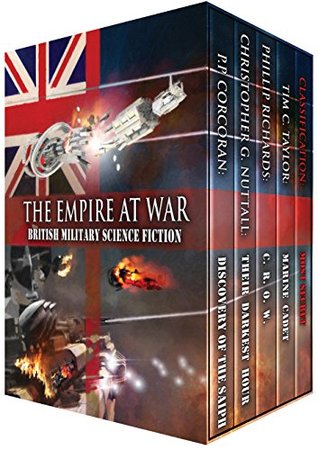 The first book in the series, Marine Cadet has been released as part of the Empire at War collection. How has it been to join forces with fellow British authors and promote British military SF like this?
It’s been wonderful to meet a few fellow military SF authors in the flesh at the recent British convention called Eastercon, because writing can at times be a lonely profession. To begin with, I had a lot of doubts. Can really do this? I had the idea of putting together a box set of military SF books, and hit upon British military SF as a theme, but I was treading new ground. American readers might find this strange, but to the best of my knowledge there has never been such a thing as a ‘British military SF scene’. I mean, the Warhammer 40K novels have been enormously successful, and one of the most successful of all British science fiction authors of recent years is Karen Traviss with her four Halo military SF novels that were all New York Times bestsellers. So it’s not a new thing for British authors to write military SF, but Warhammer 40K and its Black Library publishing arm seems to sit in a splendid and psychotic isolation, and Karen Traviss seems to be largely ignored by much of British fandom, as if writing the tie-in novels where she has seen greatest success so far means that she is not a ‘proper’ writer.
To be honest, I haven’t previously placed a lot of interest in where an author was based, but when I looked at the bios of the new wave of military SF authors I had read in recent years, I was astonished to find how many were British.
So when I started inviting authors (and an artist for the cover and interior illustrations) and saying, “Let’s do something together and call it British military SF”, I don’t think anyone had ever used that term before. Now that I’m more attuned to where people are based, I realize there are many more British authors I could have invited.
By the way, I want to point out that although I kicked off ‘The Empire at War’ project, it was far from just myself doing the work, and it is a good feeling to create something as a group that we can all be proud of.
The last two books in the series have been written together with Ian Whates. How did that collaboration come about and how different is it to write together with others like this?
I already knew Ian Whates and I recruited him after the second Human Legion book was launched with the aims of speeding up the writing, taking the pressure off me, and ensuring freshness and quality of the writing. I have lots of experience working in small teams in software development, and we used a modified form of an agile software development methodology called Scrum. The need to communicate with each other’s work so you don’t conflict does add a lot of work. It is not a simple process, and relies upon you leaving your egos at the door and both making a strong commitment to the project. We’ve had our ups and downs, but when we’re planning the book, bouncing ideas off each other, it is an extremely fertile creative experience like no other. Ultimately, you can pick a wide variety of co-working approaches, but the most important thing is that you are both committed, and both believe in the project more than you believe in the sanctity of your own writing.
So what is different with British Military SF? Do you think there are aspects where British authors are able to bring something different and unique to military SF?
It’s a good question, and one I’m still asking myself. As I said earlier, as far as I’m aware no one has ever talked about British military SF before as a literary movement, despite the success of Warhammer 40K, Karen Traviss and many others. This is the kind of question fandom is good at asking, so it’s about time we British fans started asking what (if anything) makes British military SF distinctive, and why it is so enormously popular right now.
In the real world the United Kingdom has armed forces we can be proud of, but we are too small a nation to protect ourselves outside of an alliance. And while I’m sure the military of every nation will always complain they are underfunded, with the UK this leads all too often to a mismatch between the aspiration to remain a significant military power, and supplying the minimum funding to pay for that. For example, the Royal Navy currently has no aircraft carriers, and when the first of the new class comes into service, it won’t have any airplanes.
I can see this reflected in the tendency for British military SF authors to have their militaries working in alliances, and then to be starved of funds. That’s what you’ll see clearly if you contrast Christopher G Nuttall’s first ‘Ark Royal’ novel, with Joshua Dalzelle’s superficially similar ‘Warfleet’. But that is no more than a tendency. I would say Warhammer 40K, for example, feels quintessentially British to me, to the extent I would be fascinated how it would have been developed by an American game company. But I can’t articulate why it feels so British to me. I would love to receive comments on this question.
You also write short stories under the “secret” penname Crustias Scattermush. Why the choice to use a different name?
A writer called Gill Shutt, whom I had published through my Greyhart Press business, had developed a concept called The Repository of Imagination, which was a framing device to introduce stories in a young adult fantasy collection she had written. I loved the idea and developed it with Gill into an intergalactic organization that had opened a branch on Earth, and whose branch repositarian was a cantankerous alien called Crustias Scattermush. I wrote a batch of short stories under the conceit that they were historical tales from other worlds being collected by Scattermush. I had enormous fun writing them, and intended to use Crustias as a front for many authors. But sadly, Gill passed away suddenly, and without her drive and input, I didn’t have the heart to continue. There are a half-dozen Crustias stories partially written. I’m sure in a few years, I will revisit them.
How different do you find writing short stories and shorter fiction rather than novels? Do you have a preference?
If you gave me a very large sum of money, such that I never had to work again, then I would say I like writing each equally. At the shorter length it’s easier to be more radical, and try different modes of storytelling, such as Stephen Baxter did with his ‘Vacuum Diagrams’ collection that was greater than the sum of its parts. That’s not to say the shorter length is easy.
With the longer works, to some extent readers enjoy being immersed in the different world that you have created for them, especially if you write a series. In the Harry Potter books, for example, I would say a lot of the writing is ‘fluff’, in the sense that the essence of the stories could be told in considerably lower word count. But I didn’t care about that one bit when I read those books, because I loved being immersed in the world of Hogwarts.
You cannot do this in a short story!
Short story writing is a tighter discipline, and a different one, but not a more difficult one. I’ve just referred to parts of Harry Potter as ‘fluff’, but the fact is that it required great story telling skill on the part of JK Rowling to immerse the reader in a fictional world that they care about so much that they just want to be there.
But assuming you don’t give me a large wodge of money, then there is an elephant in the room I cannot ignore. I find writing short stories enjoyable, but the financial rewards mean it is strictly a hobby or a way of providing bonus material for my fans. I am currently earning a good living writing novels, and since I need to pay the mortgage and provide for my family, I don’t write short stories very often at the moment.
What books inspired your career as an author, and what authors do you enjoy now?
My inspiration comes from when I was a kid. I was seven when 2000 A.D. comic launched and my impressionable young thrill-circuits overloaded every week for many years. In my school years I read a lot of science, military history, and sourcebooks for RPGs such as Traveller, and Dungeons & Dragons, but I was in my mid-teens before I really moved into fiction. Funnily enough, the catalyst was George Orwell with a collection of his essays I studied at school. From there I moved to 1984 and on into science-fiction and fantasy.
Recently, I’ve greatly enjoyed the explosion of talent unlocked by Amazon through Kindle Direct Publishing, whether through self-publishing or through the wave of new small publishers made financially viable by Amazon. An example I enjoyed recently is Jo Zebedee who I think is a star in the making. Her tale of Belfast’s alien occupation, ‘Inish Carraig’, was rejected by traditional publishing on the grounds that the principle protagonists were a teenage character and an adult police officer, and that this was a confusing mix between adult and YA writing that wouldn’t work. The author self-published and I have to say that the mix of adult and teenage viewpoints is one of the book’s strengths. It’s this freshness and refusal to obey safe rules that I think explains why I had all but abandoned traditionally published books until I was recently hooked by Jim Butcher.
Let’s talk a bit about marketing. How do you go about the marketing aspect and especially related to your online presence? Anything you’ve seen work better than other things?
What works today might not work in six months, so it is vital to keep in touch with other authors, such as through kboards.com. The one thing I really wish I had done from the start is work on my mailing list. So my advice to aspiring authors is to get your website done properly, and start building a mailing list right away, because if you do have a breakout success, you will kick yourself if you didn’t have all this ready in advance. I had a crazy period when the Human Legion was first launched and I sold 30,000 copies in 8 weeks. But I didn’t have a mailing list to direct people towards! Don’t let that be you!
I have thoroughly enjoyed engaging with my readers through humanlegion.com, discussing things such as battle tactics in space, the physics of railguns, and the logistics of feeding an army 10 light-years away in a universe whir FTL travel is impossible. It’s fun, sometimes it’s useful to get or hone ideas, but it is also a form of marketing in the sense that I’m engaging with people who might want to buy my next book.
What’s next? Do you have more new and exciting projects you’re working on?
In the back of my mind, I’m actively planning the sixth and final book in the Human Legion series. But I’m taking a short break to develop another project called Revenge Squad, which in a roundabout way was inspired by the in-fighting over the Hugo Awards kicked off by the Sad Puppies. The one good thing to come of that came a few months ago when I was curious enough to pick up one of Jim Butcher’s Dresden Files novels that I saw in my local library. I wouldn’t have done this if not for the fuss over Butcher getting ‘no-awarded’ at last year’s Hugos.
Within a few pages I said: “Wow! I’d love to write this sort of thing.” Now, please excuse me if I look smug here, because the advantage of earning a living as a self-published author is that I can do precisely that.
So Revenge Squad is emerging is a series of adventures centered around a retired veteran of the wars described in the Human Legion books. On the surface he is wisecracking, albeit cantankerous, but underneath he’s deeply troubled and riddled with PTSD after his experiences in the war. I initially described the series as ‘the Dresden Files in space’, but although my main character Ndeki Joshua McCall has some surface similarity with Harry Dresden, he is such a strong character that he immediately demanded to be treated as a unique individual in his own right.
The other key project in my life at the moment is a spin-off series from the Human Legion that I commissioned from author JR Handley. Although with my own novels I researched hard and asked for a lot of advice, I don’t have a military background. Handley is a veteran of the US Airborne Infantry, and the corresponding verisimilitude he brings suffuses every paragraph.
2016 is shaping up to be a very busy year for me!
Once again, thank you very much for your time.
Thanks for inviting me. It’s been a pleasure.
*****
Interview by Dag Rambraut – SFFWorld.com © 2016





Bravo Tim, another great interview!! Loved the article as well!!! 🙂
His willingness to listen to his fans regarding the military and other science things is part of what makes I’m an awesome author!!!
Mr. Handley is too generous, I’m sure, but the point about listening to fans made me think about a question I was asked regarding how authors can use their online presence to market books. While it’s true that I have made use of my website to ask questions and spark debates, for aspiring writers to listen to readers all they actually require is a web browser and an internet connection. Go look at reviews on Amazon, Goodreads and fan blogs, but only pay attention to the people who are fans of the kind of book you are writing. Readers and commentators who don’t like your kind of book might make insightful contributions to the wider conversation about science fiction – I enjoy them for that reason – but if you’re wearing your author hat then ignore them completely; they lack the faculty to appreciate the kind of book you want to write.
I said I didn’t market my first Human Legion book. That’s true, but what I did do was listen very carefully in advance to readers of military SF (possibly made easier because I am one myself). I didn’t slavishly follow anything, but this ongoing exercise did give me some objective quality criteria to assess what I was writing. As a result, once I launched the book, it marketed itself by word of mouth.
I’m still listening.
Another great read Tim. And thoughtful as always. As one of the few authors that reaches out to truly engage your fans and readers, I really appreciate your thoughts and conversations. It’s nice to see other writers starting to do the same.
I think what makes British Military SF different is the worldview. As Tim pointed out, the UK has a professional military, but they also rely on alliances for world-war-level conflicts. I think this carries over to Earth’s place in many SF stories, where Earth is not a superpower, but rather a small planet with a rather war-like population and modest technology. In most stories, we see Terrans using space ships and weapons tech they received (or captured) from alien species, but they are rarely powerful enough to defeat some vast alien armada on their own.
Military SF from the United States may differ for many reasons, but one is that American views are shaped by the idea of being a superpower, so they might approach an alien conflict differently.