
 We were on the eve of another final draft deadline and the second round of edits had just been returned by our editor. After reading through the edits, I put my head in my hands.
None of the stories were where they needed to be. A couple were closer than others, but the changes we had made failed to bring Interspecies–our shared-universe anthology–into a cohesive, solidified vision.
The goal was to collaboratively build a universe from the ground up and then write stories not only based in that universe but in the same geographic locations and timeline. At first the prospect was thrilling. At the end of 2014, a group of writers from my writer’s workshop formed a team to pull off this goal. In February 2015, I founded Kōsa Press, the label that would publish these stories and safeguard the universe. And in July 2015, we published These Broken Worlds, an anthology of flash fiction stories and the first foray into this universe, a planned precursor to Interspecies.
Fast-forward to our second round of edits, and I found myself wondering if Interspecies was even possible. Since putting out These Broken Worlds, the struggle had been real and demoralizing and seemed staggering at times. Every fix meant to bring cohesion to one element of the shared world only broke continuity in other stories that were previously fine.
Why had this universe worked so well for These Broken Worlds. Why wasn’t it working now for Interspecies? As the publisher and project manager, it was my job to have an answer and to formulate a plan of action.
But the answer staring me in the face was one I didn’t want to accept. The answer wasn’t hard to grasp. It didn’t take much introspection or inference. The answer was there in the edits.
The Creative Vision
There is something behind a storyworld that gives it power and allows readers to connect with its qualities in a waking dream-like state. It’s a thing that gives the reader intimate access and immersion in the world. It’s the same thing the writer taps into that allows him or her to create a bridge between the reader and the storyworld. This is what makes a superman story a superman story no matter who writes it. As long as the vision is clearly accessible to both writer and reader, the stories will have a natural cohesion and through-line.
If behind the story lies the world, then behind the world lies the vision. But what does this vision really mean?
The vision is the quality that gives the storyworld meaning. It is the door that readers enter. It is the dream-state pill they swallow. It is the point of connection. The thing both the writer sees by means of creation and the reader by means of reading. It’s intangible. Purely experiential.
You feel it tingle in your spine. You experience it when time goes by in a blink, unnoticed, while you’re lost in a book.
The vision informs worldbuilding. Creating a universe without a vision is a futile exercise, the product of which will only feel hollow and uninspired.
A vision spawns your themes and conflicts. And it’s hard to define sometimes because when you work solo, you often don’t need to realize the vision consciously if you’re clearly producing stories from it.
However, when you have a team of writers working in the same story universe, it becomes imperative that each author understands the vision and is able to creatively access it. And it’s vital that the worldbuilding follows the vision in every story.
To help define the vision and worldbuild the universe, we prepared a source document (what we call our story bible) for writers to work from when creating their stories.
 Worldbuilding Universes
What we found on Interspecies is that the worldbuilding lacked in certain areas, which forced writers to fill in the blanks. Naturally, each writer had different answers for these blanks, so when the stories were put together, we saw clear contradictions. We were discrediting our own claim that this was a single universe.
The story bible we wrote was failing us and instead of a strong foundation, we had created a house of cards. We realised the vision would be hard for readers to connect with, and harder still to immerse in.
There were simply too many open-ended questions, and the answers were conflicting. The goal of a cohesive, immersive world felt farther away than ever, and I was faced with the decision of either publishing something that didn’t meet the quality standard the team had set or face going back to the drawing board.
I discussed the matter with my co-authors, Dana Leipold and Woelf Dietrich, and we agreed the reason Interspecies wasn’t working was its lack of detail in key areas. Less detail works for smaller, less-detailed stories, that’s why These Broken Worlds had been successful. But for longer stories that required more background, worldbuilding on the fly just would not do. It was sinking us.
Looking back, this root problem seems so obvious, yet, given the complexity of the project, the collaboration involved, the success of These Broken Worlds, and all the moving parts, it successfully eluded us for a time. But now that we’d identified the problem, what could we do to save the project and our stories? We’d invested so much time and effort into Interspecies, abandoning the project was even less of an option than publishing stories that claimed to connect but didn’t.
The answer: rewrite the story bible from scratch… in other words, rebuild the universe so the vision of this world could finally be whole.
Unfortunately, the continuity with These Broken Worlds would suffer, a casualty of staying true to what Interspecies needed to be. There is still a thematic connection between the books. However, Interspecies transcends the original conception, and it had to in order to remain true to its vision. Interspecies is inspired by, perhaps, but also a departure from These Broken Worlds.
Guardians of the Creative Vision
Publishers, writers, editors all have a duty, a sacred responsibility towards the creative vision. They must nurture and protect it. They must hone it and peel away anything that would detract readers from connecting with it.
Interspecies bloomed because we stayed true to its vision. We did not abandon the shared universe when it was in need. We did not evade its root problems. Instead we faced the challenges head on.
Building a universe isn’t a simple thing. It’s easy to be overtaken by the kid-in-a-candy-store mentality: wanting to put everything you think of into that world, everything you like and want. It’s also easy to succumb to the god-like power of creation, and allow ego to take over, defending all your contributions to the shared universe. It’s when you get past these base states that real progress is made.
As a team, we had to learn how to ask “How can I serve the vision?” instead of “How can the vision serve me?” This service is the essence of creative team work.
This is the secret.
Interspecies was the most ambitious and difficult project of my artistic life. There were pitfalls and setbacks as well as joys and triumphs. There were times when it felt like the book would never get off the ground. Moments where it just didn’t seem worth the effort.
Yet such trials offer opportunities for growth and wisdom. The project and the process become teachers. The stories receive and transmit the lessons by means of their quality.
To create a shared universe (or any universe) successfully, you have to face hardships head on, work hard, and wield determination. You must scrape away the creative vision’s rime and peel back its thorns and stay true to what you find inside.
And when you do this, when you stay true to the vision, despite setbacks, you’ll discover that somewhere along the journey the creative vision evolved into this thing, this entity with a life of its own. And all that is left for you as a writer, is to tap into it and build that bridge for your readers.
Send that bridge out into the world and your readers will find it. And this is when the book begins to build relationships without you. When readers find that bridge to the vision, they’ll let you know.
***
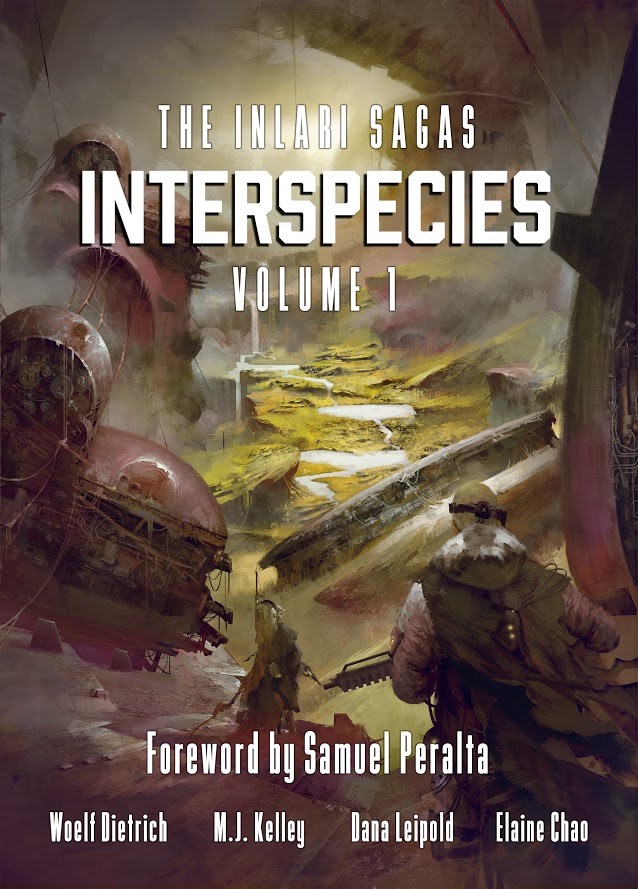
Interspecies was in the top ten bestselling science fiction anthologies on Amazon’s bestseller list upon its release. It’s received rave reviews on Goodreads and Amazon from early readers and Keith West, reviewer at Adventure Fantastic and Futures Past and Present, said “Interspecies is a solid science fiction anthology that provides entertaining reading for a thinking person and sets a high bar. . . . These are writers to watch.” The book was featured in Venture Galleries’ Book of the Moment Club, and Piers Anthony, New York Times Bestselling Author of the Xanth Series, said these are “hard-hitting stories about a grim future world. . . . I found the exploration mind-stretching . . .” Interspecies is only 99c on Amazon until June 7th.
M.J. Kelley is a published short story author, speculative fiction aficionado, and humorist with a passion for education. He is the founder and publisher at Kōsa Press, the founder and director of Write Draft Critique, and holds an MFA in Fiction from Mills College. He’s fond of fog and can peel a carrot with a look. M. J. dwells in San Francisco, CA, seasonally as well as year round.




If I may ask… What is the stated” Vision” of your shared world? Is it something you can write down?
Great question. Thank you for reading and for the comment.
The stated “vision” of Interspecies exists as the entirety of a 100+ page source document (story bible) I created with my co-authors, the purpose of which was to describe the vision in detail. So yes. It can be written down or, at the very least, described. And in the case of any collaboration similar to this, probably should be. A comparable document is used to convey the vision, and all its components, to staff writers on television shows and is sometimes referred to as a “Series Bible.”
Is a creative vision irreducible? I like to think no. In fact, the vision can be reduced to a story or stories in our case. The vision is also something hopefully reflected in book blurbs and jacket copy. Every component should point to it, but in fiction, story is a vision’s best conveyor.
Thanks again.
I think it’s always very hard to write in someone else’s universe or with someone else’s characters. Your “bible” sounds like it’s a good way to unify everyone’s contributions (even though this time it wasn’t quite so successful as the first time) but I remember a fantastic weekend with the Hull Writers’ Group, where we brainstormed a complete universe and then went to create some ideas for stories. It was all helped with a lovely meal on the Saturday evening (not forgetting the obligatory few bottles)…a fantastic experience which is great if everyone can physically get together as we did.
Anyway, I enjoyed your article.
Helen, thanks so much for the comment. Glad you enjoyed the article!
Re: “even though this time it wasn’t quite so successful as the first time”
Interspecies did end up being a successful project, just as successful as the first if not more so; we just had to rewrite our story bible to pull it off. Going back to the drawing board was part of what made that success possible. At the time of the decision, it felt like a painful thing to do. But it’s common practice among writers. Sometimes you just have to start over. In our case, we were lucky and used our stories as the jumping off point for rewriting the new story bible.
Collaborating with a group can be a fantastic learning experience. It’s certainly taught me a great deal about worldbuilding, leading a creative team, and working with other authors.
I’m glad you got a real taste for that type of collaboration.
Thanks again.