 Every other week, SFFWorld offers a small press the chance to crow about a recent publication. In an attempt to keep things completely fair (not), we didn’t want to make it too easy for these brave little presses who take on the giants. There are hurdles we make these fine businesses jump, and no we won’t lower the bar, not even for cake.
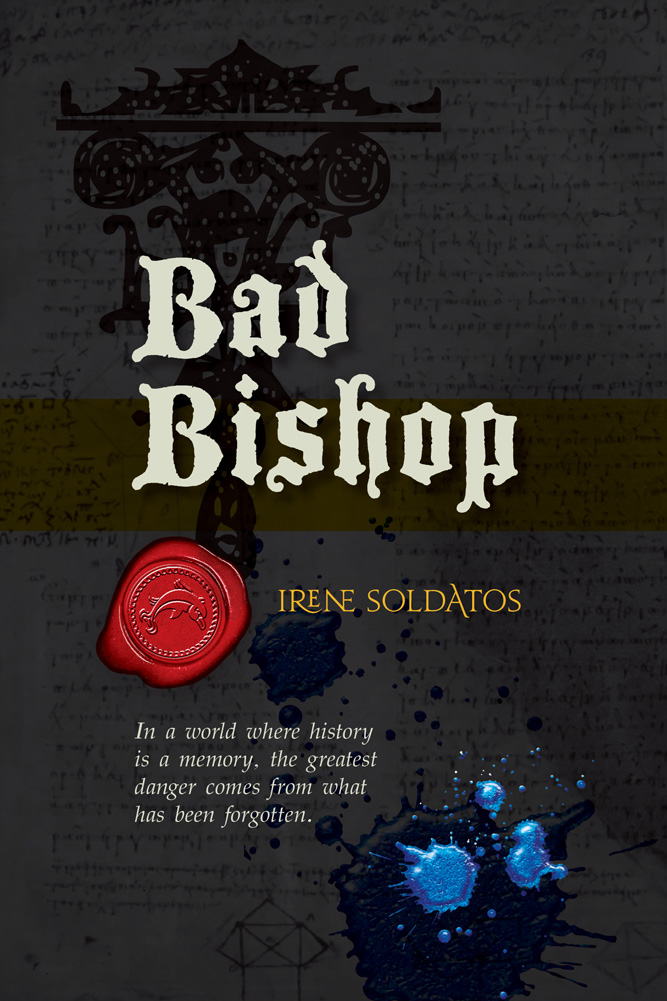
This week it’s Bad Bishop, published by Kansas (yes Kansas!) small press, Hadley Rille.
Bad Bishop has been hailed by Publisher’s Weekly as “A fresh, deeply literary view of immortals. Incredibly dense and colourful.” The authoress, Irene Soldato, is here to answer a few… gentle… questions!
Welcome to SFFWorld, Irene, can you tell us a little about Bad Bishop without quoting the publisher’s blurb?
Thank you very much for having me. It’s great to be here.
Bad Bishop is a long, complicated book, so trying to tell you more about the plot than what is on the publisher’s blurb will probably be meaningless. It doesn’t have a single – or even a couple – of protagonists, but rather dozens of characters who all contribute to the events of the plot. So I’ll plumb for themes and devices. Plot-wise, it’s both a locked-room murder mystery and a political thriller, with a bit of adventure thrown in for good measure.
But what the book is really about is history, the long view of history, and as such, about us as humans and our societies throughout history: how we change radically and yet at the same time remain exactly the same.
Is there one scene which stood out as you were writing?
That is a very difficult question. As the book comes in at about a quarter of a million words, there are actually several. But since I can only quote one here, it’ll have to be the scene near the end of chapter 6, where one of the main characters, trying to come to a very important decision, reminisces on his very long life, whilst walking through the medieval German city of Mainz – which used to be the Roman city of Moguntiacum – noting at the same time how the fabric of the city has changed over the centuries. That section – and another somewhat similar one in chapter 12 – essentially encapsulates what the book is about.
What has it been like working with a press based in a completely different time zone to your own?
It was surprisingly straightforward. Yes, my publishers wake up around the middle of my day and things do often get done – via many emails – in the evening, but I didn’t find it problematic at all. The brilliant thing with a small press – a good, professional small press, like Hadley Rille – is that relationships are very personal. Things can be discussed and – where there is a difference of opinion – negotiated. New ideas can be pitched, etc. If someone needs help with something because, as you said, there aren’t enough hours in the day or dollars in the bank account, and someone can help, people volunteer to help. Everyone wants what’s best for everyone because everyone’s fortunes are so inextricably linked. Small presses publish for the love of a good book. That’s it.
Where did the idea of Chess-playing vampires come from?
Well, it was vampires because I needed some being that was long-lived enough to have a broad and long view of history, and similar enough to us be affected by it, and for us to be able to relate to this being. But also, I felt that the vampire genre had left this aspect largely untouched. Most vampire stories centre on questions of ethics, or on the horror aspect of the mythology. Most spend no time thinking what it would be like if one had truly lived through several centuries of human history, or even a couple of millennia. I’m interested in history and human nature and in order to discuss these things, vampires seemed ideal.
Now, the chess … Well, I like chess. I’m nowhere near good enough at it, because I don’t have the patience to learn properly, but I like the intellectual challenge of it. Chess is a game that has been played for many hundreds of years, and frankly, people would know how to play it, and would play it. Everyone needs a pastime. Even vampires. Perhaps, especially vampires.
But aside from this, chess for me is a device which I use to hint at certain things – which one might get if one knows chess well – or to symbolise other things (which should be clear even if one doesn’t know chess well), most of which have to do with the plot and politics of the story. It is also used in the title of the book, which can be read as a chess term – or not. I like the ambiguity of who the eponymous character is. Near the end of the book I explain what the chess term in the title is by describing the end of a chess game – and from that one should be able to work out who this “Bad Bishop” is.
Why should a reader spend their hard earned cash on your book?
They should spend their hard earned cash if they think they would enjoy a story like this. If they like Umberto Eco, and they like historical novels and philosophy, but also supernatural themes and fantasy, then this is the book for them. It’s for people who read widely, across various genres, and who like a touch of the literary in their novels. I have found that people who never in their wildest dreams would have thought they’d like a vampire novel, liked this one.
It took me a very long time to write this book, many years, and this was largely due to the research that went into it. I’m obsessive over getting historical detail right– which might have to do with the fact that I have three historians in my immediate family and I’m terrified one of them will spot an error somewhere. But also it took a long time because I was writing the kind of book I like to read, and that means a book with many layers. Building those layers, which are dependent on detail and metaphor and symbolism, takes a long time.
So, if this sounds like your sort of thing, then I think it’ll be worth your hard-earned dosh.
Also, you know, I have cats to feed … And bills …
Recommend a book you like from a different publisher… and it can’t be written by your bestie!(Frienemies aren’t allowed either. )
OK, I will have to cheat, somewhat, and recommend Mélusine, which is part one of a tetralogy called “The Doctrine of Labyrinths”, by Sarah Monette. It’s not a new book/series, but it’s hands down one of my favourite fantasy books/series ever. They are the kind of layered books that I love reading. They are also dark, and decadent, and an unflinching portrayal of the best and worst in human relationships and nature. I find them magnificent!
Who designed the cover and who edited Bad Bishop?
The cover was designed by Molly Suber Thorpe of Plurabelle Calligraphy and Design http://plurabellestudio.com/
Molly also did the incredible typesetting of the interior.
Bad Bishop’s history is a bit complex. It was first published very briefly (for 9 months) by another small press. After which time I was able, luckily, to get my rights to it back. For its first publication it was edited by Harriet Goodchild. When I then offered it to Hadley Rille, the Fantasy Editor, Terri-Lynne DeFino, who recommended it to the publisher was happy with the text as it stood – which was lucky, because I wouldn’t have wanted two variant texts floating about out there – and it was taken on as was.
So, in short, Harriet Goodchild edited it, and it’s a vastly better book for it, thanks to her!
Are you working on anything else?
I am. I’m working on a sequel to Bad Bishop. Have I mentioned I’m slow? I think I have. I think I’m slower than G R R Martin! But yes, it’s in the works. I’m about 180k in and the end is still nowhere in sight. But that’s normal with me. That’s how Bad Bishop was, too.
Before we let you escape, Irene, can you tell us where Bad Bishop is available from?
It’s available from all the usual outlets. Hadley Rille have a great distribution. Waterstones have an aversion to small presses, so if you walk in you won’t find it on the shelves, but if you ask for it they’ll be able to order it in for you. It’s available from Barnes & Noble in the US, and of course from Amazon, both in print and in kindle format, and the Book Depository.
And where can we find more about you?
My website is www.irenesoldatos.eu – where you can also get in touch with me, if the mood so takes you.
But I’m also on Twitter: https://twitter.com/I_Soldatos
And the obligatory Facebook page: https://www.facebook.com/IreneSoldatosBooks/
Oh, yes, and I’m on Pinterest: https://uk.pinterest.com/irenesoldatos/
*****
Small but Mighty – SFFWorld.com © 2016
*****