
I thought it would be easy to destroy Earth. Oh, was I naïve . . .
I’ve always loved the control that I feel as an author. Characters fall in love, out of love, make mistakes, kick ass, die or, hopefully not often enough to destroy all credibility, get resurrected at my will. When real life sucks every ounce of patience out of me, I can always go home and torture one of my characters without the threat of repercussions. I like to think it keeps me sane, but of course, those closest to me may argue that point.
When I plotted out my five-book series a couple years ago, I knew that by book four, it would be time to give my characters a break and began to torture my worlds. I needed to increase the stakes across both dimensions for the big finale in book five. It took quite a bit of research, in spite of my amateur earth and space science interests, and found that it’s not easy to make reality align with your imagination! The challenge was to have my antagonist destroy Thrae, Earth’s mirror dimension, while salvaging enough of the planet to support life. Luckily, I sat on a panel with two NASA scientists at Denver Comic Con and cornered them afterwards to verify my research. I was thrilled, and more than a little relieved, to discover that the details were accurate!
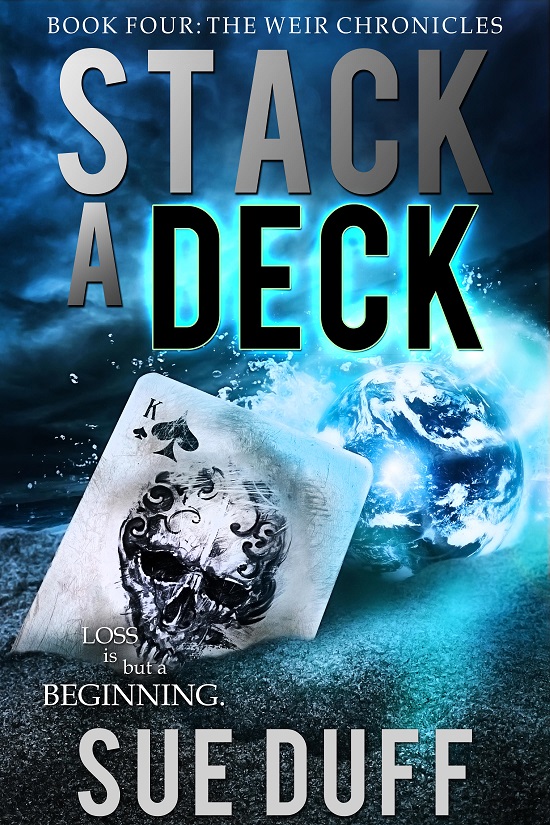 So, what does happen when a powerful being drains some of the planet’s core energy? The rotation of the liquid nickel slows, triggering a domino effect that weakens the magnetic field, our first-line of defense from those nasty meteor showers. The distance between Earth and the moon increases with the change in mass of the planet and time changes with the rotation of the planet, winters are longer, and summers, too. Oceans shrink with the increase in heat and expansion of deserts from the meteor destruction. And that’s just the beginning . . .
Each element impacted something else that I hadn’t anticipated, and my world building became a wild, out-of-control animal difficult to contain. I’ve left out most of the scientific details for the sake of the story flow and for reading ease, but make no mistake, the science is supported, albeit sparsely explained in places. Given that the fate of both worlds hang in the balance for book five, I’m now in the position to ask the ultimate question. Is it possible to save a ravaged planet? You’ll have to tune in to find out, but first I need to track down those scientists to verify my theories.