 I was in an undergraduate art history lecture, sometime in the early nineties, when the idea for the book first came to me. The speaker was talking about the various invasions of Egypt (Persian, Greek, then Roman). The lecturer said Egypt was so old when it was at last overrun, so ancient, that it had no walls, no army at the borders. It had always been there and always would be there—or so the people thought. Their civilization had been there for such a long time, longer than any other culture, that they couldn’t imagine it ending. Egypt was eternal. But, of course, it wasn’t and that got me thinking. I wanted to write about a culture that had grown blind to its own vulnerabilities, an ancient people who thought no one would ever conquer them. In a way it reminded me of our own culture, so I kept this idea in the back of my head.
A few years back, I had a second inspiration while reading Daniel Boorstin’s The Discoverers. In one of the book’s early chapters, the author describes how the first 365-day calendar was made. The story goes something like this: Each year, just prior to the annual flooding of the Nile in Egypt, the star, Sirius, appeared on the horizon just before sunrise (the so-called heliacal rising of Sirius). After a time, people started using the star’s rising to predict the annual flood. Now, the flood was important to the Egyptians; the flood enriched the desert soil, making the land suitable for farming. Without the flood, Egypt would starve, so they kept careful track of the star’s movement. They noted that Sirius rose, just prior to sunrise, every three hundred and sixty-five days, which became the basis for their calendar and ours too. Now, I wasn’t really interested in calendars, but the idea of a culture completely wrapped up in this sort of yearly cycle sounded pretty interesting to me. I started thinking about all of the possibilities and one interested me more than any other. If a culture is completely engrossed in this kind of cycle, if the people’s lives are dependent upon it, what happens when that cycle fails? What if the star did not rise or, in the case of Soleri, the moon did not eclipse the sun, as it did each year? I wanted to visit a culture that was predicated on such a cycle and then I wanted to see what would happen if things fell apart. In Soleri, I explore that moment when everything changes and the people’s beliefs are inverted. What happens when we experience the impossible?
Soleri is a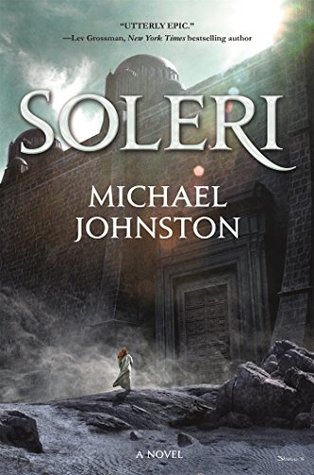 big mix of the real and the unreal, the believable and the impossible. I’m trained as an architect and there is a lot of real architectural history in Soleri. For me, the challenge was to take all that real-world knowledge and blend it with a fantasy narrative. The book is full of examples. The Cenotaph in Solus—a key location in my novel—is similar to a proposal made by the 18th century French neoclassical architect Étienne-Louis Boullée (In case you’re not familiar with 18th century French visionary architecture: A cenotaph is a tomb without a body. The building itself acts as the tomb. Its architectural design is shaped into a kind of monument to the person). In Boullée’s proposal, he dedicated his cenotaph to Isaac Newton and his study of the stars and their motion. To commemorate the man, Boullée created a dome that appears as a nighttime sky during the day and, with the addition of a lit brazier, a daytime sky during the night. He envisioned a building that would simulate the whole cycle of our cosmos. This sequence of night and day seemed a fitting commemoration for the gods in Soleri and fit well with the history of those gods, so I adapted it for the cenotaph in Solus. I wanted Soleri to be its own original world, but I also wanted it to resonate with our world. Merging my invented history with our real one helped me create a hybrid world that is both real and invented.
In Soleri, references to real architecture abound. The badgr, the wind scoops that cool Harkan homes, can still be found in the Middle East and the Tulou, the fortress where one of our character’s allies make their stand, is a type of desert fortress found mainly in China. Both examples are pictured in Bernard Rudofsky’s Architecture Without Architects. For me, the work in Rudofsky’s book is almost a kind of fantasy architecture. Everything in it is real, but the images feel so distant that looking at them is almost like glimpsing into another world.
That tension between the real and the imagined has always fascinated me. The desert is another place where I’ve often felt the real has dissolved into the unreal. It’s not a place where humans were ever meant to live and yet we build there all the time. I lived Palm Springs for several years (ok, you’re picturing golf courses and pink flamingos, but there is real desert there too). I hiked, and I walked the desert. My characters do the same. Many of the details in Soleri—the descriptions of plants and the harshness of the landscape—were taken from my desert walks. But I also tried to capture the feel of the desert, that unreal sense of being in an unlivable place where there is nothing but sand in every direction, no food, and nothing to eat, the way the air turns hazy when the heat rises off the sand.
Soleri is a big world and it ranges over not just the desert but the mountains and the forest too. Again, I tried to take real locations and merge them with my invented ones, taking the real and imbuing it with a sense of wonder. The Stone Forest where one of characters undergoes an ancient, mystic rite is based on an actual Stone Forest in Madagascar. A Google search of “stone forest” will reveal a surreal landscape of serrated stones, dense as an actual forest. It’s as fantastic as anything the mind can imagine and it’s all real. Some of the least likely moments in the novel come from real places. The plank walks one of our characters must traverse are based on the real plank walks in the Huanshan Mountains (in China, again google it). The planks there are nothing but old boards sitting below rusty chains nailed to sheer cliffs. No one in their right mind should climb these paths but people do it every day. It looks like fantasy but it is real.
So, this takes me back to that art history lecture, the one about Egypt and the people who had forgotten they could be conquered. I’ve never found that story in any history book, but twenty years later I remember it distinctly. Maybe over all those years that lecture has somehow become my own fantasy, something that is continually evolving and inspiring me, based on the real but, like everything in my novel, changed, rendered unknowable and charged with magic. I like to think that Soleri is that sort of novel.