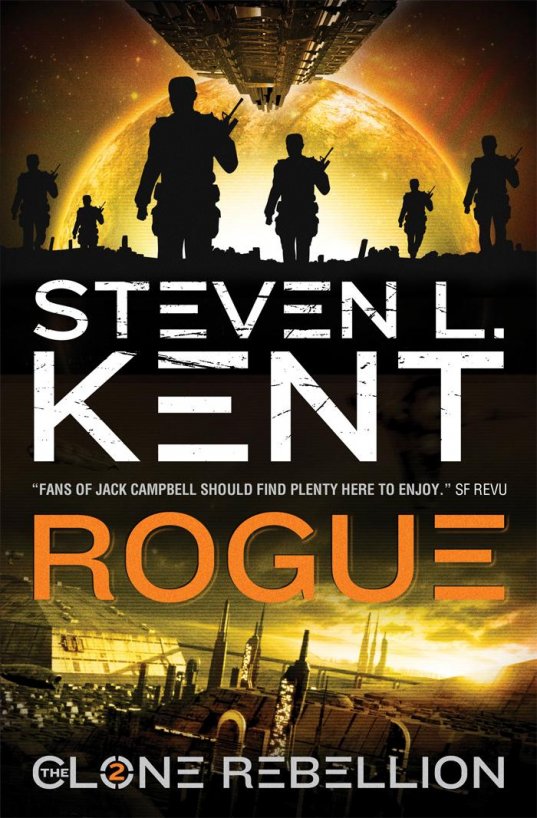
 Rogue Clone by Steven L. Kent
Book Two in the Clone Republic series
Published April 2012 by Titan Books UK
(Originally published in the US by Ace Books, 2006.)
ISBN: 978-1781167168
400 pages
Review by Mark Yon
Book One of this series (Clone Republic, reviewed here) was an enjoyable and solid mil-SF novel, which I enjoyed a lot when I read it. I recommended it for Baen Books fans and those wanting something a little more than their Star Wars: Clone Wars counterparts. Rogue Clone shows a steep upward learning curve for the writer. Whilst the characters are fleshed out, the plot is a rapid-firing, adrenaline pumping cousin of the first book, rather like a clone of the first, but on steroids.
Rogue Clone manages something very difficult from the off: to summarise the events of Book One without too much information dump and move the story on, all within the first thirty pages or so. Whilst war is brewing between the Unified Authority of the Orion Arm (that’s Earth to you and me) and the rebellious Outer Worlds, led by Crowley and the Morgan-Atkins (Mogat) separatists, Wayson Harris of the Unified Authority, now presumed dead, and his mercenary colleague Ray Freeman, are on the hunt for the leaders of the Mogat rebellion. Whilst reporting under cover back to his old mentor, Admiral Klyber, Wayson soon discovers where his nemesis, Amos Crowley of the Galactic Central Fleet, is hiding. We spend much of the beginning of this novel in space, with Harris undercover, guarding Admiral Klyber at a conference on board the Doctrinaire. Harris meets Admiral Huang again, a political enemy of Klyber’s and no friend of the Liberator clones, of which Harris is one of those remaining. Despite this, the conference appears to pass fairly successfully. However an incident after the conference leads to a plot which involves betrayal, political manoeuvring and a coup attempt, whilst in the background the influence of other partners in some rather fragile coalitions become increasingly important.
This one really steps up the game here. We have space battles, behemoth spaceships, planetary attacks from space and large scale destruction. Perhaps more interesting, however, is that we have some very interesting fundamentals that are questioned.
Firstly, the position in society of clones continues to be examined. Whilst they are often used as cannon-fodder, Steven continues to question and examine that simplistic view. Wayson has to consider where clones fit into society, and whether clones can follow questionable orders. There’s the recurrence of questions that were first mentioned in Clone Republic – can clones have a soul, follow a religion, and believe in redemption, even when society and religion shuns them? There are no easy answers here.
Whilst trying to determine answers, it doesn’t help that we see more of those things that help blur our perceptions of what is right and wrong. We see more of Wayson here as a fully formed killer, albeit at times one with a new emotion of regret. There are occasions here when Wayson’s highly efficient killing techniques are used fully and Stephen doesn’t skimp on the details. This is not gratuitous violence, however. Wayson’s killings are usually necessary, efficiently executed and rather chilling. There is no doubt here that the Liberators, of which Wayson is one, are lethal when they turn their mind to it.
As this is the second book, we see the necessary character development required for a series to develop and progress. We lose some characters and yet we strengthen our connection with others. There are deaths and new, unexpected friendships, all of which lead to an evolution in our main characters. The qualities of loyalty and duty are part of this, yet there are also doubts, as Wayson tries to deal with an increasingly difficult situation.
The last part of the book is a resolution of sorts. When the rebels destroy the means of galactic transportation, the Unified Authority is spread out over enormous distances too great to travel. Wayson and Ray end up back at where Ray started, on the planet Little Man, now renamed Delphi. Here both Wayson and Ray have to deal with people from their respective pasts. The novel’s denouement is one that I should have seen coming, but didn’t, and one that is appropriate to those fundamental issues discussed throughout the novel.
In the end, Rogue Clone was a book that surprised me by continually punching above its weight and confounding my expectations. The ending leaves many issues unresolved and a number of hints that things are about to change, and not necessarily for the better. Which make me want to read Book Three as soon as possible. This series is becoming seriously un-putdownable stuff – I look forward to the next book.
Mark Yon, May 2013