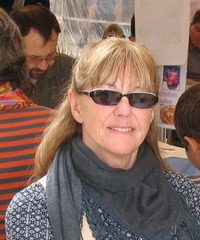
 Alexes Razevich is the author of Khe, a wonderful new world to explore for those who want to read something different and new.
For those not familiar with “Khe” can you tell us a bit about it?
The title character, Khe, is a young alien female anxiously waiting her first opportunity to mate. When she fails to see the colors that will guide her to her mating place, she is sent for an experimental operation in hopes that it will unlock the ability. The operation is a success, but other abilities are set loose in her as well. These new abilities trigger a series of events that cause Khe to discover the hidden truths of her world and herself.
“Khe” can be read as a straightforward adventure story set in another place, another culture, or the reader can delve into the themes of self-determination, the push/pull of wanting to belong and wanting to be oneself, or see it as a cautionary tale about the dangers of a controlled society, or as an analogy of the sometimes painful, sometimes confusing transformations we all go through in life. I like the idea that each reader reads his or her own book, taking from it what s/he wants.
Khe herself, definitely. I think she successful represents all those trying their best to navigate a bewildering world—the people who, whatever walls and obstacles they find in their way, grit their teeth and keep going forward on the long march to being themselves. I’m happy, too, with the depth of the world created in the book. It feels organic and true.
There are always things that could have been done differently, but at some point you have to let the book go.
The novel is, in many ways, about transformation—physical, mental, and spiritual. Khe’s an innocent moving through her socially engineered world, discovering that things are not what she’s been led to believe. She’s young when the story opens, but not stupid, and not simple. She takes what she learns and applies it, even when it shakes her to her core. She’s kind, brave, and curious about the why of things—and gets angry, frustrated, and jealous, and makes mistakes. I find her quite endearing. If she were a person, I think I’d enjoy her company. I certainly hope readers do.
It’s hard to know how much is conscious, how much unconscious, in the writing process. From my conscious point of view, Khe and her sisters, and the commune setting arrived in my mind just as they are in the book. Khe showed up smooth skinned, earless, bald, infertile, and with her species’ unique way of displaying emotions. The story stemmed from her disability and its consequences, rather than from my desire to create something different.
That said, once Khe had shown up, I got interested in exploring and detailing a world that was completely different from the one in which I, in which most of us, live. Everything—society, family relations, methods of reproduction, foods eaten, aging—had to be developed solely from imagination. Then it was a matter of letting Khe and the others live in their world.
What goals might you have set for yourself when writing “Khe” and how do you feel about the end result?
I wanted to do justice to the characters, especially Khe—to write their stories in a way that sent the reader on the journey with them, made the reader one of them. I think I might have succeeded since people say they stayed up late to finish the book, and felt like they were in Khe’s world. And people want to know what happens next—always a good sign.
 I felt the cover was very good as it managed bring me straight into the world you’ve created. Can you tell us a bit about it and why you choose this particular cover?
Thank you. I love that cover. It was designed by the brilliant Tony Honkawa of THD. He came up with the original concept, layout, and font choices, and then we worked together to get it just right. There was some back and forth, changing background colors, working on the direction of the light source—that sort of thing. I’m pretty pleased that the eyes were my idea.
Not that you have to put a label on things, but after reading “Khe” I’m not sure if I should call it SciFi or Fantasy. How would you describe the world you’ve created yourselves?
This topic came up in a writers group I belong to. A number of us do work that combines several genres. None of us know how to categorize our books. If pressed, I’d say “Khe” is dystopian science-fantasy.
What’s next? Can we expect more stories set in the same world or do you have something entirely different in mind?
Next up is a fantasy thriller called “Shadowline Drift” set in the Amazon rainforest with two protagonist—one an American and one not—who are each three and a half feet tall . “Shadowline Drift” should be out by the end of the year. After that, the follow-on to “Khe.” I want to know what happens next, and the only way to find out is to write it.
What sort of challenges, as a writer, might you have faced before “Khe” was published? Any insights you would be able to share for those aspiring writers seeking advice?
This goes to the question: Is “Khe” Scifi or Fantasy? I have the letters traditional publishing editors sent my agent saying basically, Loved this story, but can’t figure out if it’s Science Fiction or Fantasy and don’t know how to market it. I understood that from a publisher’s point of view and business model, but understanding didn’t make the situation less frustrating.
All I can say to aspiring writers is keep at it. I have a t-shirt that says, Read Harder. (Actually, I’m wearing it right now.) Read a lot. Read everything. Read genres you think you don’t like. And write. And write. And write. Find a knowledgeable, cold-hearted editor or critique partner and listen to what s/he says, especially the parts you don’t want to hear. Never give up.
What kind of books do you read, any favourite authors?
I’m an equal opportunity reader—I’ll read just about anything with a good story and interesting characters.
What do you do when you’re not writing, any hobbies?
I’m a hard-core ice and roller hockey player. I play several times a week on various teams. I love to read, of course, and crochet to relax. I love to travel. Give me five minutes to pack and I’ll go anywhere.
Hi y’all. Thank you, and happy reading.
* * * * * * *
Interview by Dag Rambraut – SFFWorld.com © 2013