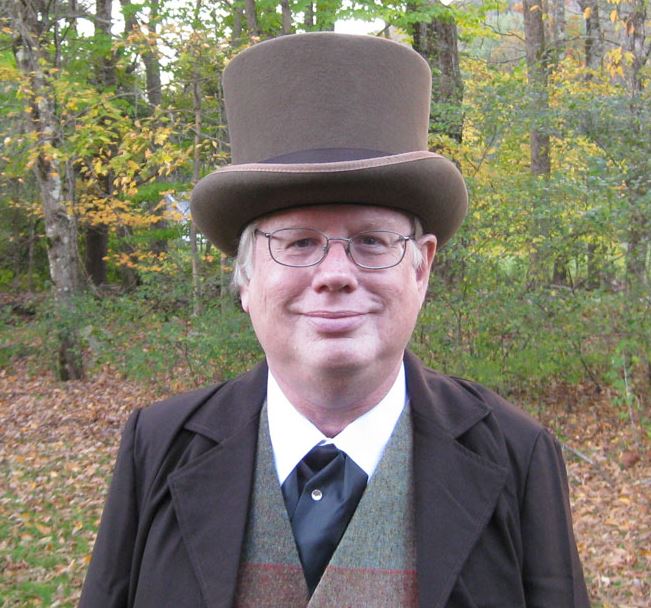
Bruce Hesselbach is the author of the new steampunk novel Perpetual Motion set in the late 1800s.
For those not familiar with your book, Perpetual Motion can you tell us a bit about it?
Steampunk is Science fiction set in the Victorian age. Featuring zeppelins and steam locomotives, steampunk novels have traditionally been centered in England or in the British Empire, but increasingly the scene has been expanding to other parts of the world. Perpetual Motion recounts the story of a time-traveling family who leave Colorado in 4026 A.D. to settle on the shores of Lake Constance, Switzerland, in 1866. Here, they save a young inventor from drowning, and are horrified to learn that as he matures he may change the course of history to enable Germany to win the Great War. The story is told in the words of the family’s young daughter, who finds herself torn between her growing love for the inventor and her belief that changing history would court disaster.
What is it with the Steampunk genre that you find fascinating and why do you think it has become so popular lately?
I think it comes from the elegance of the Victorian Age. In the Calgary Olympics, Dorothy Hamel and the other Olympians all went skating dressed up as Victorians and it looked very cool. If you compare a Stutz Bearcat or a Pierce Arrow to modern cars, the older cars are so much more impressive. I know the cars are actually post-Victorian, but the idea of machines that are intricate, awe-inspiring, and yet functional does go back to the Victorian Age. For example, the Eiffel tower, or Big Bertha, the enormous cannon the Germans had in the Great War. The Victorians did many amazing things, both good and evil, but they did it with a certain flair that is appealing to the modern age.
What goals might you have set for yourself when writing Perpetual Motion and how do you feel about the result?
I had a lot of ideas about time travel and religion that I wanted to explore in the book without being dogmatic. I wanted to let the reader puzzle over these things and reach his own conclusions, and I think I did that. More important, however, was the fact that I wanted this book to focus on characters that would be vivid and live for people. People have told me that they did accept this time traveling family as real, which makes me very happy. Last Sunday night I read a part of the book on a local VT radio show. My brother and his grandkids, who live in Texas, heard the show over the internet and told me today that they thoroughly enjoyed it. This is because the characters clicked and worked, and I can’t ask for anything more.
You’re telling the story through the eyes of Sybil, a privileged girl living in the late 1800s. Why this point of view for the story?
The young Sybil provides a bridge between two worlds, since she was brought up in the Victorian age by very religious parents, yet as time travelers her parents give her inklings of a much different society. In creating Sybil, I was inspired by spunky Victorian ladies such as Mary Kingsley, a traveler in Equatorial Africa, and Mary Mummery, who wrote a witty chapter in her husband’s mountaineering book.
Did you do a lot of research into history and the technology of that age?
Yes, and I enjoyed that tremendously because I enjoy reading about history. To read about Richard Wagner’s life and times, and read what clothes Alfred Lord Tennyson wore when he went walking on the Downs, were very enjoyable and helped me picture scenes in my imagination.
What about the time travel aspect? Was it hard to come up with a believable and logical story with the many paradoxes time travel creates?
I started reading Science Fiction avidly when I was 11 years old. I’ve been thinking about time travel for a long time and have developed my own ideas. My daughter, who received a PhD studying astrophysics, actually took a course on Time Travel. What fun! Unfortunately, they didn’t have such courses when I was in college but the subject has long intrigued me. In my book, I gave play to my own theories of time travel, but I also have alternate theories that are presented, particularly the one by the mercurial Erasmus Gegenwart, and I leave it up to the reader to decide which theories seem most believable.
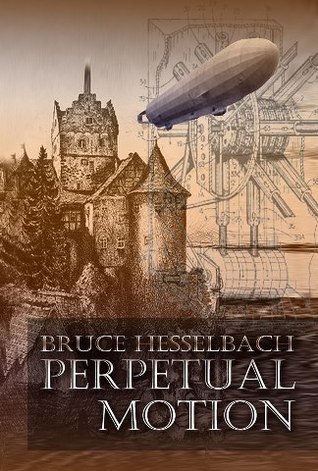 Tell us about the cover and how it came about.
The owner of Cogwheel Press at that time was a very fine artist by the name of Desiree Finkbeiner. I emailed her a slew of time traveling, zeppelin, and Lake Constance photos and pictures that are in the public domain. She selected the ones she liked best and put together the cover, which I think matches the book perfectly. After that, Susan Chase took over ownership of Cogwheel Press and worked on the back cover. I suggested that we ought to try using a silhouette of Sybil, and she found an artist to do it.
I have to ask since I’m from Norway, why did Norway get a place in your story?
I was influenced by Paul du Chaillu’s book, Land of the Midnight Sun. He portrays Norway as a mysterious and almost paradisiacal place, which is exactly how Erasmus Gegenwart pictures it in my story. Of course, in du Chaillu’s case, he had been traveling for many years in the jungles of Africa, and therefore getting away to somewhere nice and cool must have seemed to him in some respects like Paradise.
How did you start writing? Was there a particular book or moment in your life that spurred you on?
When I was in third grade, my teacher Ms. Collins told me that she loved the stories I wrote. Then in junior high, I wrote a lot of stories with some friends that I had. Books that I loved early in life were The Three Musketeers and Asimov’s Second Foundation.
What kind of books do you read, any favourite authors?
My favorite books are travel and exploration. Writers like Paul du Chaillu, Douglas Freshfield, Sven Hedin, and Valerian Albanov are some of my favorites. In fiction, my favorite novel of all time is Susanna Clarke’s Jonathan Strange and Mr. Norrell. I also admire Gogol’s Dead Souls, and Jasper Fforde’s many novels, among others.
What in your experience has been the best way of marketing your book?
A. I don’t really know. I’ve tried a combination of things. Fellow Cogwheel Press author Jen Eifrig and I put together a power point show on Victorian technology and we were presenters at the 2013 Waltham MA Steampunk Festival. That went over really well and therefore we repeated the show at Books and Boos in CT and at the Northampton MA Forbes Library. I was a featured reader at the Brattleboro Literary Festival last October. Last weekend I was part of a radio show about the Newfane Writers Salon. Next January I will be part of a three author reading in Brattleboro. My feeling is that it is best to try everything you can.
Can you give us a sneak peak into the next book in the series? When should we expect it?
After I wrote Perpetual Motion, at first I wasn’t sure whether or not I would write a sequel, because I have some other stories I want to finalize. However, once my book was published and readers told me that they really want me to write a sequel, who could resist that? I can say that the sequel will have scenes in 4026 AD, which will help illuminate the struggles that Otto and Antoinette had before they came to Switzerland. As far as timing goes, what I have done over the last number of years was to spend most of my free time from May to October hiking, and most of my free time from January to April writing. The next project I have in the works is a short story collection and my publisher is looking at that now. I probably will have a draft of the sequel to Perpetual Motion by the spring of 2014 but that’s just an estimate. It took me a year to write the original book and it was then accepted by the first publisher I sent it to. Cogwheel Press encourages sequels. They will soon be publishing a couple of sequels to other authors. I’m very much looking forward to reading them because I liked the first ones.
What do you do when you’re not writing, any hobbies?
I’m an avid hiker, and have climbed 496 different mountains to date. High Ledges, Green Mountains (Bondcliff Books 2005) is my memoir about hiking Vermont’s Long Trail in sections from Massachusetts to Canada. I’ve climbed many of these mountains multiple times, such as Dix Mountain in the Adirondacks (4 times), Mount Monadnock (eleven times), and others. I have a hiking website with over a thousand photos on it. I also have a Pinterest site with hiking photos on it, and a writer’s website at www.hesselbachwriter.com which references these.
Thanks for asking!
* * * * * * *
Interview by Dag Rambraut – SFFWorld.com © 2013