

Tracks by K. M. Tolan
E-book Edition (review copy)
Published March 2014 by Burst Books
Review copy provided by author.
Review by N. E. White.
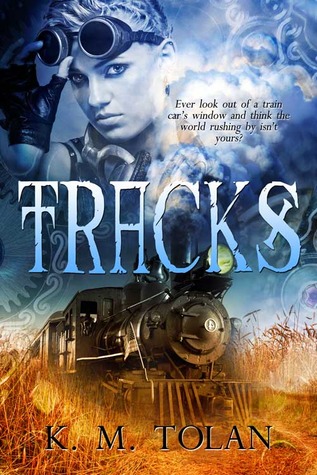 Tracks is a story that will take you to a unique side of the American countryside. While this book is most definitely a work of Fantasy, it does not fit the Urban Fantasy label nor Magical Realism, though I suppose that comes close. It is kind of hard to explain exactly where this books falls in the Fantasy sub-genre spectrum (even so, I’m sure there’s a name for it), so I’ll just jump right into the story summary and let you figure it out.
During a vague slice of American history, Vincent is a young man on the brink of going from bad to worse. While making a half-hearted attempt to help a bum that’s been beaten near to death by two thugs, Vincent draws the attention of the local cops, leading to a chase through the city and into the heartland of America. He soon finds himself on the road to home, to his mother, because he has no where else to go.
Once there, he’s reminded of why he left. His mother blames him for the loss of his sister, Katy. We learn that the entire family was shattered one day long ago when a set of mysterious train tracks appeared before Vincent. He has long held that his sister got on a train that rode those tracks.
But those tracks never existed, as far as anyone could tell.
That is until Vincent again finds himself at the spot where his younger sister disappeared and the tracks are there before him, as real as the sun and the trees. He follows them, hoping to find some clue as to where his sister might have gone, but instead he finds a world he can barely understand.
The two men who had been beating the bum appear, but they are warped creatures, all shadow and claws. They attack him and he does his best to thwart their advances, but he is no match for them. A woman, seemingly out of the blue, comes to his aid and kills the beasts with blasts from her shotgun.
From her, he learns he’s in Hobohemia, a world between worlds, that his sister is alive (sort of) but is trapped by the local railroad baron, and that he must save her. He also finds out that Hobohemia itself is under threat by the new spread of Taylorism, a form of capitalism that threatens to unhinge the magic that binds Hobohemia together.
He doesn’t quite trust this gal that gives him orders and withholds information, but he’s got nothing left. Together, they learn more about each other than each wanted to reveal and in the process they save Hobohemia and themselves.
My summary doesn’t do the story justice. There’s so much great world building in K. M. Tolan’s Tracks that I’m not sure where to begin. He’s got steam trains powered by steam children and magical train tracks are laid by gandy dancers. Hobo or Mulligan stew can truly heal all wounds, its only main ingredient goodwill towards your fellow traveler. There’s also railroad baron’s willing to risk it all to control the tracks between worlds, and the big rock candy mountain is real here, too. You just might not want to get there as badly as you might think. Oh, and there are real monsters in Hobohemia. They look like you and me until they allow their inner terror to come out.
Vincent is a great character to follow along in this story. He is both incredulous at all that he finds, grounding the reader into the story world, and brave despite knowing that he doesn’t have all the answers. All he can do is try his best and do what he thinks is right. In the end, the reader is left with a very, heartfelt conclusion that if we just all care for one another, it will work out in the end. And in, Tracks, it does.
I also enjoyed the author’s exploration of capitalism and how it would infect the world anew. It really brought some things to light and got me thinking. In addition, Mr. Tolan also gives us a small glimpse into a world where the United States are no not united and ingenious cultures reign. I look forward to future books set in the many worlds linked through Hobohemia.
With all that said, I do have one gripe with the text. The transitions between scenes were a bit jumpy for me. While I never felt lost in the story, several times I did wish that a scene was set a bit better before plunging the reader into it. This is a very minor criticism. Otherwise, I think this book is perfect.
Tracks is action-packed, touches on a face of America few of us have seen, and promises a rich story steeped in magic and traditions. I highly recommend this book to anyone looking for a new kind of fantasy with a bit of romance.
N.E. White, June 2014.
Copyright © sffworld.com. If quoted, please credit “sffworld.com, name of reviewer”.




Note: The “Taylorism” in this well-written novel is historically accurate, being based on Frederick Taylor’s “The Principles of Scientific Management”, published in 1909. Taylor, after a series of experiments, wrote the book with the objective of increasing labor productivity through standardization– removing the artisan from the industrial equation and replacing him with a laborer performing repititious tasks, resulting in increased corporate profits.
Also historically accurate is the existence of– and conflicts between– craft unions such as that of the railway conductors on the one hand and the International Workers of the World on the other. The IWW, called the Wobblies, was open to all workers, including the unskilled, and also to African Americans and Asians, which was unheard of at the time. As the book indicates, some hobos were IWW members,
Sorry– an error of fact and an editing problem. ‘IWW’ stands for Industrialized Workers of the World, vice International Workers.
The Wobblies organized by industry, vice craft, so that all of the workers in, say, a shoe factory would be members of the same union, whether they were the relatively well trained and paid crafters of leather uppers, or the untrained, poorly paid pushers of brooms.
In the more traditional craft-based union model (which is directly descended from that of the medieval artisan guilds), there would be a skilled cobblers union, but the unskilled workers would have no part of it, nor could they start their own. This would leave those with the least resources as the workers most liable to abuse from the owners and supervisors. The IWW’s belief was (and remains) that workers and owners are involved in a class struggle, and will be for as long as the vast income disparity remains. Hence the Wobblies’ attraction for the hobos.