

The pueblo people who landed on the Fifth World found it Earthlike, empty, and ready for colonization … but a century later, they are about to meet the planet’s owners. We’ve talked to Greg Keyes about Footsteps in the Sky.
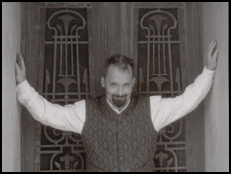 First of all can you tell us a bit about your new novel, Footsteps in the Sky?
It’s a science fiction novel that takes place primarily on an extra-solar planet, several hundred years in our future. When this planet was discovered, it was found to have been modified to suit the needs of some unknown – and apparently long extinct – alien race. Since it was almost habitable by humans, people from Earth began terraforming it, people who wanted to shape a world in their image, to reflect their beliefs. There were problems with this. Some of the settlers realize that once their work is done they will be pushed aside and replaced by immigrants coming directly from Earth, and everything they’ve worked for will be taken from them. But then a more immediate threat arrives, in the form of three ancient starships, artificial intelligences who have come to check up on the progress of their planets – and don’t like what they find.
The Fifth World is populated by descendants of the Hopi tribe. How did you come up with this rather unique idea and did you do a lot of research into their culture before you started writing? You’ve brought in elements such as the Kachina.
I came to this from several directions. I lived on the Navajo reservation when I was seven, and became fascinated with both the Navajo and the Hopi, who live in the same area. When I wrote the book, I was in graduate school studying anthropology. I also played this game called kapucha toli, a Choctaw game. My team played against Choctaw teams – sometimes in Mississippi (where the Choctaw are from) sometimes in Georgia where I lived at the time – but often we were asked to play at pow-wows and various Indian festivals. There I met groups of people who identified as Indian, but who hadn’t necessarily been raised in a “living” tradition, and were working to “re-create” an ancient way of life. Nor were they the only ones – a lot of people were reaching into their ethnic pasts, trying to fulfill some sort of longing for a vanished – often Utopian – way of life. I knew plenty of people who wanted to get back to nature, learn to make fire with bow-drills, live close to the Earth. I could imagine, centuries from now, a group of people eager to leave Earth and start over. I chose the Hopi because their tradition maintains that have already done this – they moved up through a succession of worlds until they reached this one – the Fourth World. They found it rough and unmade – they would have to take a wasteland and make it livable, and they took on the challenge. So why not move on to a Fifth World and do the same? Some prophecies claim that is what will happen.
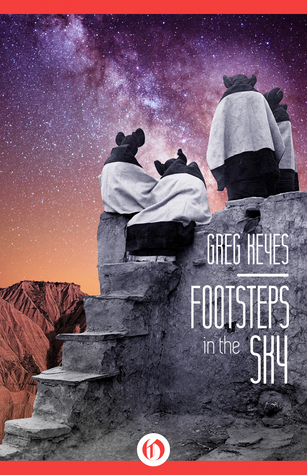 Footsteps in the Sky stands fine on it’s own, but I also feel it leaves room for more set in the same universe. Do you plan for a sequel?
I wrote this about twenty years ago, and before Footsteps I wrote some short stories, developing this future universe. The ancient farmers started other planets, and other idealistic groups were used as “sodbusters” on them as well. I don’t currently have plans for another book in this setting, but there is plenty of room for more stories.
You have a mixed set of characters that all act out of various motives, but everything isn’t always as black and white as one should think. How do you develop your plots and characters? Do you use any set formula?
The short answer is no. I usually write an outline, but rarely follow it. The characters develop as I go along. Often characters that were meant to be minor players end up taking over. I basically get better ideas – and more into the heads of my characters – when I’m writing, rather than outlining or brainstorming.
How did you start writing? Was there a particular book or moment in your life that spurred you on?
There was no particular moment. I loved to read, and I loved science fiction. I grew up in rural places, without much access to television, so I read all the time. By the end of second grade I was into the Tom Swift series, the Lester Del Rey and Heinlein YA books, and so forth. If you had asked me in second grade what I wanted to be, I would have told you “an exopaleontologist”. I always wrote stories as a kid. It wasn’t until about sixth grade that I started seriously trying to write a novel. I had a few little things published in high school – I placed (third, I think) in a state-wide literary contest with a science fiction short story, and the local college literary magazine published a couple of things. It wasn’t until my mid-twenties that I really started trying to get published in a big way.
Have you ever struggled between what you would like to happen to a character and what you considered more sensible to occur? Can you tell us when and what did you do at last?
I always have these troubles. In my first published novel, The Waterborn, I planned for one of my POV characters, Perkar, to flee from a battle while his friends foolishly turned to fight and die. My whole plot depended on him surviving, but by the time I reached that place in the story, it didn’t seem plausible at all for him to do so, and I knew the reader wouldn’t buy it either. At that point the outline collapsed, and I was in unknown territory. But the book turned out better for it.
What sort of challenges, as a writer, might you have faced over the years? Any insights you would be able to share for those aspiring writers seeking advice?
The biggest hurdle is actually writing a book. It’s one thing to have this brilliant (imaginary) novel in your head, but it’s another to deal with the ugly facts of writing it. Not just of how to write it, but how not to. When I start a book, there are lots of ways to tell the story I have in mind. The first thing I have to do is start shutting the doors I’m not going through. Let go of certain ideas. Which is hard, because a writer usually thinks all of his or her ideas are genius. Once you actually have something written, then you face criticism and probably rejection. A writer must learn to deal constructively with both of these unpleasant, ego-battering things. My first published novel was actually the fifth book-length manuscript I wrote. Footsteps was the fourth. The first three were rejected by everyone. But I got a great deal of constructive criticism from the editors who did the rejecting, and I took it to heart. I tried to really understand what they were seeing right and wrong with my work and do something better the next time.
How do you feel you have evolved as a writer throughout your career?
That’s hard for me to judge. When I did my recent edit of Footsteps, I was tempted to make a lot of changes. There were things I would do differently if I wrote that book today. Not to say it would be better or worse – just different. I thought it was more honest to leave it pretty much as I wrote it. If I can think of any way I might have evolved, it probably has to do with making harder choices rather than easier ones, taking on characters and situations that don’t come naturally, that I really have to work at.
You’re writing both Fantasy and Science Fiction. Do you have a different approach to wring one vs. the other?
I don’t think so. I’m mostly thinking about character and story. I like the science to be right and the magic to make some sort of sense on its own terms. I tend to approach both in a sort, “If this is so, what follows from it?” Which is probably more of a science fiction approach.
For your own reading, do you prefer ebooks or traditional paper/hard back books?
I still love paper books, both as a reader and as an author. That’s really what I want to have in my hand. But I’ve believed for at least two decades that ebooks were the future, and I think it’s really clear now. I got readers for my kids (currently six and nine years of age), and they love them. I really believe the struggle now is to keep people reading rather than moving completely to audio-visual media, and the ebook is doing that, I think.
What kind of books do you read, any favourite authors?
To be honest, I mostly read non-fiction, mythology, and folklore as spurs to my imagination and for research. I hesitate to give a list of current authors I do read for fear of leaving someone out and offending them. In terms of my development, the authors I read leading up to the beginning of my writing career included (but was not limited to) Larry Niven, Isaac Asimov, Robert Heinlein, Jack Vance, Poul Anderson, Roger Zelazny, Michael Moorcock, Ursula Le Guin, J.R.R. Tolkien, A.E. Van Vogt, Eleanor Cameron, Susan Cooper, Lester del Rey, Alan Nourse, C.S. Lewis and Philp Jose Farmer.
What do you do when you’re not writing, any hobbies?
I have a son, Archer, who is nine, and a six year old daughter named Nellah. Fatherhood isn’t exactly a hobby, but it keeps me busy. I fence foil and epee and teach fencing. I like to cook.
What’s next, what are you working on now?
I’m working on an as-yet unnamed fantasy novel at the moment.
* * * * * * *
Interview by Dag Rambraut – SFFWorld.com © 2015




Very interesting setting and premise. Dag – it sounds like you read this book. Would you recommend it?
Yes, it was a very enjoyable read actually.