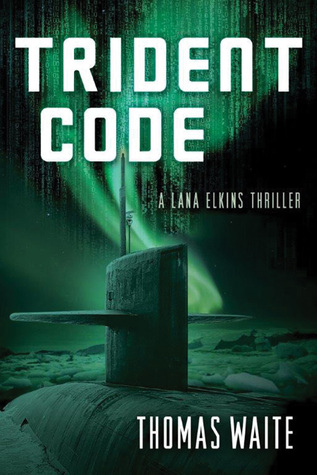
 Thomas Waite’s cyberwar series features the bright, bold heroine Lana Elkins, a former top NSA operative and now head of a major cybersecurity company. We have talked to Thomas about his new book, Trident Code.
In Trident Code, your second book in the Lana Elkins series, we are faced with a US Navy nuclear sub hijacked by cyberterrorists. Can you tell us a bit about it?
In Trident Code, ruthless cyberhackers seize a US nuclear submarine, training its most powerful weapon on a target so unusual, yet so vulnerable, that a successful strike could change the face of the earth for millions of years. With the world held hostage, former NSA operative Lana Elkins must join forces with a mysterious computer mastermind—who might be working with the enemy—to prevent the worst catastrophe in human history.
Can you give us some insight into your main character, Lana Elkins?
Lana is a former NSA operative who now heads a cyber security firm. She’s a single Mom with a fifteen-year-old daughter, Emma. Lana’s brave, smart, technologically a superstar, but still feminine, maternal, and human with flaws like anyone else. I’d grown up reading about the adventures of heroes like James Bond, Jason Bourne, Jack Ryan, and Jack Reacher. When I conceived of this series, I didn’t think the world needed another stereotype macho male figure. So I created my heroine.
How do you feel Lana as a character has evolved since the first book? If you had the chance, is there anything you’d want to go back and change?
Lana has emerged organically for me. I didn’t set out planning her character arc and rarely do with characters because they are changed by the circumstances in which they find themselves. So saying that I’d go back and change such-and-such about her would be to ignore the contexts in which she’s been formed and the challenges that she’s faced. Let’s just say she continues to surprise me, and as long as she continues to surprise me I think she’ll do that to readers.
Your first book in the Lena Elkins series took on cyberattacks collapsing the U.S. grid and now Trident Code with a hijacked nuclear sub. What is it with this kind of near future disaster type of setting you find fascinating? Do you think people might be scared by the potential that this is something that almost could happen?
When I was thinking about this series, I recognized that cyberspace would become the next domain of terrorism and criminals with codes could wreak serious harm. I had a number of conversations with experts in the field of cybersecurity, and I did a lot of reading on the topics of cyberattacks and cyberwarfare. It was captivating—and scary. Most of the technologies, cyberattack vulnerabilities, and cyberwar scenarios in my novels are based on facts. For Trident Code, I was searching for a unique story with an unusual terrorist threat when I saw a startling news report about an environmental catastrophe that could arise from Antarctica, and realized that climate change could become a weapon of choice for terrorists.
What sort of research, if any, did you do as part of this project?
I do a lot of primary and secondary research for my novels and this one is no different. Like other writers, the Internet offers a wealth of information that can be very valuable. I also read authoritative books and articles on various subjects. However, that only gets you so far. I consulted with leading experts, such as CEOs of major cybersecurity firms and former and current senior government officials, including the head of the FBI’s Cyberterrorism Unit. And I benefitted enormously from my conversations with a retired Admiral and former Vice President of the Chiefs of Staff.
How did you start writing? Was there a particular book or moment in your life that spurned you on?
I’ve loved reading novels and writing as long as I can remember. In college I poured my heart and soul into my creative writing courses. After graduation, I needed a job and my career in the technology sector was not at all calculated. That said, I found the field fascinating.
But writing was a constant, at first ghost writing for others, and later under my own byline. If you read what I published in the Harvard Business Review, it is really storytelling. That can be as powerful in the business world as it is in literature. After building and selling a firm, I returned to my first love and started writing novels. And I love it!
Have you ever struggled between what you would like to happen to a character and what you considered more sensible to occur? Can you tell us when and what did you do at last?
I think Oleg was a classic example of what I was saying earlier. When I set out to write Trident Code I wanted to create a Russian villain, not out of the Cold War but what I call the Code War. That’s how Oleg came into being, and at first I thought I had his role and personality well defined. But as he appeared he reacted to the world around him and became funnier and larger than life, and assumed a far greater role than I’d originally envisioned. I guess since one reviewer describes him as a Russian mastermind that “you’ll love to hate,” it was the right choice.
What sort of challenges, as a writer, might you have faced before your first book was published? Any insights you would be able to share for those aspiring writers seeking advice?
With my debut novel, I queried more agents than I can remember and without success. It was very discouraging but I was determined so I opted to self-publish. Fortunately it did well and hit #1 at Amazon Kindle (Paid). After that I wrote Lethal Code, the first novel in my Lana Elkins series. This time an agent took me on, pitched it, and it found a home. My advice? Write as good a book as you can. Then when you’re ready to submit it to agents, don’t. Read it again and revise it, maybe even twice. You only get one shot with an agent.
What has been most surprising to you in your writing and publishing career so far?
My readers. I guess I hadn’t given this much thought before publishing my first novel, but I really enjoy hearing from them, answering questions, even listening to their ideas about future novels. It’s great.
How do you go about the marketing aspect and especially related to your online presence? Anything you’ve seen work better than other things?
Social media can be an enormous time suck for authors, so staying focused is key. I’m active on Twitter and Facebook and they seem to work pretty well.
For your own reading, do you prefer ebooks or traditional paper/hard back books?
I prefer physical books in part because I spend so much time looking at a screen when writing. But I do love ebooks when travelling.
What kind of books do you read, any favourite authors?
I read a ton, both fiction and non-fiction. As for favorite authors, I always fear I will leave someone out. When I was younger I certainly admired le Carré, Fleming, Turow, Follett, Clancy, Asimov, Bradbury, and Clarke to name a few. But in college I actually loved reading Milton’s Paradise Lost, to the pleasure of my professor and chagrin of my classmates. I recently read Paula Hawkins’ The Girl on the Train. It was a great suspense novel. I think Stephen King tweeted that the alcoholic narrator is dead perfect, and I agree.
What do you do when you’re not writing, any hobbies?
Perhaps because I am cooped up indoors so much, I gravitate outdoors and ski, hike, boat, and travel. I spend a bit of time in board meetings and attending events, given my work in the technology sector.
What’s next, what are you working on now?
I’m currently at work on my next novel in this series, in which Lana for the first time confronts deadly threats to her and her family that originate from deep within the United States.
* * * * * * *
Interview by Dag Rambraut – SFFWorld.com © 2015