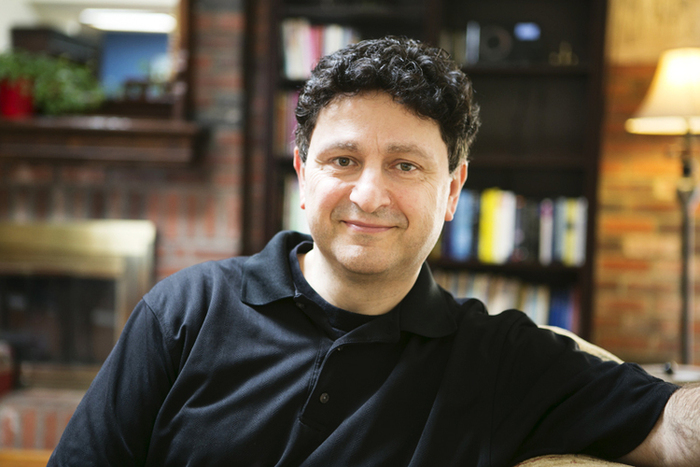
Michael Joseph Murano is the author of the Age of the Seer, the first book in his new Epic Fantasy series.
First of all can you tell us a bit about your new novel, Age of the Seer?
Age of the Seer is the overture, the first book in Epic of Ahiram, a high fantasy, ten-books series. Age of the Seer explores three inter-related themes: should a slave win his freedom at any cost? Does a magician control magic or is magic toying with the magician? Is loving the right person at the wrong time a tragedy or a supreme act of self-giving? At the same time, Age of the Seer is a fast-paced action and murder mystery seeped in a world of deep magic with a middle-eastern tonality.
Can you give us some insight into your main character, Ahiram?
Even though a millennia separates Ahiram’s world from ours, he is a child of this epoch: uprooted from events beyond his control, Ahiram is almost rudderless. He remains tethered to reality by the love of his sister Hoda, the faithfulness of friends who are dear to him, and the love of princess, even if he does not yet know how to reciprocate that love.
He shares with Bruce Wayne a singular goal from which he does not deviate. Like Clark Kent, he has a deep appreciation for the hope hidden within a sunrise in the blue skies. He will quickly learn the art of politics without becoming a cynical child of Amber or worship at the altar of power as in the Games of Thrones. He shares a realistic compassion as with Vin, in Mistborn, where suffering is not used to demonize those who caused him to suffer, and he resembles Tavi the furyless (the Fury Series) in that he must rely on his wits when facing powers far greater than him. He is from Finikia, the land of Lebanon, and as such shares a similar heritage as Sindbad and Ali-baba, which makes him an unrelenting survivor.
His greatest enemy is his fiery temper: hot, uncontrollable, and destructive. When it is coupled with a powerful source of magic he does not yet understand, it threatens to destroy everything and everyone around him.
What goals might you have set for yourself when writing Age of the Seer and how do you feel about the end result?
I wrote the main thread of the Epic of Ahiram over a period of fourteen years. Initially, I intended a trilogy, but the story said “harrumph,” and went its jolly way, becoming ten books.
Age of the Seer introduces the reader to the world of Ahiram, sets the stage for what is to come, and takes the reader to a different type of high-fantasy world, one where the Middle East, in all its mind-bending complexity, inspires many of the kingdoms and characters. Some of the reviewers found the various perspectives in the story hard to follow. Indeed, the reader is invited to witness the action as seen from various perspectives. The thoughts of many characters are revealed to the reader who will, in some case, know more about a given situation than Ahiram does, and at other times, Ahiram will know more than the reader does. The majority of the readers, thus far, have expressed satisfaction with this approach.
What is it with the fantasy genre you find fascinating?
The Epic definitely falls under the High Fantasy heading. It builds a complex world, it has recourse to several intricate systems of magic, and it introduces several races.
As a student living in Paris, France, I very much wanted to expand my horizon. Being dirt poor, I was left with fewer options than most, so I resorted to reading books, especially books I would not voluntarily choose. I would wander around my neighborhood’s library and pick five books at random. That’s right: completely at random. I would not look at the titles until I got home, and then I would force myself to read them. One of these books was titled Le Seigneur des Anneaux, or as it is commonly known in English, The Lord of the Rings. It contained the entire trilogy and I read it in eighteen hours, non-stop. I still regret what I put my mother through that day (I read while eating, I went to the bathroom with the book…I almost took a shower with the book).
The impact Tolkein’s masterpiece had on me was lasting. I fell in love with his world, even more so than with his characters. The thought of world-creation had not yet occurred to me, and The Lord of the Rings remains a principal influence.
But beyond world creation, the struggle that Tolkien presented impressed me. Tolkien created another type of Jean Val Jean (from Les Misérables), one who is less tortured, less complex but with the same quiet greatness. Frodo was, and still is, my favorite character. Not because of his strength, but because of his weaknesses. Tolkien convincingly showed me that we could explore human struggle, weakness, and greatness compellingly by casting it into a different world. Eventually, I understood why: when traveling abroad, I find myself more awake, focused, and paying more attention to details than I normally would back home. In like manner, I think of the world of fantasy acts as a magnifier, helping the readers to focus on details they might otherwise ignore.
How did you start writing? Was there a particular book or moment in your life that spurned you on?
I started to write during the civil war in Lebanon. I wrote while bombs were falling overhead. Back then, I wrote the initial version of the Epic in French as a Sci-Fi adventure set on ten planets in a far-away slice of the galaxy. Perhaps it was my desire to escape the war, or an attempt to regain a semblance of control over an uncontrollable situation, or perhaps it was my thirst for love and justice that were overtaken by the imprint of war? I would not wager an answer, but the truth lies somewhere under the rubbles. Nevertheless, it spurned me on, and I have been writing ever since.
Have you ever struggled between what you would like to happen to a character and what you considered more sensible to occur? Can you tell us when and what did you do at last?
Absolutely. The Epic of Ahiram contains hundreds of character. One important lesson I learned from Ursula Le Guin in her EarthSea series is to be compassionate towards characters be they evil or good. True compassion towards characters does not mean preserving them from harm. It simply means refraining from castigating them or casting them in a negative light, leaving ample room for the reader to decide how to interact with them.
The corollary to this principle is that we must allow characters to “make their own decision,” so to speak, even when I, as the author, do not agree. When a character decides on a course of action I did not anticipate or when something happens I did not plan for, I go through the following ritual, developed over years of writing:
- I get up and start pacing
- I argue out-loud with the character in question (better do this when you’re alone and not in public)
- I demand of the character to convince me of the reason of the action or decision.
- I gain a deeper insight of the character’s motivation, and often realize that a thread I had not yet noticed was being deployed in the story all along.
- I finally, submit to the course of events.
In many ways, I consider myself the first viewer of a movie playing on the screen of my imagination, and my job is to record it as faithfully as possible without forcing the story to go my way.
What is your favorite and least favorite part of the writing process, and why?
Favorite part of writing: It’s night. All is quiet and dark. I settle in my chair, fire up a medley of classical music and minimalist jazz, and away I go, following the story wherever it wants to take me. As words flow from the keyboard and the world forms and the action proceed, I find myself entranced and enchanted, transported to a different place, a different realm. It is exhilarating and extraordinary and there is nothing quite like it.
Least favorite: The writer’s avalanche, a writing process that I define as the high-rate inception of new threads, which may or may not be related to the main story. This overflow of new characters, situations, and intrigue continuously risk to derail the story and turn it into a chaotic jumble. This happens because when I write, the story is in control and I am a viewer of a movie I have not seen before. That is why I waited until the entire Epic was finished before publishing the first book—It gives my editors and I the distance required to trim unnecessary threads and enhance those that need enhancing.
To illustrate, suppose the action I am writing about takes me into a city. As I enter the city, it unfolds before me, I start to see the streets, the buildings, and people. So many details to take in, so many characters moving by, walking, chatting, or yelling. Say my character is walking down a narrow street filled with street vendors, something—a trinket: a silver pendant of a moon crescent with three gashes—catches my attention, (not my character’s attention, he went on his merry way). If I stop to inquire from the young woman who is selling the trinket what this might be, a new thread of the story could be born. I have only seconds to decide whether this young woman and that trinket are worth mentioning or not. This sort of thing happens continually as I write.
How do you go about the marketing aspect and especially related to your online presence? Anything you’ve seen work better than other things?
As I embarked on the publishing adventure, I have gained a greater appreciation for the marketing process. There are two types of marketing, I think. One that seeks to scam me, by selling me something I don’t need, and the other that seeks to attract my attention to something I would enjoy. I subscribe to the latter philosophy. I truly want my readers to thoroughly enjoy the story. Nevertheless, a quick search of “high fantasy” on Amazon yields over 17,000 titles, so how can I bring attention to Age of the Seer?
I follow a principle of “gentle marketing.” I wrote an epic. It is a marathon. In my case, I have a team of 18 volunteers helping me market the book. Here’s a brief summary of what we have done thus far:
Literary contests: As of now, Age of the Seer has won three awards:
- Honorable Mention in the ReaderViews contest
- Honorable Mention in the Paris Book Festival
- First place in the International Book Award
Social Media:
- Created a website and a blog at www.EpicOfAhiram.com
- Created a website for our burgeoning publishing company at www.CandleBrightBooks.com
- Established a presence on Good Reads where Age of the Seer gained 75 ratings in 8 months.
- Created two Facebook accounts, one for me as an author and one for Ahiram
- We are also on Pinterest, Instagram, twitter and You-Tube.
Events:
- We have—and will be again—distributing close to 10,000 drop-cards at Comicon in San Diego
- We will have a booth in WesterCon (come and see us if you’re there!)
- We have been in the newspaper and are trying to secure interviews with radio stations and television.
So what works? It’s still too early to tell with great certainty. We are still in the learning process and I would wager it will take us three years before we can have a sense of certainty. Since the Epic consists of ten books, we are in it for the long haul, and we are willing to continuously learn and improve.
Do you think that the cover plays an important part in the buying process?
Absolutely. The digital buying experience often begins with a thumbnail of the cover showcased side-by-side with many other books. The cover, as a thumbnail, must stand out sufficiently to catch someone’s attention, to get someone to click on it. Next, every element of the cover, front and back, must be considered carefully. One often overlooked element is the rating of the title on search engines. I would suggest that authors look up their selected title before publishing, to see how many other books have the same title. Also, the cover must be true to its content; it must reflect the story.
For us, hiring a professional graphic designer was a must. The graphic designer worked with a team of five to define every element of the cover. Once the initial design was completed, we sent the cover to a group of beta readers and revised it based on their input.
Can you tell us a bit about the process that led to the book being published?
I spent two years collecting rejection letters from agents. Over 70, I believe. Then, my wife and my daughter pushed me towards self-publishing. We did our homework and quickly realized that self-publishing is more than “getting the book out there.” Based on the sales figures we could get our hands on, a published book (not self-published) sell on average 550 copies during its shelf-life, and a self-published book: 75. According to an article in Publisher’s Weekly dating back to 2006, figures from 2004 showed that only 2% out of 1.2 million titles sold more than 5,000 copies. Nothing indicates that this has changed much since. To beat these odds, we follow this formula: self-publishing = writing + editing + packaging + marketing. We consider it critical to success.
For your own reading, do you prefer ebooks or traditional paper/hard back books?
No preference, really. They have their strong points. I do like the feel of a book and the solidity of it. I can, at a glance, figure how far I have to go, and leafing through it can be quick and enjoyable. On the other hand, I enjoy the electronic version since it is more interactive, easier to search and bookmark. With the proper backlight, it makes for a comfortable reading experience.
What kind of books do you read, any favourite authors?
I have a wide-ranging set of interests spanning history, geography, anthropology, philosophy, theology, math, physics, computing science, and the rest. Like many other readers, I read multiple books at any given moment.
Favorite authors: You have seen some of my HF and SF references in earlier questions. I would like to mention a few more in no particular order: Philip K. Dick, Charles Dickens, Victor Hugo, Erofeev Venedikt, Faulkner, Jules Verne, and a slew of others. I love to read.
What do you do when you’re not writing, any hobbies?
What else is there besides writing?
Seriously though, when I am not reading and not writing and not coding (I am working on an event-based forward chaining inference engine for writers, but that’s a different story… pun not intended) and not spending time with my family and not walking on the beach or sharing a coffee or a beer with friend when I am not doing any of these things, I sit in a quiet corner and listen to the stories cooking up in my head.
What’s next, when can we expect the next book in the series?
Wrath of the Urkuun, book two of the Epic of Ahiram, will be out this coming fall. We’re gearing up to our first beta round of readers for June. July and August are when our second (formal reviewers) will receive early copies of the book and if all goes well, we will release Wrath of the Urkuun in September of 2015.
* * * * * * *
Interview by Dag Rambraut – SFFWorld.com © 2015