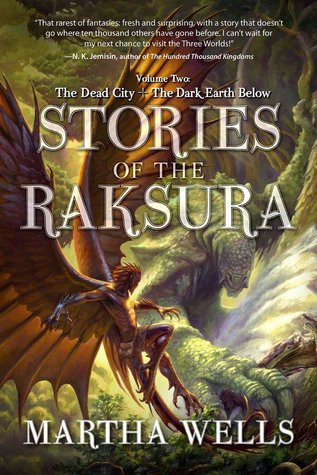
 We have talked to Martha Wells about the release of Stories of the Raksura, Volume 2. Martha Wells is the author of over a dozen SF/F novels, including The Books of the Raksura series and the Nebula-nominated The Death of the Necromancer.
Stories of the Raksura, Volume 2 has just been released. Can you tell us a bit about what your fans can expect from these two new novellas?
In “The Dead City” you see Moon after the Fell attack on Saraseil. You get to explore a bit more of the Three Worlds, and see more of what Moon was like before he found the Indigo Cloud court. In “The Dark Earth Below,” Moon and Jade are having their first clutch, while the court is being stalked by a strange creature. So you do get to find out more about the forest floor, and what kind of species live there.
What about the Raksura universe are you most proud of? And if you had the chance, is there anything you’d want to go back and change?
I’m proud of quite a lot of it, and I really enjoy the worldbuilding and the characters. I can’t really think of anything I’d like to go back and change. I do wish I’d had the opportunity to write more about Moon and Stone wandering the world together on the way to Indigo Cloud, but it just didn’t fit with the pacing of the book.
You’ve also written Stargate and Star Wars stories. How has that been compared to writing in your own universe?
I’ve always loved SF movies and TV and fanfiction, so being able to write tie-ins was a childhood dream and a lot of fun. For a tie-in, I have to be very careful to try to capture the look and feel of the TV show or movies, to try to get the characters’ voices right. I have to make sure the worldbuilding matches what’s already been done. So in some ways it’s more difficult than writing original fiction.
Your writing spans many subgenres, both with the Stargate/Star Wars stories already mentioned, but also with the YA / Steampunk Emilie books. Which one do you enjoy the most to write and why?
I think what I enjoy most is fantasy, whether it’s for the general audience or YA. I love creating new worlds and characters and cultures and exploring the magical elements.
Who or what has influenced your writing, and in what way?
Andre Norton was a big influence on me. Her books were some of the earliest SF/F I read in middle and high school. Other writers who have influenced me are Barbara Hambly, Judith Tarr, Tanith Lee, Diane Duane. Jessica Amanda Salmonson’s Amazons anthologies were a huge influence on me.
Have you ever struggled between what you would like to happen to a character and what you considered more sensible to occur? Can you tell us when and what did you do at last?
Probably the closest issue I’ve had to that is when I have to kill a character off. Sometimes it’s very difficult, especially if it’s a character who’s been in more than one book in a series.
What sort of challenges, as a writer, might you have faced over the years? Any insights you would be able to share for those aspiring writers seeking advice?
I had a three year period where I wasn’t able to sell any new books, and had almost nothing published. It was very difficult to keep going. Persistence is a big part of getting published, and staying published. You have to continue to write and finish new work, and continue to submit it. Don’t reject yourself by not submitting your work.
What is the hardest thing about writing?
Doing it, even when you don’t feel excited about it. The middle of a book can be a hard slog, even if you still like your story. It’s very easy to get distracted by a shiny new story, and you have to just put that aside and finish what you’re currently working on.
How do you feel you have evolved as a writer throughout your career?
I think I’ve learned how to write faster, how to get past plot problems and other issues more easily. I also think my mind is a lot more open to new possibilities. When I first started writing professionally, I felt like I had to do certain things and not be self-indulgent with my writing. Now, I have no idea why I thought writing things I wanted to read was self-indulgent. I’ve really learned to pursue weird ideas and just let the stories and the characters go where they want to go.
What are your thoughts on good/bad reviews?
I’ve had some reviews that really helped me see my work in a different light. There’s nothing better than a reviewer who really gets what you’re trying to do.
How do you define success as an author?
Staying published. I’ve never been a bestseller, and I’m not expecting that to change anytime soon. I’m not a writer who gets nominated for awards. But as long as I’m able to find publishers for my work, I think I’m doing okay.
For your own reading, do you prefer ebooks or traditional paper/hard back books?
I generally prefer traditional paper, because after I’ve been working all day, reading from a screen tends to hurt my eyes. Though I do have ebooks. I usually get them when the book is not available in my local store and I can’t wait to read it.
What kind of books do you read, any favourite authors?
Besides the authors I named who are influences, there’s Lois Bujold, Kate Elliott, N.K. Jemisin, Ben Aaronovitch, Sharon Shinn, Catriona McPherson, Ann Leckie, Carol Berg. I have a lot of favorite authors, actually.
What do you do when you’re not writing, any hobbies?
Not really. I like to read as much as I can, and I love TV mysteries, especially British mysteries. I’m also a big media SF/F fan, and I like Doctor Who a lot.
What’s next, what are you working on now?
I’m finishing up a new book and getting ready to start another, but I can’t say what until the contract is final.
* * * * * * *
Interview by Dag Rambraut – SFFWorld.com © 2015