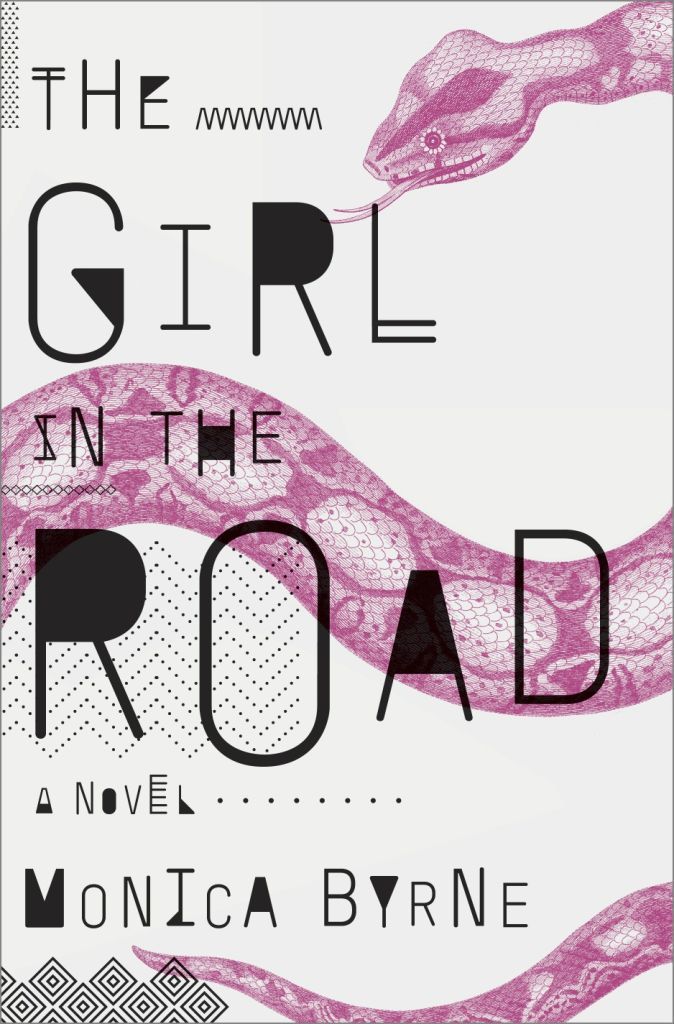
It is not surprising The Girl in the Road, Monica Byrne’s debut near future SF novel, features the snake as a recurring motif. The book itself is very much like a serpent. From a distance it is beautiful and graceful, but the closer you get to it, the more unpredictable and dangerous it becomes. There is a poisonous venom running through this hissing, vicious and mesmerising creature.
Or perhaps a more apt way to describe the book might come from the protagonist herself – Meena – who likens her own journey to passing through the chambers of a Hindu temple in order to reach the shrine at the temple’s heart. The Girl in the Road is a challenging book, but rewards readers greatly if they take the time and care to pass through its many chambers to get to the rewards at the heart of the novel.
Those who require their fiction to fit within neat subgenre definitions will struggle with the book’s first chamber. This ambitious novel spans many literary subdivides.
Undoubtedly many readers will approach The Girl in the Road as SF; it is set in not one, but two near future timeframes and a speculative engineering concept forms a major plot point in the book.
At the centre of the plot of the book is the idea of the Trans-Arabian Linear Generator, colloquially known as the Trail. This is a technology that resembles a pontoon bridge, joining stations in Mumbai and Djibouti. A substance called metallic hydrogen runs through the Trail and uses the motion of the ocean’s waves to generate power for the African coastal city. At a basic level, the book tells Meena’s story as she walks across this bridge from Mumbai to Africa. This plot point could pass as a classic hard SF concept (and not surprisingly, Byrne is a MIT graduate).
The book also shares a concern about the impacts of climate change with many of the near future SF novels I have read lately (I am thinking of books like Wolves by Simon Ings, Clade by James Bradley, and The Water Knife by Paolo Bacigalupi):
“They talked about the rising sea threatening Ndar and Kuta Sesay, the city’s poet activist. It was too late to take protective measures, they said, unless UNESCO decided to save it. I thought ‘Unesco’ was their god or at least a very rich man. I wanted to know why anyone who had the power to decide would let such a beautiful city drown. I was young, Yemaya, and had no idea that this city was one of hundreds of beautiful cities all over the world, each with an eye on the rising sea.” (page 73)
From the passage quoted above, however, it is obvious that The Girl in the Road wants to take a global perspective than some other recent near future SF. The book presents a future in which global power now rests with Africa, India and China. In this way, the novel can be seen as falling within a trend in contemporary SF that values representations of diversity and uses genre to explore cultural legacies of colonialism and imperialism:
“Africa is the new India, after India become the new America, After America became the new Britain, after Britain became to new Rome, after Rome became the new Egypt, after Egypt became the Punt, and so on and so forth.” (page 106)
The book, for a good part a road novel, is set in India and across almost the entire continent of Africa. Meena is a gay black woman, and the other point of view character – Mariama – is a runaway slave girl from Mauritania. With its near future non-Western setting and plethora of characters from a variety of races, cultures, genders and sexualities, the book is reminiscent of recent works by writers like Ian McDonald.
In The Dervish House McDonald went someway to introducing a flavour of magical realism to his near future SF set in the developing parts of the world; Byrne goes even further in The Girl in the Road. Myth and spirituality, both Indian and African, pervade the pages of the book; characters share names with goddesses, a ghost known as Bloody Mary haunts the Trail, and the tight first person perspective told through the voices of two unreliable narrators leaves the reader lost in the interstices between reality and delusion:
“The Trail seems unreal: a floating pontoon bridge moored just offshore from Mumbai, which spanned the whole Arabian sea, like a poem, not a physical thing. I asked Mohini what she thought it’s be like to walk on it all the way to Africa. She received my enthusiasm in her gracious way but cautioned that the Trail was all blank sky and faceless sea, the perfect canvas upon which to author my own madness.” (page 16)
The characters’ psychic landscapes are projected onto the physical environment around them, creating a fabulist feel to the book, blending the SF plot points with something more akin to the works of Haruki Murakami.
The second chamber readers must pass through is the writing itself, which makes no allowances for casual or lazy readers. Ironically, at one point in the novel a character remarks, “Just tell the story and don’t worry about extemporising. The facts are enough” (page 272). Though Byrne is undoubtedly a beautiful prose stylist, it is obvious that her research has been extensive, and she clots the first few pages of the book with a plethora of non-Western proper nouns and foreign terms that will be unfamiliar to many English language readers. I will freely admit to pausing and referring to Google many times until I found my rhythm in the book. However, this level of detail is skilfully applied and proves vital to immersing readers in the book’s setting, providing the proper authenticity, while avoiding the pitfalls of exoticism or cultural appropriation.
Narrative and structure intertwine to provide the next chamber for readers to pass though. As already mentioned, Byrne drops the reader into parts that alternate between the first person perspectives of two unreliable narrators. Both these characters are repressing recent incidents in their life, and acting in a kind of dissociative fugue. This lack of narrative context for the reader is intentionally and effectively estranging.
The first plot thread in the year 2068 follows Meena, who is fleeing Thrissur in South-western India for Mumbai, following an assassination attempt involving a snake in her bed, which leaves her with five fang punctures in her chest. No background is given except that a terrorist organisation named Semena Werk (Amharic for ‘the golden meaning’) might be responsible for the attempt on her life and she must now escape Kerala.
The second, alternating plot thread begins in the mid 2020s where Mariama, a young slave girl in Nouakchott, runs-away after her mother apparently disappears. Mariama stows away with a pair of truck drivers transporting oil drums to Ethiopia.
Both Meena and Mariama’s stories are set apart by both a spatial and temporal distance. Though there are hints throughout the book about the relationship between their two plotlines, things initially seem disjointed and readers may find jumping between the two points of view jarring. However, both stories come together in a ways that are both expected and ingeniously unexpected as the novel progresses.
The final chamber readers must pass through to reach the heart of the book contains the book’s challenging thematic concerns. I have already mentioned above that the plot of The Girl in the Road pivots on a new technology for producing energy. Energy is something that underpins modern society: “… energy flows directionally through the human race because the gradient’s always trying to reach equilibrium. Like layers of the ocean” (page 272). The production of energy can by harmful, exploitative and volatile. Energy is in many ways similar to book’s true primary concern:
“Mohini once said to me that we’re all children of rape, somewhere in our lineage, and how did I feel about that? We’re all the result of energy forced, not welcomed. The waves are coming whether we want them or not.” (page 142)
The book’s treatment of sex is it’s most confronting and vital characteristic. Sex, both consensual and non-consensual, is the catalyst for much that happens in the novel. Meena is a character that uses sex as a comfort and means of expression. At one point in the novel she remarks, “I told Mohini that sex was my mother substitute, but she said that was needlessly cynical, that sex was my dharma, even my art, like performance was to her” (page 141).
Likewise, Marima’s life is shaped by significant acts of sex. The word ‘saha’ haunts Mariama throughout the book; a word that means both ‘powerful’ and ‘let us be together’ or simply ‘with’. The book is about how the act of being together, the flow of energy between people, can shape who we are and dramatically alter the course of our lives.
Given the moving and insightful way that Byrne handles these thematic concerns it is no surprise to me that The Girl in the Road won this year’s Tiptree Award. It was also nominated for the Golden Tentacle Kitchies Award for best first novel. I have now mentioned several times that this is the young American writer’s first novel. This bears repeating: The Girl in the Road is Byrne’s first novel. I find this amazing. This is a debut novel that achieves more accord between ambition and execution than most books by seasoned writers. I can’t wait to see what she does next.
The Girl in the Road by Monica Byrne
Published by Blackfriars Books, May 2014
336 pages
ISBN: 9780349134215
Review by Luke Brown, May 2015