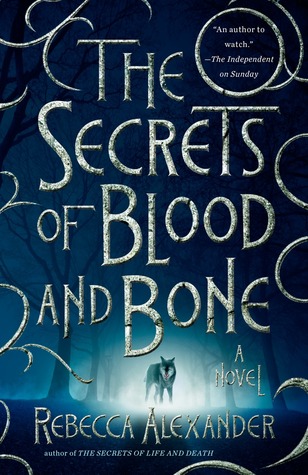
 I read a lot of fantasy (and historical, crime and psychological thrillers), so it feels natural to write it. At first, I thought I should stick to contemporary stories and I started writing a very dull novel about a woman keeping a hotel in England. I wrote The Secrets of Life and Death alongside it to stop me getting bored. I never finished the ‘sensible’ novel—instead Jack and Felix and Kelley dragged me into their world. I could imagine the characters somewhere in the house, Jack elusive and silent, Sadie playing with the cats in front of the fire, Kelley walking down to the smugglers’ cove to see if there was an adventure he could get into. Felix I knew the best—perhaps there’s a bit of me in Felix. He’s a man of many worlds, who is as comfortable in academia as in rolling up his sleeves and helping Jack. I have now finished The Secrets of Blood and Bone to take Jack, Sadie, Felix and Edward Kelley’s story further.
I think the challenge of writing fantasy is the same as any other fiction—making it believable or plausible. Readers want to be carried into someone else’s story, and feel that the character would respond in that way, or the magic would backfire in this way. Magic (it’s hard not to believe in magic) underpins the books, but I wanted to make it so that it’s the personal qualities of the characters— their humanity, compassion and kindness—that wins the day. In Bram Stoker’s Dracula the characters are pitted against an overwhelming supernatural agent, yet their courage and loyalty carry the day in the end.
That was the kind of book that I read over and over in my early years, and along with modern fantasy writers like Kelley Armstrong, Neil Gaiman, Terry Brooks, Terry Pratchett, Philip Pullman and Stephen King, I still read the classic fantasies again and again. They come from a part of human belief that is drummed into us as small children: talking animals, scary monsters, and heroes fill fairy tales. Books like Winnie-the-Pooh, Alice in Wonderland and The Wizard of Oz are set in amazing fantasy worlds that fire my imagination. I have also been influenced by TV shows like Buffy the Vampire Slayer and Firefly with Joss Whedon’s fantastical plots and characters.
I’m also interested in the early myths and beliefs that underpin legends and stories. The idea of vampires comes from early beliefs about ‘undead’ people, who needed to be mutilated in some way to neutralise them. Those beliefs can be found all over the world, from the Indian vetālas to Icelandic draugur and West African sasabonsam. Werewolves are known all around the world too, and witches and elves, magic and spells. Researching old myths has meant reading many old texts, as many as I can find, and someone could probably base a novel around any one of them. I think fantasy writers are tapping into beliefs that we develop before we are old enough to discount them. Lots of adults are scared of the dark, perhaps for good reason.
In one sense, all fiction is fantasy—the characters are invented, and the world we set them in mirrors our own, even in contrast. And the dilemmas are the same: love, death and survival underpin all character arcs. Fantasy seems to satisfy my emotional needs, with good characters finding their way through challenges, and my imagination loves to find ways to set human stories and journeys in different worlds. Sometimes it’s easier to see what’s going on for a character when they are not set in our busy, over-connected, chaotic environment, but have the freedom to act in new and different ways. That shapes my writing.
I’ve recently been working on a book that isn’t straight fantasy, but when I read through it again, the book is haunted by the past, ghosts of people both dead and living. Places seem to hold impressions of the people who lived—and especially—died there. Although The Secrets of Blood and Bone doesn’t feature a literal ghost of the woman who burned to death in a witch’s medieval cottage, her history, her influence is everywhere, raising a protective force of nature that guards not just the cottage’s secrets against my protagonist Jack, but also the inhabitants when they are in danger, miles away. The cottage, the garden especially, seemed to me to almost be another character, so I gave it a voice. In a very stressful time in my life, after my young husband died, I moved into a cottage where the garden had overwhelmed the house. We couldn’t get out of the doors at the back of the property. The ten foot high thorns perfectly fitted my mood. It was easy to imagine it as a sentient being! Now I read more fantasy like The Night Circus (Erin Morgenstern) and A Discovery of Witches (Deborah Harkness) and am inspired to write more, try harder, and tell more stories of things that go bump in the night.
Rebecca Alexander is the author of The Secrets of Life and Death. She has worked in psychology and education, and has an MA in creative writing. She lives with her husband on the coast of England. I’ve included further praise below and would love to send a galley your way if you’re interested in taking a look!