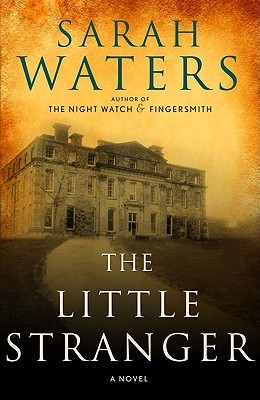
 The Halloween Countdown continues as Randy M. looks at Sarah Water’s The Little Stranger.
Join us in the Countdown to Halloween discussion thread
THE LITTLE STRANGER by Sarah Waters (2010; Riverhead Books)
… My heart began to sink almost the moment I let myself into the park. I remembered a long approach to the house through neat rhododendron and laurel, but the park was now so overgrown and untended, my small car had to fight its way down the drive. When I broke free of the bushes at last and found myself on a sweep of lumpy gravel with the Hall directly ahead of me, I put on the brake, and gaped in dismay. The house was smaller than in memory, of course – not quite the mansion I’d been recalling – but I’d been expecting that. What horrified me were the signs of decay. Sections of the lovely weathered edgings seemed to have fallen completely away, so that the house’s uncertain Georgian outline was even more tentative than before. Ivy had spread, then patchily died, and hung like tangled rat’s-tail hair. The steps leading up to the broad front door were cracked, with weeds growing lushly up through the seams.
Does something lurk in Hundreds Hall?
A local man who has advanced from his father’s working class heritage, Dr. Faraday struggles to make his practice profitable. When the Ayres family doctor is unavailable, he is called to Hundreds Hall to attend the servant girl, Betty. The trip revives memories of an earlier trip to the Hall as a boy not long after World War I when his mother still worked there as a nursery maid and when he swiped a souvenir of his visit. The memories evoke a pleasant nostalgia for that simpler time in an idyllic setting and a bit of melancholy for his current station in life.
Betty’s illness proves to be youth and loneliness on her first extended stay away from home, in a house she finds creepy. The family, struggling to maintain Hundreds Hall and not succeeding, appreciates the company of a well-mannered, educated man. Mrs. Ayres, widowed since before the war, was a beauty in youth and, in the vernacular of the times, is still well-preserved, a gracious hostess enjoying a chance to chat and gossip since the family is no longer able to entertain. Roderick, her son, a pilot during the war and wounded in a crash, is less welcoming, his attention absorbed by trying to eke out what can be earned from the farmland and the dairy cows. And Caroline, Mrs. Ayres younger daughter, proves intelligent and good-humored and catches the bachelor doctor’s interest.
As the novel progresses, the Ayres family is plagued by bad luck and odd, inexplicable events: The family pet, a friendly old dog, bites a little girl for no apparent reason; Roderick’s room catches fire; the whistle in the speaking tube in the kitchen begins to whistle at all times of day, and once removed, if you listen closely to the tube it sounds like a voice might be speaking from the abandoned nursery.
What lurks in Hundreds Hall? Could there be a malevolent spirit? Or could it be, as a colleague of Faraday’s suggests, a “little stranger,” an extension of a living person, a sort of imp of the perverse conjured by someone’s unconscious desires? Faraday struggles to find rational, plausible explanations that satisfy his scientific mind-set and explain the odd occurrences around the Hundreds household.
One of the lessons of haunted house novels seems to be, stay out of places with the initials H. H.: Whether Hill House or Hundreds Hall, they are likely to be dangerous. If Hundreds Hall is not quite as imposing as Shirley Jackson’s Hill House, Waters has adopted the psychological nuances of Jackson’s novel and spun a different tale, one exploring the fate of the English gentry in the late 1940s when their wealth, already in decline between the wars, was further eroded by the economic malaise post-World War II; skilled labor and the middle-class eventually prospered while the landed gentry found their estates increasingly difficult, if not impossible, to maintain. The pressure to keep up appearances, to survive and to stop the decline of Hundreds Hall weighs on all of the Ayres family, and that pressure eventually brings disaster as first Roderick then Caroline are forced to sell part of the property.
Early on Waters establishes her setting, especially the dilapidated, crumbling Hundreds Hall, and equally deftly establishes her characters and the interplay between them, a good deal of which is based on class distinctions and the ebb and flow of efforts to adhere to or ignore them. This also leads to one of the real fears of the novel, which is not of the supernatural, but of intimacy. English reserve merged with class distinctions and personal expectations causes a potential romance to move in fits and starts, each participant not quite comfortable with his or her own emotions much less the feelings of the other, and each harboring other motives as well. By the end, much of what happens at Hundreds Hall springs from those class distinctions. The relationship between Caroline and Dr. Faraday ebbs and flows; there is more than one reason for attraction, and those reasons play into events that seem to churn faster and faster to the detriment of the Ayres family.
While I did not love The Little Stranger, I did find it good reading for the long, cold nights of winter.
Other eerie domiciles:
The Haunting of Hill House by Shirley Jackson
Hell House by Richard Matheson
House of Windows by John Langan
Nyctophobia by Christopher Fowler (another H. H., Hyperion House)