
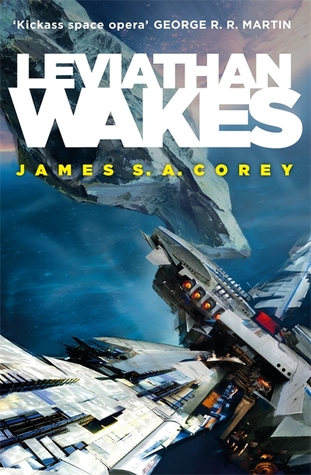
The reliance on food metaphors in conversations about books… Ugh. Such a lazy and reductive way to describe a reading experience.
So it’s not without some sense of shame that I say reading Leviathan Wakes by James S.A. Corey is the equivalent of eating a well-made burger. You don’t have to have a sophisticated palate to enjoy it, but even a true food snob will find something to appreciate if in the right mood. Be warned, there are some pickles you’ll wish weren’t included. Unless you really like pickles in your burgers. I can overlook pickles in my burgers, but I understand why others can’t overlook pickles in their burgers. And some people inexplicably like pickles.*
I read Leviathan Wakes when it was first released in 2011 and I remember enjoying it, though I never continued with the series (too many books, not enough time). I recently reread the book with two purposes in mind. Firstly, to continue with the series, known as The Expanse, which is now up to five books in length, plus a number of interstitial novellas and short stories. Secondly, the book has been adapted for television by the Syfy channel, and I wanted a refresh before the show begins in December.
I enjoyed my second reading of Leviathan Wakes just as much, if not more, than my first poke at it. I’m not surprised that The Expanse is the basis for a new Syfy television show. Leviathan Wakes is accessible space opera and a perfect entre into the subgenre of “spaceships with big guns fighting each other in space and exploding”. The plot is packed full of action and danger, and only a person with attention deficit disorder would find it slow moving.

However, there are a lot of slick and fast-paced space operas that do fail to hold my attention. This is because, quite often, books like these fall short of any kind of intellectual or emotional engagement. Leviathan Wakes is not one of these books. It’s not a dumb book, but it’s also not too smart for its own good. While peppering the text with enough scientific detail to be credible to my scientifically deaf ear, it’s not fuselage deep in hard science, and is more focused on character and plot than many other like-minded works.
One of the things that makes Leviathan Wakes standout, for me, is the setting. Leviathan Wakes tells a story that takes in a future where humanity has colonized the solar system. It’s a throwback to futures imagined by the likes Bester and Clarke in the Fifties (acknowledged explicitly by Corey in this book’s sequel, Caliban’s War), but updated with modern sensibilities and contemporary science. There is enough specific detail and texture in the prose to make things feel real and lived-in, but Corey never sacrifices the momentum of the plot.
The intriguing and convincing political landscape, featuring a solar system divided into various factions, works very much in the book’s favour, giving the plot some real grist. Firstly, there’s Earth (and Luna), looking after the interests of the cradle of humanity. They have a soft alliance with Mars; a more technologically advanced and militarised society, as befitting a planet named after the Roman god of war. Lastly, there are the Belters who inhabit the moons, meteors and space stations of the Outer Planets, and who are viewed by Earth and Mars as a ragamuffin society of people almost no longer human.
The plot follows two men, one Belter and one Earther, on complimentary and intertwined personal quests.
Detective Miller, the Belter, works for a security firm providing law enforcement on Ceres Space Station. When he is given the job of tracking down the missing daughter of a wealthy and powerful magnate from Earth he slowly becomes infatuated with the object of his case.
The Earther protagonist is James Holden. Holden begins the novel as the XO of an ice hauler, known as the Canterbury, working in the Outer Planets. When the Canterbury, along with almost all its crew, are destroyed in an apparent act of terrorism, Holden assumes command of a small group of survivors and seeks to uncover who or what was behind the attack and bring them to justice.
The story is told in chapters that alternate between the two points of view. Things escalate quickly. The solar system and humanity are threatened. Ships explode. In space.
Putting aside the exploding ships in space, it’s the moral conflict between our two point of view characters that is perhaps the most interesting aspect of the book. At the macro level they work together to achieve the same ends, both Holden and Miller have strong, if somewhat opposing, ethical viewpoints.
While I’ve said Leviathan Wakes isn’t a dumb book, Holden at various points in the narrative does some very stupid things in the name of freedom of information. He uses pirate broadcasts to make information public because he thinks people have a right to know. This has devastating results when incorrect assumptions are drawn from this public information. Holden’s defence? He just provides the information and people are free to make their own conclusions.
Miller sees Holden as stupid and naive. He is far more elitist. For Miller, information should be given to, and used by, those who can be trusted to do the right thing with it. It’s an interesting moral argument within the narrative that adds some hidden depth to the wham-bam space opera antics.
The book is also interesting in the way it explores contrasting notions of justice. Miller’s character lends the book a hardboiled crime flavor. He wears a porkpie hat. Humphrey Bogart wore a hat. It doesn’t get much more hardboiled than that. Besides the porkpie hat, Miller also embodies the sense of frontier justice often represented in hardboiled crime fiction. Miller’s cynical attitudes towards crime and punishment contrast starkly with Holden’s more idealistic approach, and this is another source a narrative and thematic conflict in the book.
But what about the aforementioned pickles lurking under the innocent looking, lightly toasted bun?
The first pickle is the caricature, and decidedly dumb, corporate villains. These guys reveal their dastardly plans over badly protected broadcast communications. They sign their emails with “mwuhahahahahaha.” They roll around naked in vaults full of cash and drink the blood of newborns in their spare time just to prove how greedy and evil they are.
The second pickle is the book’s distinct lack of strong female characters. Sure, there are two female characters that might be viewed as significant if I squint really, really hard. But, in truth, one is relegated to that status of victim without agency and the subject of male infatuation. The other is so insanely competent at absolutely everything it feels patronising.
It’s not surprising that the makers of the television adaptation have chosen to bring forward the character Avasarala, a feisty and potty-mouthed elderly female politician, from the second book of the series to feature in the first series of The Expanse. It also looks like the role of Julie Mao, the tycoon’s missing daughter, has been expanded to give her character more agency. If my impressions are correct, these are smart moves by Syfy, directly addressing one of the problematic elements in what is an already very fun and accomplished space opera novel.
If the Syfy adaptation is only half as good as the source material, it will be enjoyable indeed. Bring on December and bring on book 2, Caliban’s War.
*Disclaimer: I actually quite like pickles in my burgers, but I had to try and make this specious food metaphor work.
Review by Luke Brown
Leviathan Wakes by James S.A. Corey
Paperback, 561 pages
Published June 2nd 2011 by Orbit
ISBN 1841499889




I’ve been trying to find time to start this series as well. I have a couple of blog buddies that are all caught up and I’m so jealous! In any case, I’ll be watching the TV show for sure. (And thanks for making me salivate with all your talk of pickles:-D)
Love the food metaphors! It really is a nice hamburger, with maybe a few pickles thrown in. I also really enjoyed this book. Glad you picked it up again and are going through the series. It definitely expands.
A novel that possesses few or even no female characters; strong or otherwise, is most decidedly NOT flawed.
This current fashion for demanding a variety of genders/race etc is just that; a fashion.
It’s a different matter if the female characters themselves are poorly written; but that is a different matter. A novel does not need strong females, any more than it needs strong males.
Evidence? Moby Dick has zero female protagonists and is an undisputed masterpiece. The Bond novels have underwritten femmes, but are jewel-like genius.
There are so many, many more examples.