
We have talked to Oisín McGann as The Wisdom of Dead Men, the second book in his Wildenstern Saga is being released.
For the benefit of those not familiar with Ancient Appetites, the first book in your The Wildenstern Saga, can you tell us a bit about it?
It’s a story set in nineteenth century Ireland, about a massively wealthy family who control much of Europe’s trade with America. They have a vampire-like healing ability that responds to gold, rather than blood and are raised to be predators, to the point where they are permitted to improve their rank in the family by killing an older male relative. Their healing abilities have a barely understood link with the living machines, the engimals, that inhabit this world, but whose origins are lost in the past and now serve humans in much the same way that domestic animals do – and like animals, they are not all as domesticated as their owners would wish. The story follows some of the younger members of the family, who are rebelling against the Wildenstern traditions; Nate is a self-absorbed adventurer who has a passion for studying engimals, but is being drawn back to take his place in the family business. Berto is a gentle soul who protests at the family’s brutal ways. His wife, Daisy, is a social reformer, a savvy businesswoman, but who, as a woman, is prevented from holding a position of authority in the business. Nate’s cousin, Gerald, is a sharp-witted and curious young man and a keen student of science. Nate’s little sister, Tatiana, dreams of creating a better world, where everyone, even peasants, will be able to speak French. Together, they try to survive the scheming and back-stabbing existence that is normal life in Wildenstern Hall. In the opening chapter, Nate and Gerald capture a wild motorcycle, only to return home to find that Nate’s older brother, Marcus, has been murdered and Nate is the prime suspect. We also meet Francie, a boy from a poor family in Dublin whose father’s ill-conceived plans for a heist result in a massive upheaval in the Wildenstern household and the unearthing of some mysterious bog bodies.
Open Road Media are now about to release the second book in The Wildenstern Saga, The Wisdom of Dead Men. Can you tell us a bit about what to expect?
In The Wisdom of Dead Men, Nate and the others are still trying to change their family’s ways, but they’re making slow progress. They learn more about the cruel fate of women who have defied the family’s traditions, including the mother of a boy called Cathal. From a seemingly normal, lower class family, the woman dies in mysterious circumstances that suggest she has a link to the Wildensterns. Cathal, a bluntly spoken and belligerent young man with quick fists, appears to have some of the same healing abilities as the rich family. When this is discovered, he ends up being hunted by a secret society that serves some of the most powerful figures in Ireland. The story opens with the apparent spontaneous combustion of an old woman, and goes on to feature some unconventional fight scenes, insidious experiments, a view of religion’s attitudes to women, there is the discovery of an enemy everyone thought defeated, the revelation of an illegitimate child, the involvement of Fenian rebels and a man who runs a grim mental asylum that hides the secrets of powerful families.
What new challenges did you set for yourself when you wrote The Wisdom of Dead Men?
I wanted to feature further discoveries about the Wildensterns’ healing powers, the nature of the engimals, to add depth to this world, but in a way that would contribute to the plot and the relationships between the characters. I was also wary of falling into the trap that’s common in sequels, of trying to go bigger, making things more complicated, featuring too many characters or creating a story that relied too much on the set-up from the previous book. This had to be a thriller that could work on its own, even though it was a second episode of a longer story. The characters had to develop too, of course, but without losing the friction between them that made Ancient Appetites so much fun to write. I also wanted to contrast the very restricted position of women in Victorian times, with their position in Irish mythology, where women were associated with nature, fertility and power and could steer the fates of men, but also with the ignorant attitudes of the Middle Ages, towards the women who were considered witches. It provided some nice, thorny material for the story.
Can you give us some insight into your main characters?
Nate is selfish and egotistical, but has more moral standards than anyone has a right to expect, given his family history. His real passion is studying engimals, and particularly hunting and capturing the wildest ones, but his responsibilities to his family clash with this. He is at his most open with his sister, Tatiana, who dreams of living in a world where she can do whatever a man can, and of being one of the women who will make that happen. Despite being fully aware of what her family is like, she sees life in bright, simple terms and is relentlessly positive. Berto is a soft-hearted soul, who loves the arts, his wife, his brother and sister, and hates the rest of his family and their cruel ways. He is the most vocal critic of the Wildensterns, but hasn’t the violent nature needed to handle them. Daisy is his wife; educated, highly intelligent and strong-willed and desperate to play a bigger part in the family’s business, where she hopes to introduce reforms. She is a devout Christian, horrified by the true nature of the family she married into and is constantly trying to do the decent thing, but as she is a woman living in nineteenth-century Ireland, she lacks the influence to carry through and has to find ways around the family power structure.
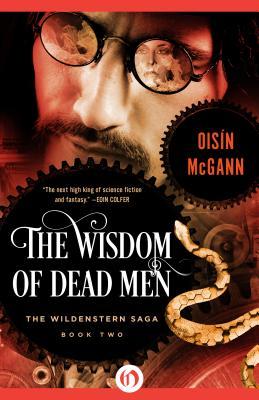
There is a new cover designed by Jason Gabbert. Can you tell us a bit about the cover and how it came about?
There is no typical situation when it comes to working with a ‘foreign’ publisher on a cover. Once you’ve sold the rights for your book to a publisher outside your own country, some will give you input into the design or the image, others don’t; most will show you it before it goes to print, at least, but not always. When Tor published The Gods and Their Machines, the first time that I saw the cover, it was on Amazon. Open Road were quite the opposite, giving me as much input into these US editions of the books, both into the edits and the cover, as I had into the original ones with Random House in the UK. I got to see early drafts of the cover in each case, normally two or three options, where they showed me the type of images they wanted to use, before going to a more finished version.
How involved were you in the process and how do you feel about the end result?
Ancient Appetites was the third book I’ve done with Open Road and The Wisdom of Dead Men the fourth (not including the promotional novellas we’ve released). In each case, I was sent a first draft of a cover, which I then responded to. I’m an illustrator and designer, so I have firm views on this stuff, but I also know what it’s like for a designer working on a cover – they’re always committee jobs, with so many people’s opinions involved, which is tough when you’re the one doing the actual work. There’s a real trend in US publishing to have a big face dominating the cover. The theory’s sound – our eyes are naturally drawn to faces, but I think this kind of format comes from film posters. And film posters feature world-famous film stars. Books don’t! You can end up with a lot of books with close-ups of faces, each of which looks good individually, but which don’t look different enough from each other. I wanted to feature more specific elements from the stories, so that each cover was distinctive and could only be the cover for that particular book, while still retaining the impact that Jason was aiming for in the original design. That’s harder to do than it looks; to find that one thing to focus on, so the cover stands out – is individual, but also packs a punch. The people at Open Road were really flexible, and each time Jason improved further on what I’d asked for. I’m delighted with how the covers have turned out and we’re getting great feedback from them.
What is it about Steampunk you find fascinating?
I think steampunk is a kind of nostalgic science fiction. The Victorian period is such a time of contrasts that emphasise human achievement, but also its costs: there’s the civility versus the violence, huge wealth versus grinding poverty, rural versus industrial and in Ireland, of course, you have the whole issue of it being a British colony and the fight for independence. The technology is lovely because it looks like it’s supposed to perform a specific function. Nowadays, a round-cornered box could be anything. The aesthetics of the time are so exaggerated, so decorative and yet firmly functional. Instead of mysterious electronics and touch-screens and devices you can’t open or fiddle with, you have blocky, mechanical parts; oily pistons and hinges and big protruding lights and machines that look crude and clumsy and beautiful at the same time. It’s easier to understand and offers less easy solutions than calling for help with your phone or finding your way around with a GPS. Steampunk is history that some part of us would like as our future.
Both Ancient Appetites and The Wisdom of Dead Men are set in Dublin and Ireland. Is it the familiarity with Dublin and Ireland that made you go for this setting?
There was already plenty of this stuff set in Britain and other parts of Europe. I’m Irish, I figured this was as good a place as any for stories like this – better, in some cases, because of the unique qualities of the setting. And it would help differentiate it from other books – something you’re always trying to do when you write a story. Besides, I wanted Irish voices and slang and that idiosyncratic humour. It would all add to the reality of the world.
How did you start writing? Was there a particular book or moment in your life that spurred you on?
I’ve been writing stories pretty much since I could write at all. I can’t remember a time when I didn’t write stories. I couldn’t list all my influences here, but for the Wildenstern Saga, it would be Jules Verne, Bram Stoker’s Dracula and maybe the League of Extraordinary Gentlemen (the comics, not the film), would have had played a part. I suppose I wanted a blend of Charles Dickens and the Addams Family. Once you get into the research too, there’s so much that triggers new ideas. And there was a LOT of research to do.
What is your favorite and least favorite part of the writing process, and why?
My favourite bit is that I get to sit and make stuff up for my job. That’s my job. It’s ridiculous, really. My least favourite bit of the process is . . . I don’t know, really. There’s no part of it I really hate. I know most people would say editing, but I see that as a valuable part of the overall work, a time to apply a final bit of craftsmanship to the story. It’s not always pleasant, but that’s just how it is, and I do a lot of planning beforehand to try and get the story as finished as possible by the time I write ‘The End’ (and I do still write ‘The End’). One or two edited drafts after the original one and I’m normally done. I like the early creation work, making the notes in preparation for writing, the excitement of the start, I like the challenge of pulling yourself out of that wallowing place in the middle where you can lose your way, and I relish the downward slope towards the ending. I always feel a bit odd letting it go at the end, when I know others now have to see it, but that’s part of the experience too. I don’t believe in this shite about the suffering artist. This job is weird and insecure, creating the intangible for an audience, most of whom you’ll never meet, who will measure it in terms that will always be subjective, tossing it around between different opinions. That’s too much to take if you don’t have the confidence that comes from doing something you’ve devoted your life to learning and to having a good time while you’re doing it. If you can’t enjoy it, how is your audience supposed to? And that’s always been my goal; to spend my life doing what I love.
You write both for children and adults, which do you find most challenging? Do you have a different approach to writing for one vs. the other?
I’m often asked why I write for children. I find this a bizarre question. I want to write for everyone. Like every writer, I want to have an effect on my reader, so I try to write for the readers who are at a stage where books have a dramatic effect on their lives, where their imaginations are still free and open, but as they get older, they’re able for more sophisticated plots and challenging concepts. I don’t see readers as children or adults, they’re all just at different places along a timeline in their lives. Whatever point they reach, I want to have a book waiting for them. From a practical viewpoint, this means that I have to set my language at the right level for younger readers, or present ideas in ways they can engage with and comprehend, but beyond that, a story is a story. You can only hope people will enjoy what you write, whatever age they’re at.
What kind of books do you read, any favorite authors?
I don’t have favourites, really, and it’s very hard to list authors you like, when you know you’ll leave people out. Writers I keep coming back to would include Terry Pratchett, Lee Child, Iain Banks, China Mieville, Eoin Colfer and I love some of Philip Pullman’s work. Growing up, it was people like Richard Scarry, Dr Seuss, Beatrix Potter, CS Lewis, Agatha Christie, Tolkien, Louis L’Amour and Stephen King, along with a host of Cold War thriller writers. Then there were classics like Treasure Island and 20,000 Leagues under the Sea and a steady supply of crime, horror, sci-fi and fantasy.
So what do you do when you’re not writing, any hobbies?
I travel a lot for events and I have young kids and a doer-upper house, so at the moment, staying home at the weekends and getting jobs done is a bit of a treat! When I get a chance, I like to go hillwalking, getting out with my two dogs, I love films and books and learning about new stuff.
What’s next? Do you have more new and exciting projects you’re working on?
I’ve just finished writing a sequel for my surveillance state thriller, Rat Runners and I’m now working on a Cold-War-style, near-future thriller set mostly at sea, in a world struggling to adapt to a changing climate. I have a story in a new anthology, along with other Irish writers like Roddy Doyle, Eoin Colfer, Marie-Louise Fitzpatrick, Derek Landy, Siobhan Parkinson, Sarah Webb, and John Connolly, entitled Once Upon a Place, where each of us was asked to set a story in a place in Ireland. I’ve also got a few younger kid’s projects being pitched to publishers too. I always try to have a few things on the boil – life’s too short not to be writing.
* * * * * * *
Interview by Dag Rambraut – SFFWorld.com © 2015





I’ve not read a steampunk novel before, but this one is intriguing me. I’m adding it to my wishlist.