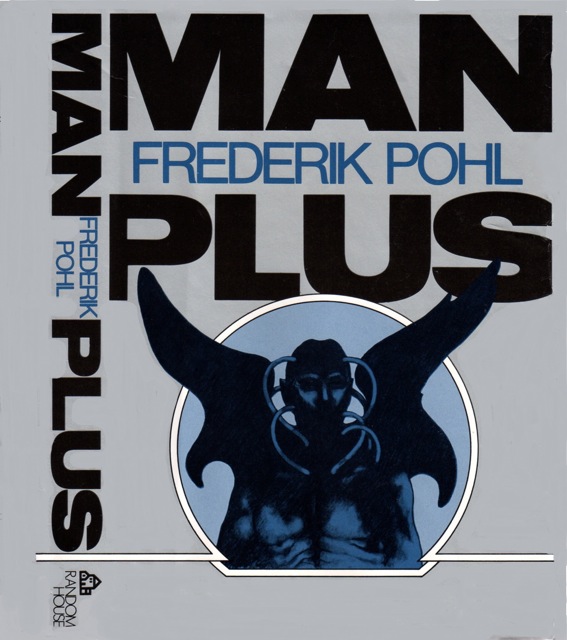
Man Plus is a 1976 novel by American SF Grandmaster Frederik Pohl. The book won the Nebula Award for Best Novel in 1977, and was nominated for the Hugo Award for Best Novel the same year. Over time, it has become regarded as a standout work in Pohl’s venerated career and one of the seminal stories about human augmentation. It is a novel that delves deeply into what it would be like for a human being to be transformed into something other and explores not only the physical ramifications, but also impact on that individual’s psychology and relationships. In conjunction, it posits some interesting ideas about the next stages of human colonization and evolution, making it fascinating, if not always comfortable reading.
At its core, Man Plus is a novel that offers a study in isolation. The book tells of humankind’s first attempt to colonize our neighboring, yet still distant, planet of Mars. To facilitate this endeavor, the United States government, in a near-future skillfully and economically depicted by Pohl, has initiated the Man Plus project. The aim of this program is to build a cyborg capable of living on the surface of Mars. When the initial candidate dies from an aneurism caused by sensory overload, the book’s protagonist Roger Torraway is next in line to be cybernetically augmented and sent on the Mars mission. The majority of the book details Torraway’s transformation from man (and the book focuses very much on a heterosexual male’s identity) to cyborg, and skillfully depicts the physical and psychological horror of his increasing separation from his fellow human beings. In particular, Torraway struggles with his estrangement from his wife, Dorrie, which gives this hard science fiction tale some much needed emotional and personal nuance. In a lovely piece of thematic coherence, Torraway’s eventual separation from the rest of humankind mirrors the great physical gulf of space he eventually traverses from Earth to Mars.

On an interrelated theme, Man Plus also explores the relationship between the way one thinks and what one is. Torraway’s new artificial body affects how he relates with the world around him, but the inverse is also true, and the way the rest of the world interacts with Torraway also changes as he goes through his augmentations. As Torraway becomes increasingly disconnected from humanity, he is essentially transformed into an alien. He lives behind glass windows where he is monitored and manipulated and tested. His wife refuses to see him and his friends begin to treat him as a scientific curios or precious specimen. This is particularly pertinent in the depiction of the character of Don Kayman, a scientist and priest, who is torn between viewing Torraway as a friend with a soul and an expensive piece of machinery. Torraway’s limbs and organs are replaced with artificial substitutes, and as he literally becomes unable to feel his own new body, so too do the emotions that make human begin to die, and his understanding of his place in the world slowly fades. However, after arriving on Mars, Torraway’s new body begins to make sense to him and his life is imbued with meaning once more. He adapts almost immediately to this new world, and any last tendrils connecting him to his old home, his old life, and ultimately his humanity, are severed.

Man Plus is very much a novel born from Cold War tensions. It is set in the not-too-distant future from the time of the book’s writing at a time when a Cold War between the United States and a Chinese dominated Asia threatens to turn hot. The President of the United States, Fitz-James Deshatine, is a recurring character in the book and it is obvious that he and his government envisage, not only future of their country, but the entire world, as dependent on the success of the Man Plus project. Ironically, even perversely, given Torraway’s dehumanization, the Man Plus project becomes a focus for the hopes and dreams of the entirety of humanity. The success of the United States’ Man Plus project spurs similar cyborg programs in other spacefaring nations and brings in a period of peace and increased prosperity. However, in an interesting twist it is revealed that novel’s narrator, referring to itself throughout the book mysteriously in the first person as ‘we’, is a conglomerate of the computer networks of Earth that have become sentient. These computer networks have manipulated the United States government with a series of tampered predictive models to encourage the pursuit of the Man Plus project. By ensuring humanity’s survival they are also seeking to guarantee their own continued existence. With its ambiguous ending, the novel leaves the reader with plenty of room to speculate about future of human and machine interplanetary colonization and evolution.
It will not come as a surprise to regular readers of my SFFWorld reviews, familiar with how under-read I am in the history of the field (a fault I am slowly but surely addressing), that this was my first Pohl. Having enjoyed Man Plus greatly, the author’s esteemed novel Gateway sits on my shelf unread and now beckons to me enticingly. If Pohl’s heteronormative masculine worldview and Cold War near-future setting date the book somewhat, his existential speculations about the nature of humanity and humankind’s place in the world remain relevant and intriguing. As body enhancements and technological augmentations continue to develop and progress beyond the bleeding edge, this is a book that ponders whether we might be transforming ourselves into the aliens from another world so often posited by science fiction.
Man Plus by Frederick Pohl
ISBN: 978-1-85798-946-5
215 pages
Published by Gollancz, May 2000
First published by Random House, August 1976
Review by Luke Brown