Gerald Brandt has just released The Courier, a far-future science fiction debut set mainly in Los Angeles, though the city San Angeles stretches from the Mexican border to San Francisco -action adventure with a cyberpunk tone.
Many thanks for giving us some time here Gerald. Welcome to SFFWorld.
Thanks for having me!
First of all can you tell us a bit about The Courier?
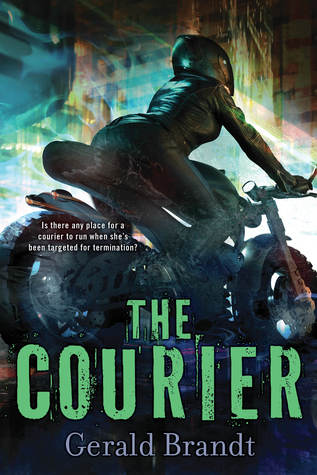
THE COURIER takes place in 2140, in a city called San Angeles that stretches from the Mexican border up to San Francisco. Motorcycle couriers are used to send information that is too sensitive for the net, and in order to hide when sensitive information is being sent, thousands of packages containing low-level information are also sent daily. No one knows which, or if, any couriers are actually carrying important information.
Kris is asked to do a late pick-up and delivery, and during the delivery she witnesses a murder. Now Kris is on the run from the corporations that want to know what she is carrying and the murderer who wants to cover his tracks.
Your main character Kris is very much portrayed as a victim. Can you give us some insight into Kris and what you were trying to achieve?
I really wanted to portray Kris as a strong and independent young woman. One that uses her street smarts, her knowledge of the city, and her past history to get through whatever gets thrown in her path. I think more than a victim, Kris is a pawn in a much larger game. I hope that all of her strengths come through as well.
What goals might you have set for yourself when writing The Courier and how do you feel about the end result?
My main goal was to portray a young woman as a strong and independent person. So much of what I’ve read, even if the main character was a woman, had an external entity of some sort help the woman out of what the novel had thrown at her. In THE COURIER, I purposefully brought in Miller as a strong male character to turn the tables. It looks like Miller is there to rescue Kris, but in the end, it’s Kris that rescues Miller.
 Why Los Angeles?
Kris popped into my head as a fully formed character, and it took me quite a while before I figured out what kind of world I wanted to place her into. The final decision for Los Angeles came about because I needed a large stretch of land to build San Angeles on top of. I was tossing around the east coast for awhile, but I would have needed to go through North and South Carolina, Virginia, Maryland, Delaware, etc. That made the potential political system too complex for me to include. I’ve also been to Los Angeles and San Diego several times, which I think helped me get a feel for the area.
Getting published by a major publisher has to be every author’s dream. Can you tell us a bit about the process that led up to The Courier being published?
Getting picked up by DAW is a dream. In fact, DAW has been my dream publisher for quite some time. I couldn’t be happier.
THE COURIER was my first nanowrimo novel. I sat down and wrote 75,000 words in November 2008. It took another year to turn that into something I was proud of. I started sending out to agents around December 2009. In May 2010, Sheila Gilbert from DAW attended a local Science Fiction and Fantasy convention, KeyCon, in my hometown where she did a pitch session. Basically, writers get ten minutes to talk about their novels, and based off the pitch, she decides if she wants to take a closer look at the work. I believe she pretty much asked for a full manuscript from everyone that day, including mine. Sheila’s closing remarks was that she would get back to me in three months. I believe she hit that three month mark for everyone but me.
Sheila read THE COURIER in 2013. Over the intervening years, we’d meet up at various conventions, mostly World Fantasy, I think, and chat about various things. We also, by her request, kept up a fairly frequent email chain. What I think got THE COURIER read in 2013 was that I had a short story published in the Blood & Water anthology by Bundoran Press , and the anthology won a Prix Aurora award. At any rate, Sheila asked for a rewrite. That rewrite took me nine months.
In October 2014, at the World Fantasy Convention in Washington, DC, we sat down for coffee, and Sheila started telling me all the things that were wrong with the book. She ended that with an offer. I couldn’t believe it, and had to ask her to repeat it.
With the offer in hand, I once again went out on an agent search. THE COURIER was rejected by as many agents after I had the offer as it was before. In all, it was rejected over forty times before I found the wonderful Sara Megibow at kt literary. From there, it was almost a year and a half before the book came out.
You also got a very positive blurb from Robert J. Sawyer. How did that come about and how does it feel to get a positive comment from such a renowned author?
I’ve known Rob for a number of years. He is a regular at KeyCon, where we became acquaintances and then friends. Rob is always free with his time and advice when dealing with new writers. He goes out of his way to be available at every convention he attends. If you’re at a convention with Rob, feel free to approach him, even if he is with a group. If the group turns out to be a meeting or something else that can’t be interrupted, he’ll let you know in the nicest way possible, and ask you to come back later. His web site contains tons of information for the up and coming writer.
Rob actually offered to blurb THE COURIER for me. His blurb, and the offer, are indicative of how much Rob supports new writers.
How has the response been so far?
Response has been wonderful. I went on a small book tour, and attendance at the readings have been great, even in cities I don’t know anyone. The reviews have been awesome, and I’ve even received some one-on-one feedback from my website. Barnes & Noble and Amazon.com have both picked THE COURIER as one of their SF&F books of the month for March. I’m humbled by the reception of the book.
I come from the Robert J. Sawyer camp, if you see me at a convention, come over to say hello. I’m more than happy to talk to anyone about (almost) anything.
You have setting where all of coastal California is bound into one multi-layered megacity. What is it about this dystopian kind of future and worldbuilding you find fascinating?
I originally built the city as a reflection on the social and economic status of the world today, although somewhat exaggerated. I wanted the bottom five levels to contain the world as most of us know it, with the top two levels showing how the rich people live, and the satellite cities being the top 1% (and their support). Separating Level 4 from Level 5 and up came about for two reasons, one is I wanted to show how difficult it is for those of us on the lower levels to break through to the top, and I wanted to make sure Kris had never, and could never get access to those levels. Once I’d thought up the construct of the city, I realized what kind of mess I’d gotten myself into. How much of the city would be dedicated to waste removal? How would water get pumped to where it was needed? How was air recycled on the lower levels? I ended up doing a fair amount of work that is never shown in the book, just so I could figure out how things worked. I certainly know more about sewage now than I did before I started the novel.
How did you start writing? Was there a particular book or moment in your life that spurred you on?
I started writing when I was in Junior High. I would go to the library, open up my notebook, and tell myself stories. Sometimes I would draw elaborate maps of my worlds and figure out how the different peoples that populated it would interact. I still have one of those old spiral bound notebooks.
I was introduced to computers in High School, punch cards and the old Commodore Pet 2001 computers. It didn’t take long before the computer room replaced the library. I don’t know if it was the right choice, but computers gave me a great career.
I started thinking about writing again in my late thirties, and when I turned forty, I decided to start getting serious about it. I have multiple short stories and novels tucked away on my hard drive somewhere that will never see the light of day. They say when I die, there may be a chance for them. I think I’ll burn them all first. Maybe it was a mid-life crisis that helped me make the decision to take writing seriously, though I still have a fast motorcycle from when I used that excuse. Maybe it was just the need to go back to the library of my younger days, and write whatever I wanted. All I knew was that it was something I had to do.
What’s next, what are your hopes and dreams for the future? Do you now have a grand plan for your writing career?
Next are books two and three in the San Angeles series. Book two, THE OPERATIVE, is already handed in and I’m waiting for editorial feedback. Book three, THE REBEL, should have been started a while back, but instead it’s still bouncing around in my head.
I have an alternate world fantasy series I’m working on. Book one, QABAL, is written and just needs some serious polishing. It’ll have to wait until THE REBEL is completed though.
I’d love to write for a living, stop doing all the programming and IT work I’ve been doing and just write books. For most writers, that’s just a dream. But it’s been known to happen. As for a grand plan, I’d love to do two books a year, have them all in print in multiple languages. The only part of that I can control is the two books a year. Beyond that, it’s up to the readers and the publishers.
Once again, thank you very much for your time.
Thank you very much! I had a great time answering your questions.
*****
Interview by Dag Rambraut – SFFWorld.com © 2016