
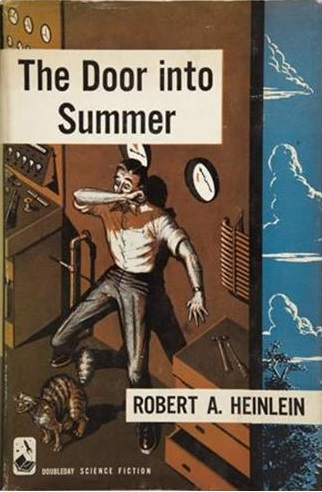
 Here’s the latest reread of Heinlein’s works, as Mark goes through the Virginia Edition series. *
The Door into Summer was originally serialized in The Magazine of Fantasy & Science Fiction (October, November, December 1956) and published in hardcover by Doubleday in 1957.
Unlike the previous novel re-read, The Door Into Summer is an adult novel, which at this stage of Heinlein’s career were being written in tandem with his so-called ‘juvenile’ novels. Putting Door into Summer into context, the most recent of these juveniles was Time For the Stars, which I admired but didn’t love when I last re-read and reviewed it.
The Door into Summer is a story that still holds up very well, perhaps more so than many of his 1950’s novels, and also gives us Heinlein tropes that will be used again and again in the future. It is rarely out of print, and often appears in ‘Best of’ lists – the Locus Readers Polls have often included it as one of the best. According to Wikipedia, in three separate Locus Magazine readers polls, from 1975 to 1998, it was judged the 36th, the 29th, and the 43rd all-time best science-fiction novel respectively.
According to biographer William H Patterson the background to this novel is that Heinlein wrote this one very quickly, being inspired by a sudden remark that Heinlein’s wife Virginia (Ginny) made when their cat (Pixie III) refused to leave the house on a snowy day: “I guess he’s looking for the door into summer.” Heinlein wrote the complete novel (66 000 words) in only 13 days. No major rewrite was needed, with only some light editing that Heinlein did himself.
Though written quickly, it is clear that this has lost none of the usual Heinlein precision and style. It begins as one of those Heinlein stories that has an able and competent guy as its hero, although admittedly this one starts a bit down on his luck. However, generally engineer and inventor Daniel/Dan Boone Davis (there’s that name thing again!) is a Mr. Everyman who by dint of hard work, great ideas and skill manages to travel in time.
But to many readers who remember it, The Door into Summer is the one about cats and THAT relationship.
The novel begins in 1970 with Daniel, an engineer and inventor, in a bit of a slump. He has been scammed by his business partner, Miles Gentry, and his fiancée, Belle Darkin, so that he has lost his company, Hired Girl, Inc. Dan’s only friend in the world is his cat, Petronius the Arbiter or “Pete”, who hates going outdoors in the snow.
Left with a large financial settlement, and his remaining Hired Girl stock, he elects to take “cold sleep”, hoping to wake up thirty years later to a brighter future. First he mails his Hired Girl stock certificate to the one person he trusts, Miles’ stepdaughter Frederica “Ricky” Virginia Gentry. However when Dan confronts Miles and Belle, they inject him with an illegal “zombie” drug, and have him committed to cold sleep.
Dan wakes up in the year 2000, with no money to his name, and no idea how to find the people he once knew. He has lost Pete the cat, who fled Miles’ house after Dan was drugged, and has no idea how to find a now middle-aged Ricky.
Nevertheless, Dan begins rebuilding his life. He finds Flexible Frank in use everywhere, but now called “Eager Beaver” and made by a company called “Aladdin Auto-Engineering,” Clearly someone has taken Dan’s prototype and developed it. He is even more baffled to find that the patent is credited to a “D. B. Davis.”
A friend at Geary lets slip that he once saw time travel working, in a lab in Colorado. Heading to Boulder, Colorado, Dan meets Dr. Twitchell, a once-brilliant scientist who admits to having created a time machine of sorts. Dan persuades Twitchell into sending him back to 1970, some months before his confrontation with Miles and Belle to set things up for his future self.
Back in 1970 Dan creates “Drafting Dan”, which he then uses to design “Protean Pete”, the first version of Eager Beaver. He sets up a new corporation called “Aladdin Auto-Engineering,” returns to Los Angeles, and stakes out Miles’ house on the fateful night. Watching himself arrive, he lets events happen as before until Pete the cat emerges, then Dan takes his own car and uses it to remove all his engineering drawings from Miles’s garage.
Destroying all evidence of his own work, he goes and meets Ricky at her Girl Scout summer camp. Like before, Dan assigns his stock in Hired Girl to Ricky but then suggests that she takes cold sleep until she is 21 so they can meet again. Ricky asks Dan if he will marry her after their cold sleep and Dan agrees.
With Pete, he sleeps for the second time until 2001. He greets Ricky when she awakes. They are married in Yuma, thus completing the cycle. Setting himself up now as an independent inventor, he uses Ricky’s Hired Girl stock to make changes at Geary, and then settles back to watch the competition with his own company, Aladdin.
As Heinlein’s ‘engineering everyman’, our hero Dan has many of those traits that readers will love or hate. As the story is told from his perspective, Dan is meant to be likeable, and I was surprised by how quickly I got to like this self-depreciating inventor. Ultimately though, (and especially noticeable on this re-read) it must be said that Dan comes across as a rather bland and rather nondescript character. Though he fits into the Heinlein template admirably, and undeniably does the task in the story he is intended to do, there’s actually not a lot of depth there (something which James Blish, as William Atheling, pointed out when he reviewed the book in 1957. According to Heinlein’s letters, RAH wasn’t amused.)
Much of the time Daniel seems to be there to espouse the merits of independence and self-support. He is a character who makes his way through life, despite all the odds, by not relying on others and instead using creative thinking, intelligence and skill, all typical Heinlein traits (and often beloved of Astounding Science Fiction editor John W. Campbell.)
The influence of Heinlein’s wife Virginia in the writing is again apparent, as it was in Time for the Stars, but perhaps more so. This time, the female lead character has inherited her name, and her role is undeniably stronger than girls were in Heinlein’s last novel. Here we see the capable-girl character move more towards centre stage than of late, though RAH loses a point from me for calling her ‘Ricky’. It is noticeable that Ricky asks Dan to marry her and not the other way around, which would have no doubt raised the odd eyebrow in 1956.
In terms of the marrying of his friend’s younger stepdaughter, RAH was clearly pushing buttons, but over time the scandal of this has lessened. Today, admittedly from a position of nearly sixty years after the book’s publication, I see it more as a case of exploring possibilities, a case of ‘what-if?’ rather than anything deliberately scandalous. Alternatively I have heard it suggested (and can sympathise with) that this major plot revelation was, in part, a deliberate slight towards Miss Dalgleish, the editor with whom Heinlein had had such battles with in the past.
Mention of the juvenile novels brings me to what I guess is the other major question here: Is there a difference between this and his juvenile novels? Well, some, but frankly, not much. Instead of an alien friend (as in the juveniles: see Red Planet’s Martian Wilbur or The Space Beast’s Lummox) we have Pete, ever loyal but occasionally disdainful as cats can be. According to Patterson’s Introduction, at one point RAH did have Martians in the novel but, in one of the few revisions to this stream of consciousness, removed them to focus on the main plot.
The main difference is that our hero is an adult rather than a typical teenager, and as such has a more mature internal dialogue than the leads in the earlier novels. Having said that, the writing style is still typical Heinlein of this time, and RAH is still ahead of much of the other SF writing of this time. (Though things are clearly in a process of change – for comparison, see Alfred Bester’s The Demolished Man, 1953 and The Stars My Destination, 1956, which would suggest that other writers were catching up.) Interestingly, Heinlein wasn’t sure that the story would actually sell himself – even John W. Campbell, his usual stand-by editor of Astounding Science Fiction, rejected it, another reason for RAH’s deteriorating friendship with him. According to Patterson, “Heinlein didn’t think any SF magazine would pick up this story since there was so much boy-meets-girl and so little science-fiction gadgetry.”
This may be the reason for the book’s success, as I think that the rapid writing process of The Door into Summer has given it a focus and a pace that is addictive. What I noticed most on this re-read is that, unlike many of RAH’s later novels, there is no flab or padding here. The prose is generally tight and lean, with only the occasional drift into homily. It may be this that has kept Door into Summer so perennially popular.
Whilst the pace that is fast, it also helps that the ideas within are as strong as ever. It is unabashedly a romantic novel, and there is some more talk of sex and marriage, but as recent re-reads have shown, it is only a little less explicit that the comments Heinlein has been sneaking into his so-called juvenile novels.
Well, that and the introduction of a cat as a main character.
Though there are links, it is here that I have suddenly noticed how important some of Heinlein’s now-traditional motifs have become. What were elements in the background now become more centre stage. And, of course, some of those elements Heinlein will re-use in later novels – the use of historical names as his characters, food, cats, multigenerational relationships, for example.
Having said that the differences are relatively slight, I suspect that if I had to draw a line between where the juveniles become less important in RAH’s writing and his other work becomes more important, then it is here. The Door into Summer, whilst not markedly different from the earlier work, has an enthusiasm that seems a little lacking in his juveniles written at the same time. Whilst I feel that there’s nothing really new here, it is fun, if you can cope with the now-dated ‘wise-cracking guy and doll’ dialogue routine. (Again, this style of dialogue was very common at the time.)
In summary, then, The Door into Summer is not RAH’s best novel, in my opinion. (And please don’t ask me what I think it is – I’m not sure, other than whatever this is, this isn’t quite it.) But it’s also not his worst (again – still working on that one), and I can see why it has stayed in print in the UK pretty much since its publication. Whilst it’s not pushing the envelope as much as some of his writing, I can see it as a potted summary of all of Heinlein’s traits (strengths and weaknesses) up to this point in his writing career, and if you wanted one book to show his popularity at the time then this might be it.
For all its strengths and weaknesses, writing The Door into Summer is clearly a breath of fresh air for Robert, allowing him to break away from the restrictions created by writing for a juvenile market, and it further inspired him for greater changes to come.
Next: back on track – Citizen of the Galaxy.
*Confession – I know I said that my next re-read was Citizen of the Galaxy, which it is, strictly speaking. This review was written a while ago, but never published, even though I thought I had. (Perhaps on an alternate time line?) So, with slight tweaks, and apologies, it is the next Heinlein review, but not the next re-read. Hope that makes sense.
The Door into Summer by Robert A Heinlein
The Door into Summer was originally serialized in The Magazine of Fantasy & Science Fiction (October, November, December 1956) and published in hardcover by Doubleday in 1957.
Virginia Edition, with minor corrections, published April 2008. Volume 5.
ISBN: 978 1 897350 07 2
164 pages
Review by Mark Yon





Door into Summer is perhaps my favorite Heinlein story. Well, certainly it competes with Glory Road. It definitely is my favorite time travel story. Thanks for the pleasant walk down memory lane.
A curious detail that never seems to get mentioned in reviews is Heinlein’s take on the automobile industry in the year 2000 when he was writing in 1957. Useless variations in junk for the money.
Nathan, you mentioned my two fav of RAH. Although I will red any of his work if available